Good things come to those who wait

My new sewing machine WITH a stitch regulator is due to arrive mid-week. Cue the happy dance music!

This time last year, my sewing machine dealer strongly advised that I move on picking up a new machine before price increases due to tariffs went into effect. Unfortunately, that wasn’t a possibility as I’d needed to buy a replacement vehicle at the time. Over the next several months, I watched prices keep increasing with lackluster sales promotions. Dealers became even more selective on which machines they’d accept on a trade-in – if they even accepted trade-ins. I kept saving money and waited to see if a used machine came on the market or if prices return to reality. Neither happened.

I practiced FMQ on my Janome 8900. (I’ve gotten pretty good at variations of a loopy meander plus a boxy meander). I took a longarm quilting fundamentals class at a local quilt shop. This helped me realize 3 things: (1) I prefer to FMQ sitting down, (2) a stitch regulator is a game changer for me and (3) I’d still continue to send larger items out to a longarm quilter. Scheduling time to use the longarm has been a hassle due to limited availability of time slots. We’re limited to hand guided only – no computerized E2E for folks who rent time on the machines.

So when a substack article writer mentioned how his dad had negotiated a great deal on the sister version of my machine of choice, I reached out. An Elna 782 with the ASR for the same price my local Janome dealer was selling the 9480 without the ASR in December 2024. DEAL! They are the exact same machine – just a different color scheme and badging on the outside.

I’m supporting a family-owned business and got what I wanted at a really fair price.

I‘m good.

I’ll post pics once Ellie arrives, gets unboxed and set-up.

And we’re off!

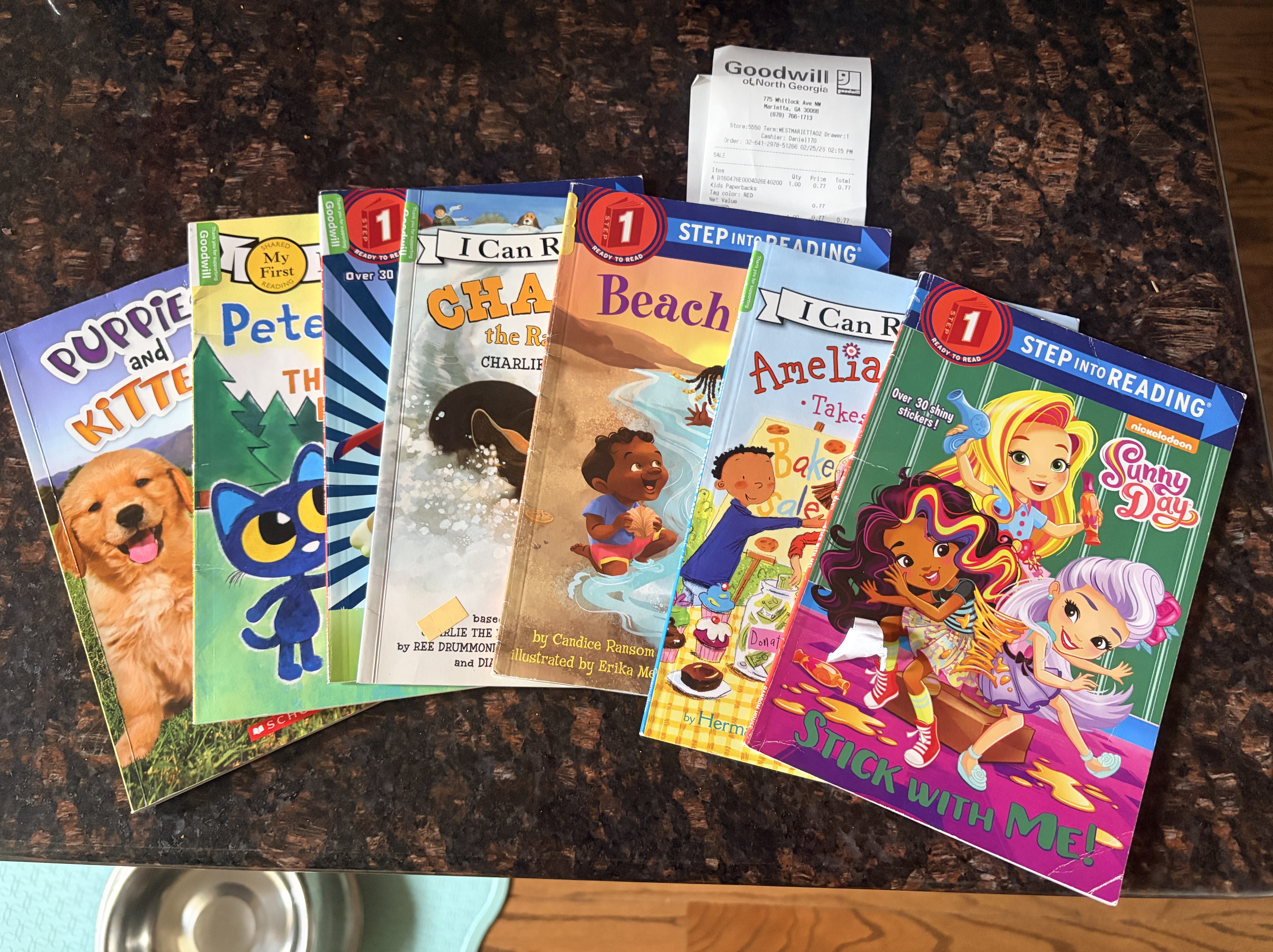
Therapy dog activities resumed this week after an extended holiday break. Sadie was ready to get back to work! Here she’s showing off her recommended reads display at a school we visit each week.

In addition to working with our regular students, we visited several classrooms and checked in on two special friends in the AU unit. One even proudly shared his Sadie countdown calendar, where he marks off the days until her next scheduled visit. 🙂 I am thoroughly enjoying this season of therapy dog work with Sadie. We made a total of 48 official visits in 2025.

My guild hosts a large quilt show every two years. Our 2026 show will be held in June at the Cobb Civic Center. On Wednesday, the entire quilt show committee met in person for the first time. It was nice to finally put some names with faces. In person meetings reveal so much more about people that a Zoom call ever could. There are definitely some strong personalities within the group! I have a lot of respect for those willing to chair an event of this magnitude. Not me! I’m perfectly happy in my role as the kid’s exhibit chairperson for this year.

Private lessons and CraftLAB continue. Since late September, I’ve been mentoring a high school senior with her admission portfolio to FIT. We’ll complete the final required garment on Monday (then take a bit of a break!). My ‘tween students have requested a summer quilt camp hosted at my house in lieu of schlepping an hour each way to the SQTM this year. I’m mulling over the logistics involved in making it happen. Below is a sample of the gingham quilt they’ve requested. It’s a wonderful size, but will require daily sewing homework to complete in a week.

Sample of the gingham quilt project for summer CraftLAB students

What about the SQTM? Last year, I taught a number of classes at the SQTM. For 2026, the executive board decided to modify class formats, scheduling and fee structure in an attempt to boost attendance. Classes are filling, so it appears to be a good call on their part from that perspective. For me, I simply live too far away to be able to make things work under the new model. (And if I lived closer, I’d be a much more active volunteer!) I’ve been told that Sewing Machine Maintenance falls under a separate category, so I do anticipate teaching this class in the spring and fall.

Meanwhile, I spotted a new art studio in Smyrna. They offer painting, mixed media and embroidery classes. I’ll be reaching out soon about the possibility of sewing classes. Stay tuned.

Show your sewing machine some love

A new year is here. Before getting started on your winter sewing projects, give your sewing machine a little attention. It’ll make your stitching time during the cold winter months a lot more pleasant.

Step 1:
Give your machine a mini-facial: clean out the dust bunnies under the needle plate, add oil where needed, install a new needle and give it a good wipe down.

Step 2:
Locate your sewing machine manual. If you can’t find it, check the support section on the manufacturer’s website or check Pocono Sew & Vac’s website to see if there’s a link to a free download for your machine. Print a copy and place it in a 3 prong plastic folder to keep with your machine. Also save the downloaded file somewhere in the cloud, so you can have access to it in case you forget/lose your printed copy.

Step 3:
Record your sewing machine’s basic stats on a sticky note and keep it with your machine manual:
Model and serial number
Modern machines? on a sticker near the power switch or on the back of the machine.
Vintage machines? may be stamped underneath or on a metal plate on the machine bed.
Shank: low, high or slant?
Max stitch width: 5 mm, 7 mm, or 9 mm?
Bobbin size and type: Class 15, Class 66, specialty brand (Elna, Viking, Pfaff, Bernina)? Metal or plastic?
Snap on feet: center needle or slightly offset left? (Janome made top loading machines use snap on feet where the connecting bar is offset to the left. This means some of the feet in the big accessory packs sold on Amazon may not work.)

Step 4:
Go through all of your sewing machine feet and bobbins. Make sure only the ones that work with that particular sewing machine are in the accessory box. Refer to your manual and info recorded in Step 3. Missing any feet? Time to visit your local sewing machine shop or order online.

Step 5:
Protect your sewing machine. Make or buy a cover to keep the dust out. Plug it into a surge protected power strip. If you take your machine to classes, sew days and retreats, buy a case/padded bag to safeguard your machine during transport. Sure, the designer trolley bags are pretty, but there are plenty of other budget-friendly options out there as well.

A common question: Do I need to take my machine in for service every year?
The answer is YES, if one of the following applies:
1. Your machine is under a warranty or has a service contract.
2. You spent megabucks on your sewing machine within the past 5 years.

Otherwise, the answer is NO. Every other year is generally fine as long as your machine is operating normally.

Keep in mind that the cost of a routine service is now $150.00 per machine. Depending on your particular model and age of machine, it might be worth buying a new machine instead of taking it in for service & repair. Only you can make that decision. Me? If it’s one from the big box store, I’d probably replace it. If has sentimental value and I plan to hang onto it, I’d definitely get it serviced at least once.

Psst: If you like to DIY, it’s very easy to learn how to service (and make simple repairs) vintage sewing machines and many mechanical machines.

Photo by FOX on Pexels.com