The value conscious quilter shops for thread

Thread. It’s kind of required to piece blocks and make a quilt. Like everything else, the price of thread has risen 25% or more over the past couple of years. It doesn’t seem to matter if it’s Aurifil, Mettler or Coats & Clark.

A recent financial news segment reported that shoppers across all economic levels are now seeking value when they go to spend their hard-earned money. It’s one of the reasons Wal-mart is still doing reasonably well in the current economy. I get it – especially when it comes to groceries and household items. Previously, I did most of my weekly shopping at the local Publix. More of my grocery dollars now go to Lidl, Aldi & Wal-mart because the same brand name product is cheaper and/or the store’s private label brand is equal to the national brand. This is what a value shopper does – seeks the best quality product for the most reasonable price – not necessarily the cheapest price. Those savings add up.

You probably have a favorite brand of thread that you prefer to use – just like I do. And chances are, it’s not available at your local Wal-mart store. Here are three strategies to help you get the most value for your thread purchases:

(1) Stick to basic colors: off-white/natural, light beige, light gray and a medium/dark gray.
Jenny Doan shared during a class I took at the Garden of Quilts that she only keeps neutral colors on hand for piecing and quilting. This, coming from someone who has easy access to every color spool of thread imaginable! No need to collect carefully curated thread collections (that can require a substantial investment on your part) unless that’s your thing.

(2) Comparison price shop before you buy. A single 1422 yard spool of Aurifil thread is almost $17.00 at an area LQS, $16.00 on Amazon and $15.00 at Missouri Star Quilt Company. However, if you buy a 3 spool pack on Amazon (with several curated neutral assortments available), the price drops to less than $13.00 per spool, with free shipping because the order amount is over $35.00. That’s a $12 savings (for 3 spools of thread) versus the local quilt shop. I also don’t have to spend time and gas driving to the shop and back home. (With gas at $4.49/gallon right now, I prefer to utilize free shipping whenever possible.)

(3) Substitute another brand of thread. Wonderfil (Efina & Konfetti) and Superior Threads (PIMA) offer products that are similar to Aurifil. The unit price per yard of thread is about the same for all three companies. Try a small spool of the competitor’s product and see how well it performs in your machine. Good? You now have an option, that might be on sale at some point.

My thread “value” shopping secret? Hobby Lobby’s Egyptian cotton 50/2 thread in 1200 yard cross-wound spools. (Compared with the Superior PIMA product, it makes me wonder if both products are actually made by the same company.) Anyway, you won’t find it in the thread display cabinet on the end cap at Hobby Lobby. It’s sold near the presser feet and sewing machine accessories on the peg board notions wall.

To me, this thread sews just as nicely as the “national” brands. The only drawback is the very limited range of colors. However, the $4.99 price point is super budget friendly – especially if you sew a lot of projects for different charitable organizations.

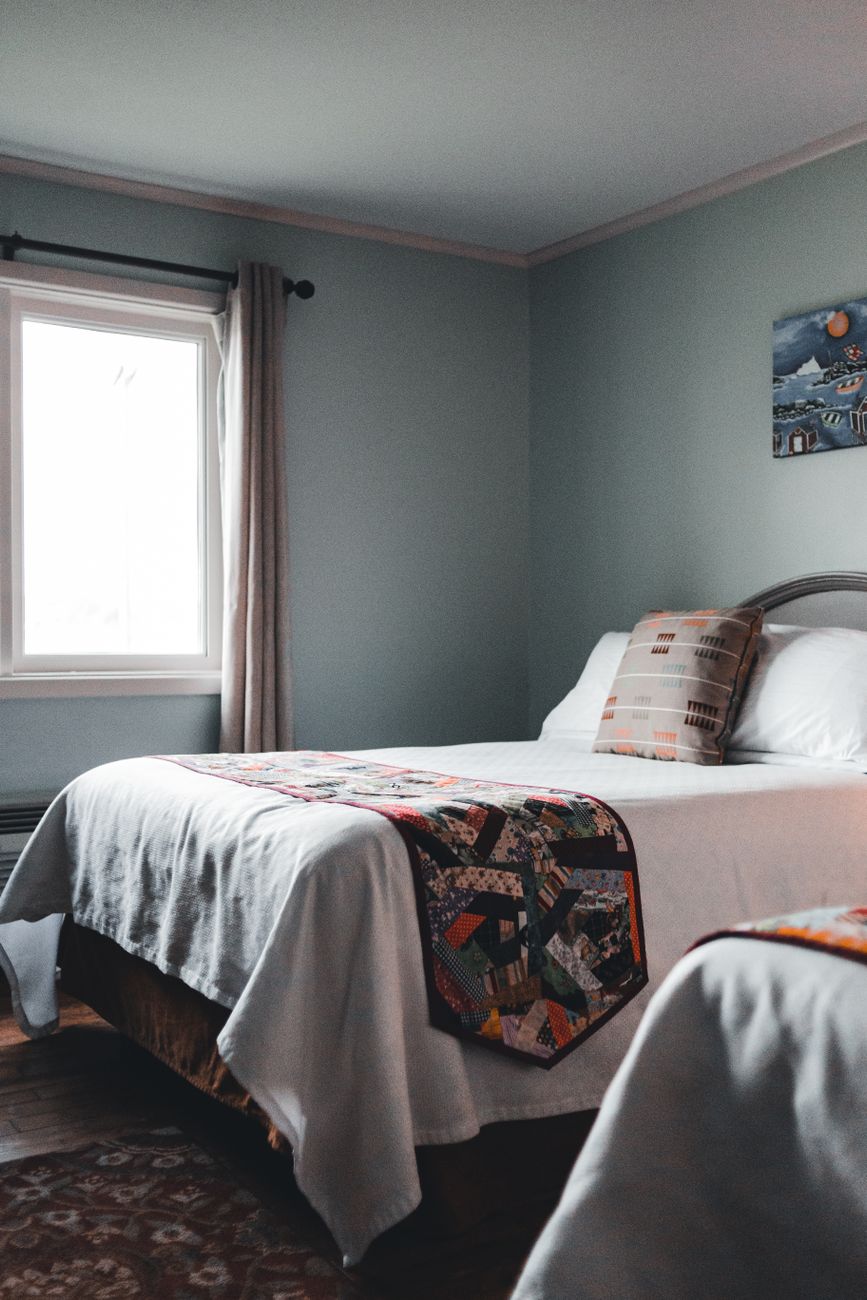
Photo by Arturo Au00f1ez. on Pexels.com

Revisiting cross-stitch after a L-O-N-G hiatus

Cross-stitch was really popular when hubs and I got married many moons ago. Eventually, the quilting bug bit and I set my cross-stitch supplies aside. However, there’s this one unfinished project that’s left me frustrated every time I pull it out to work on it.

I took the unfinished project to my Friday sewing group at the library. Their recommendations: (1) stitch using a really bright task lamp and a pair of slightly stronger reading glasses. 2) DO NOT RIP OUT any existing stitching. Merely blend the four colors (which are one shade apart) in that section as best I can and keep on going. Wise advice. I’ve made noticeable progress.

At the JK Quilts 2025 spring retreat, one of the daily projects featured a tulip cross-stitch design with Sulky 12 wt thread over 14 ct Aida fabric. I didn’t actually start the project until after I returned home, but I’ve actually enjoyed cross-stitching again! I like the sheen and feel of the Sulky thread and not having to manage 6 strands of traditional DMC floss. (A single thread of 12 wt thread equals 2 strands of traditional DMC floss). The 14 ct white/off white Aida cloth was much easier for me to see with standard reading glasses and overhead lightling.

If you like to stitch for a good cause, the Haven 2026 Charity Quilt & Stitch Along with Fat Quarter Shop has a new start date – Friday, July 3rd! Find all of the updated details here. This means you still have time to order a quilt kit or pull from your stash (and your friends’ stashes)!

This morning, I pulled supplies from my stash to make the cross-stitch version of Haven. I need a small, portable handwork project for upcoming travel and shortened summer sew days at the library. I’ll actually stitch it using Sulky 12 wt thread over 14 ct Aida cloth. Other than white, there are no exact DMC to Sulky matches for this project on the color conversion chart.

Here are the color substitutions I made using Sulky 12 wt thread already on hand:

Navy: Color 1199 – Admiral Navy Blue
Dark Blue: Color 1095 – Turquoise. (the stitched sample has more of a teal look to me than blue)
Light Blue: Color 1205 – Medium Jade (same reason as above)
Green: Color 1156 – Light Army Green
White: Color 1001 – White

Sulky – DMC conversion chart (free download) from Sulky website.
Sulky 12 wt petites color chart (free download) from Sulky website.

Serious x-stitchers may be interested in the Sulky 12 wt petites color card (with actual thread samples) that is available for $25.00 from the Sulky website.

Practice makes you better

Not perfect, but better.

After several practice quilt sandwiches, it was time to do FMQ swirls on a *real* project. I unearthed a Moda placemat panel that had been part of the swag bag at last year’s JK Quilts spring retreat. I prepped the quilt sandwiches at sew day on Wednesday. Quilted them on Friday. Four placemats are now ready to bind.

Learning to FMQ with on my Elna 782 with the ASR requires a different set of skills – not good, not bad – just different. The payoff has been a more consistent stitch length when doing FMQ. I still get occasional long stitches (usually from moving my hands too fast when changing directions), but that’s okay. It’s part of the learning process. I actually prefer to FMQ using the start/stop button rather than the foot pedal. Still haven’t decided which particular foot I prefer to use for everyday FMQ. My next FMQ will be on a project made using the fusible grid interfacing. I’m going to try the “bowl” or clear view attachment to see if this works any better with all of the seamlines.

Back to Front Binding Tips:

Start with 2-1/2″ wide strips, adding 20% extra to the total length needed (just in case).
Do a mock binding layout to preview where any binding seams may fall – preferably no seams at the corners. Adjust as needed.
Sew using a 3/16″ seam allowance, joining ends using your favorite method.
Press sewn binding away from the back side.
Roll binding to the front side and glue baste in place, leaving corners for last.
Set corners and clip in place.
Let sit for 1/2 hour or overnight so glue can dry.
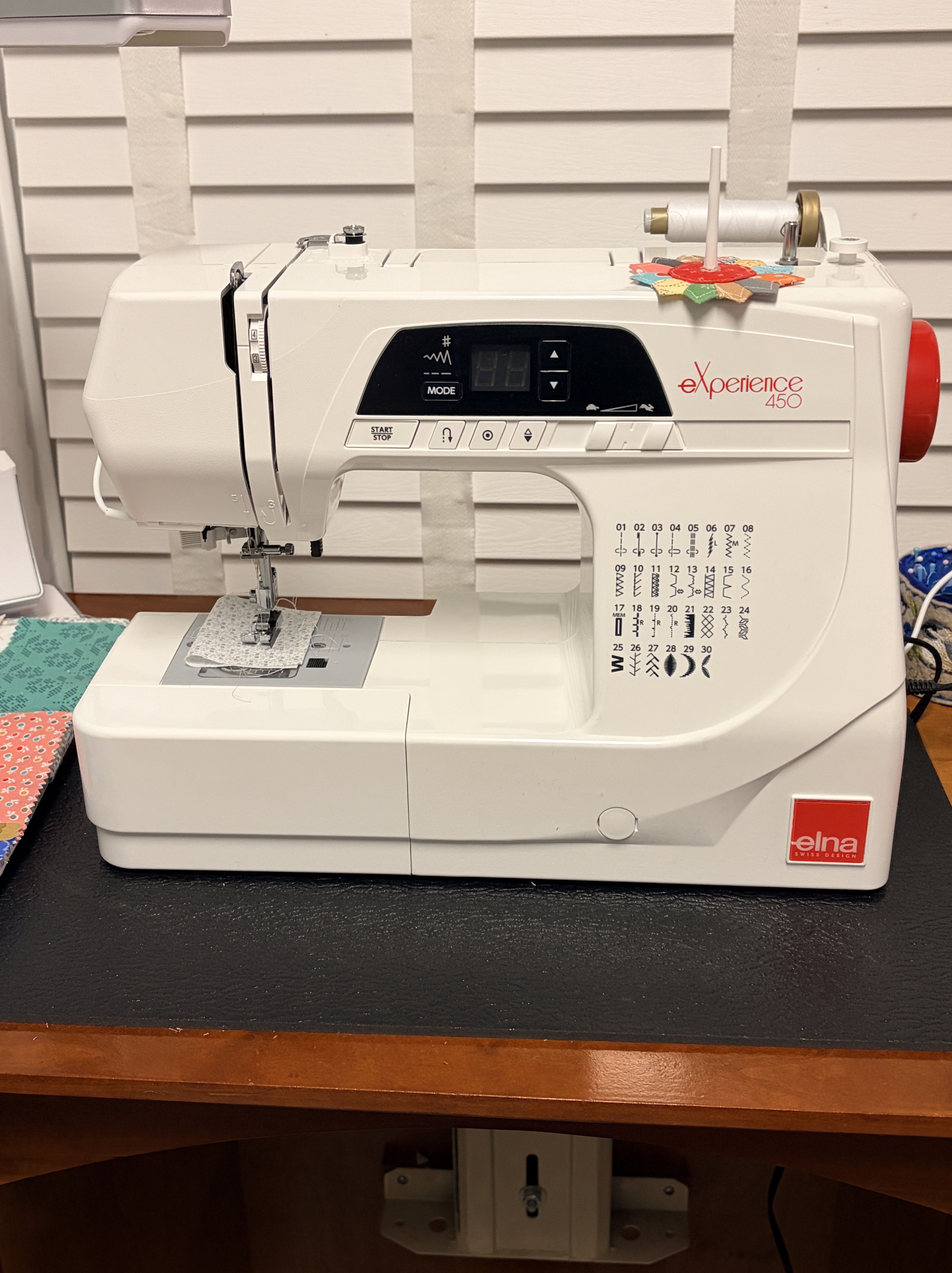
Stitch using a straight stitch with tie-off option and Janome Bi-level Left presser foot. (Note: the foot is advertised for 5-7mm machines, but I think it offers more flexibility with the 7mm widith machines. That said, my Elna 450 is a 5mm width machine. I set SW = 0 and SL= 3.0. Sew slowly with the needle down function engaged. )