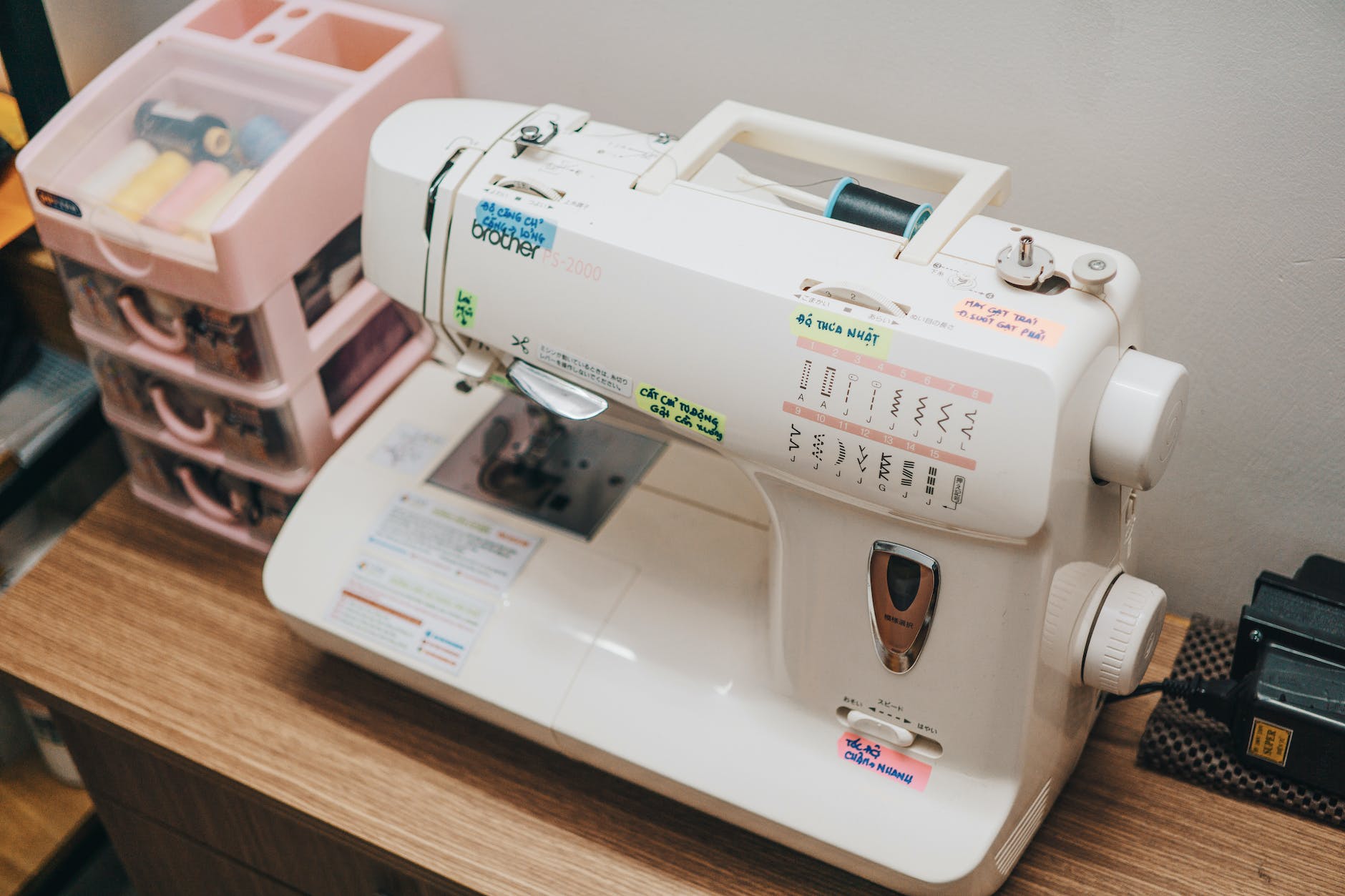
What kind of sewing machine should I buy?

That’s a loaded question! There are many variables that play into your decision. I’ll approach the following discussion from someone with experience looking to upgrade from their “beginner” machine and someone looking to buy a second/travel machine.

Here’s a good place to start for honest reviews. It’s arranged by price point. I agree with most of his recommendations, except the Baby Lock Jubilant/Brother NS80E when it comes to using it primarily for quilting. For me, it’s too finicky when it comes to sewing over thick seams.

If I could only have one machine, I’d look at a Janome Skyline S3 or the Baby Lock Brilliant. They both offer 8″ wide throat space, adjustable foot pressure, straight stitch needle plate capability and a scissors function. Cost new would be $1000-$1200. These machines are candidates to take to a retreat or class; however they are wider and heavier than a typical travel machine. Compared to my Elnita EC30, these two machines are 10 pounds heavier and 5-7 inches wider. If table space is tight (say 3 feet), you’ll definitely want to consider taking a standard size sewing machine (about 16″ wide).

If adding a “travel” machine, how do you plan to use the machine? Do you need a smaller version of your primary machine – complete with all the bells and whistles? Do you need something that will fit underneath the airplane seat in front of you, yet still offer essential creature comforts? Your budget and machine feature wish list will definitely impact your choices.

Most of the time, I see variations of the Janome 3160, Brother CS6000i, Brother Pacesetter 300 and Singer Patchwork 7285 at classes and retreats. There’s usually a sprinkling of Featherweights and a handful of smaller Berninas (325/335/475) represented, as well. Occasionally, you’ll see a 3/4 size Janome Jem 720/760 or it’s cousin – the ElnaSTAR edition.

I’ll admit, I’m a Janome girl. My current primary machine is a Janome 8900 QCP. The airline friendly version for me is an Elnita EC30, which I already use in CraftLAB. If I get a wild hair to get rid of the Jubilant that is also used in CraftLAB, I’ll replace it with the Janome 780DC (has every feature I use on my 8900 and nothing more).

Elnita EC30 packed for the airplane in my Travelpro underseat rolling tote.

An unexpected return to garment sewing

Although I’ve been quilting for several years, I learned to sew by making garments. A serger, French curve ruler and stash of specialty garment sewing notions are evidence of my past. My friend, Ruby, has inspired me to tiptoe back into garment making. We’ve chosen a simple top pattern and plan a shopping excursion to Gail K Fabrics soon.

Meanwhile, I’ve taught sewing lessons for ‘tweens and teens over many years. Our foray into garment sewing is usually limited to items such as pajama pants, elastic waist skirts and adding bling to RTW items. Back in 2017, I mentored a high school student through her senior project portfolio and later with designing/making her own prom dress. Almost a decade later, I’m mentoring another senior with the three sewn garments required as part of her portfolio application to the Fashion Institute of Technology in New York.

With Joann now closed, sewists no longer have the ability to go flip through all the pattern books looking for inspiration. To select her portfolio projects, my mentee perused my limited selection of printed garment patterns and garment sewing books, print issues of Burda Style, websites of indie pattern designers and any newer garment sewing books we could find at the public libraries around us. She also spent time on social media gathering project ideas and portfolio prep advice.

Today, she took home her first completed garment for the portfolio – a ponte knit skirt. The skirt pattern – modified to add a front slit detail – came from the book Stretch by Tilly and the Buttons, which title is part of my personal sewing book collection. I have to say I’m impressed with the pattern, instructions and overall finished result. So much nicer than my experiences with the Big 4 pattern companies.

Our local library had a copy of Sustainable Style, sponsored by the Great British Sewing Bee. Published in 2020, the book is still available for sale in print and electronic formats, in case your library doesn’t offer it. In the book, my mentee found blouse and trouser patterns she wanted to make for her portfolio. The patterns that go along with the book can be found here. Technically, the patterns are free, but you have to print and tape the pages together or send the A0 pattern images out to a specialty printer who can print them at the correct size. My local printshop said it could print blueprint size pages; however, staff could not scale the image to print at the correct size, despite repeated attempts to do so.

Solution? I sent the master pattern image files to PDFPlotting in North Carolina. Keith returned the printed pattern sheets within two days. The patterns were printed correctly to scale, with crisp images and delivered wrinkle free. Two complete patterns for less than $25.00. Very reasonable in terms of cost and time saved not having to print and tape 60+ letter size sheets together!

Will I continue to quilt? Of course! Mentoring my student with her portfolio prep has merely whetted my appetite to try new things – a top and skirt, knit pjs, rope bowls, jelly roll rugs and sashiko stitching to name a few.

Here’s to learning new things and happy stitching!

Be your own designer – start simple

Round potholder – first attempt at using Adobe Illustrator to create pattern templates. Note to self – need to raise and soften curve of pocket piece.

My kitchen is in dire need of new potholders. Thanks to home and car insurance renewals this past month, I’m going to have DIY if I want new ones. I already have all the materials, including the heat resistant batting, in my sewing room. For inspiration, I headed to Pinterest. I kept seeing a really cute round potholder with a pocket and hanging loop. All of pins directed me to various blogposts, which in turn redirected me to purchase a pattern for $10.95. No thanks. I’ll try drafting my own. While I used Adobe Illustrator to create my 8″ circle and pocket piece, you do not need a computer to draft your own pattern templates.

There’s an old-school, analog method for drafting your own patterns. It involves pen, paper, a ruler and usually something round. A round potholder is 8″ in diameter. Head to your kitchen: a luncheon plate is usually 8″ in diameter. Or try the lid to a large pot, a mid-size skillet or a 2-2.5 quart round casserole dish. Your lid can be a little under/over 8″.

You’ll need two circles – one circle per page. I traced around a luncheon plate to make my circles.

Cut out one of the circles. Leave the other circle intact (as a full-sheet of paper). Fold each circle in half lengthwise and make a crease along the fold.

On the full-sheet circle, place a ruler along the crease and make a mark approximately 4.5″ from the bottom. Place the cut circle on top of the full-sheet circle. Align both circles along the crease. Slide the cut circle up until the bottom of that circle meets the mark you made at the 4.5″ point on the other circle. Confirm that your creases are still aligned all the way to the top (fold down the top circle a bit to check). Trace the bottom of the circle to form the top arc of the moon shaped piece that will be the pocket template for your round potholder.

Cut out your moon shaped piece. You should now have two pattern templates.

What else do you need per potholder?

  • (4) 9-1/2″ squares of coordinating fabrics
  • (2) 9-1/2″ squares of Insul-Bright or Insul-Fleece
  • (2) 9-1/2″ squares of cotton batting
  • (1) 2-1/2 x 5-1/2″ strip for hanging loop (optional)
  • Approximately 45″ of 2-1/2″ bias binding

Basic construction notes:
a) Make 2 quilt sandwiches – one for the main body and one for the pocket. Include a piece of Insul-Bright/Insul-Fleece and a piece of cotton batting in each sandwich. Quilt as desired – a 1″ grid is commonly used in kitchen textiles.
b) Cut out the body and pocket pieces using the templates you drafted.
c) Add binding to curve of pocket piece using your preferred method.
d) Place pocket piece on top of body, align and baste in place.
e) Make hanging loop, fold in half and baste in place at center top on front or back of potholder.
f) Attach bias binding back to front and sew down – this video will be VERY helpful.
g) Flip up the hanging loop and stitch in place to secure (optional).

Here’s a helpful tutorial for an oval shaped potholder, but it’s essentially the same as for a round potholder with a pocket.

Helpful hints:
– Use a longer stitch length (3.5 mm) when quilting and topstitching.
– A left bi-level foot (or quilt binding foot) will help keep topstitching uniform when applying binding back to front.
– If the binding has a difficult time turning to the front and providing enough coverage, try grading the seam allowance along where the pocket and body are sewn together.