A busy week indeed

This was our last official week of summer break.  An oxymoron of sorts as I spent three days dealing with school stuff (unpaid, of course since our contract doesn’t start until Monday).  I managed to squeeze in some sewing and actually taught sewing classes this week.
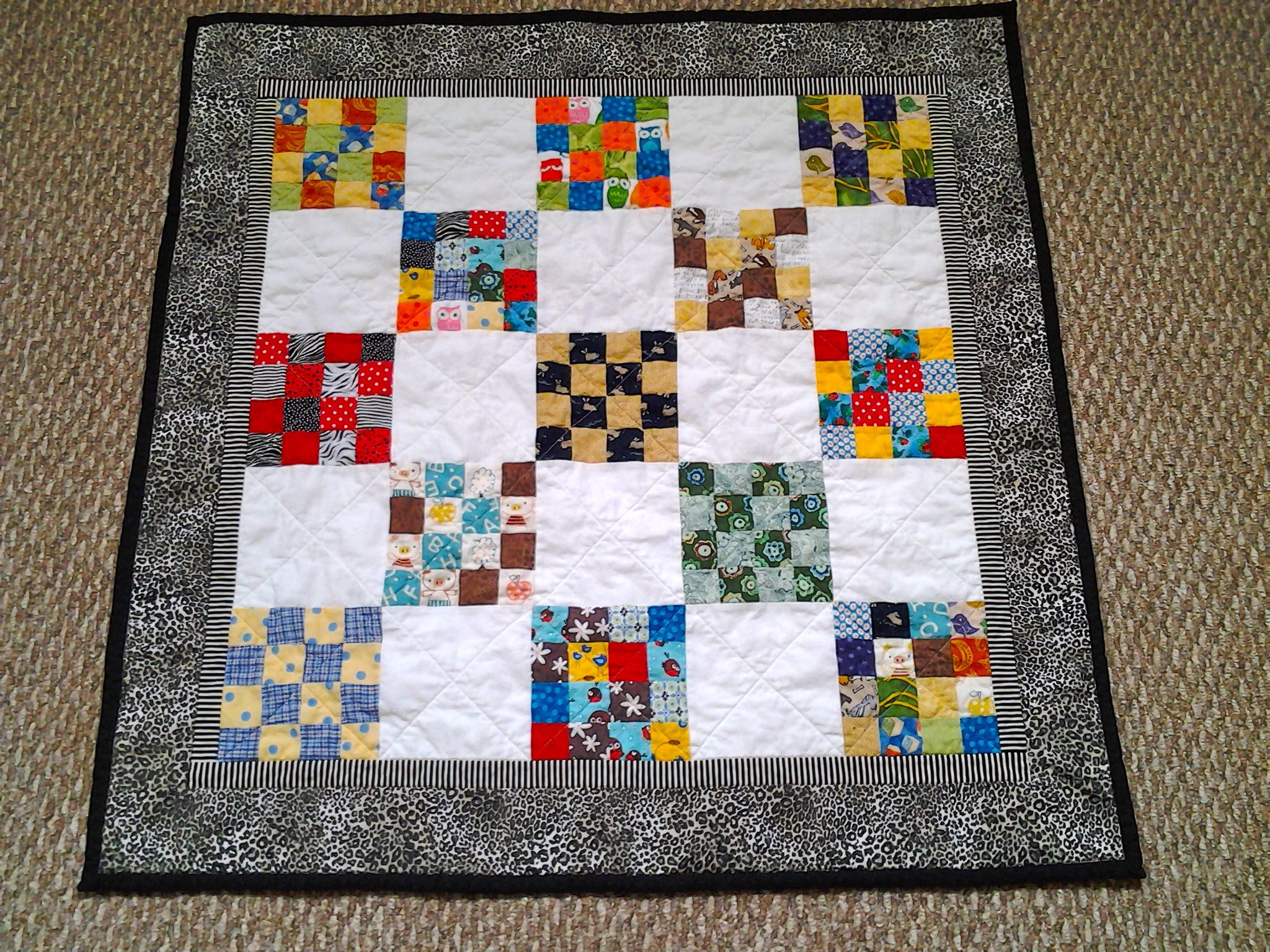
Levi’s Story Time Quilt
from the stash and very scrappy

First off, I made a very scrappy baby quilt for a library colleague of mine who recently adopted a child.  Our former library media supervisor hosted a baby shower for the new parents.  Attendees were asked to bring a favorite children’s book to help build the baby’s library.

I decided Levi needed a story-time quilt to snuggle up with while he listens to all of those great stories.  The 16 patch blocks are made up from 2″ squares cut from fabric scraps.  In fact, I cut all of the pieces for this quilt using my Accuquilt GO! cutter. It made quick work of cutting all of those 2″ squares from various size scraps.  Sewing them together was a breeze.  Can’t say the same thing for the white squares, though.  Some came out 1/8″ short, forcing me to “make it work” while assembling the rows.  I had a similar problem with the 5″ charm square die, which the company replaced at no charge.  Hopefully this was a case of operator error not equipment error.  The 6-1/2″ size is quite handy.

I taught not one, but TWO sewing classes this week.  The first was a mother-daughter private and lesson and the second was to a class full of ‘tweens learning to make t-shirt pillow covers.  What a blast.  My friend Shannon was shopping in the store and popped in the classroom to say, “Hi!” when she heard my voice.

T-Shirt Pillow Class with Anna and Shelbea

The shop owner took a number of pictures of the class in action.  I’ll write up a post when I have permission from all the parents to post the pictures.  Meanwhile, enjoy this photo of my 8th grade friends proudly displaying their handiwork.

Lastly, equipment failure forced me to seek out a better fabric organization solution for my stash.  The oversize 3 drawer rolling cart I’d inherited from a teacher friend finally broke.  I purchased color coded fabric bins from Home Depot and a Martha Stewart 6-cubby organizer to replace the plastic cart.  The color of the bin indicates which color family of fabric is stored inside.  I can tell at a glance what I have.  And yes, the fabric bins come in a wide range of colors.  The 6 drawer plastic organizer to the right  of my new cubby organizer is a really good one – but I really, really like the ease of finding fabric in the bins.  And the bins hold a lot more fabric than the plastic drawers.  Hmmm…

Stash organization using color coded fabric bins and cubby organizer from Martha Stewart available at Home Depot (on left).

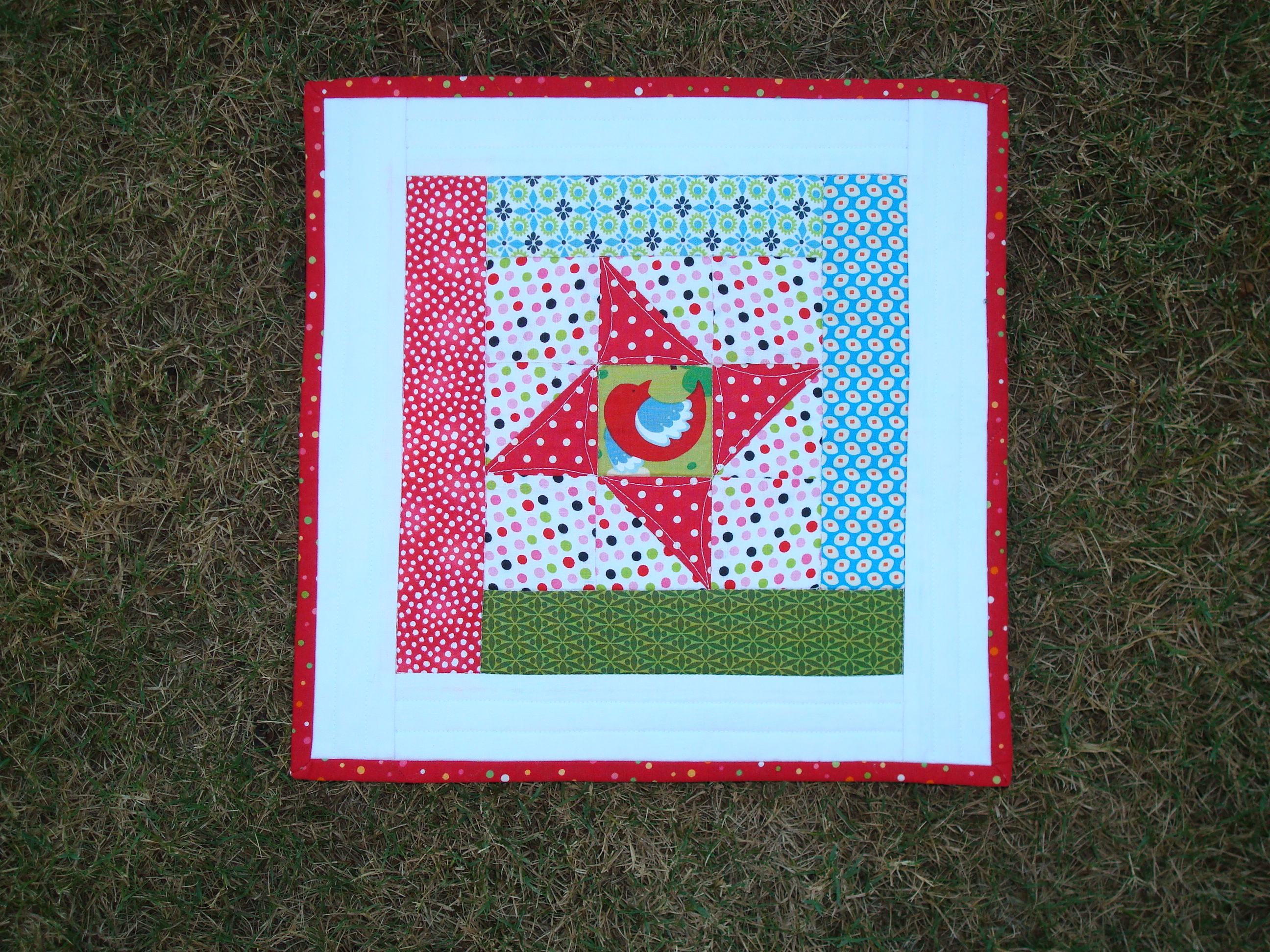
Mini Quilt Swap – the big reveal [drumroll please]

Three weeks ago, I posted pictures of the package that went off to Ireland as part of the Atlanta and Irish Modern Quilt Guilds’ mini-quilt swap.  Karen, my swap partner, lives in a small town near the Causeway Coast in Northern Ireland.  She confirmed that she received my package this week, so I can now share pictures.

The only things I knew about Karen were that she liked the color red, polka dots and birds.  No question the backing fabric would be a fussy cut of a Moda bird print I’d picked up over spring break.  But what about the quilt top?  I was inspired by a trio of mini-quilts in a recent issue of Stitch Craft Create. I had several bird fabrics in my scrap bins left over from previous projects.  So I let my creative muse out of the bottle to play…

This fussy cut bird was my inspiration.
My interpretation of the Friendship Star measures 12-1/2″ square.
Backing fabric was simply too gorgeous to cover with a traditional quilt label, so I used one of my custom printed labels attached with French knots at the corners.

Sewing Machines for Kids (and other newbies)

Earlier in the summer, I had an interesting conversation with an acquaintance who teaches adult sewing classes.  New students, especially adults, can be intimidated by other seasoned stitchers with their fancy machines.  Keep in mind that buying a sewing machine is a lot like buying a car.  Starting out, you want a quality machine that will get the job done for a reasonable price.  If you do decide sewing is your thing, then be rest assured you can always trade-in and trade-up in machine.

So, what do you really need?

A low shank, preferably center needle mechanical machine that does:

1.  Straight stitch
2.  Zig zag stitch
3.  Buttonhole

Yep, this will cover just about all of your sewing needs, especially if the straight and zig zag stitches are fully adjustable.  Anything else is merely icing on the cake.

Surprised?

I’m not saying that you shouldn’t buy a computerized sewing machine.  However, in my experience, mechanical machines are a lot less intimidating to new stitchers.  They are also lot easier for the teacher/parent to troubleshoot problems. A low-shank, center needle machine also means speciality/replacement presser feet are more readily available.

Potentially important consideration – the bobbin case

A machine with a vertical (front-load/oscillating) or horizontal (top-load/rotary) bobbin case is a matter of personal preference.  Some older machines such as the Singer Featherweight, Singer 99 and 15 class clones from the 1950’s have a side loading bobbin case.  I have front, side and top loading machines in my studio.  For me, a top loading bobbin means easier access to change the bobbin.  It’s right there under the presser foot – not hidden down below where I have to remove a free arm extension or try to get my fingers into the small opening on a flatbed like Ruthie.  I also don’t have to keep up with a separate bobbin case, which can easily get lost.  Some folks swear stitch quality is better with a traditional, vertical bobbin case.  I can’t really tell the difference.

The take away for you, dear reader, is that the type of bobbin case will dictate what sort of extra accessory feet will work with your machine.  Most “starter” machines also come with a vertical bobbin case.  A top loading bobbin usually costs a few dollars more.

Gee, this thing weighs a ton!

Vintage machines are usually made out of metal and they are HEAVY.  Great if you have a designated sewing space where the machine can be out all of the time.  Consider a lightweight (yes, plastic) machine if portability is an issue.  A free arm is a nice bonus, too – but not absolutely necessary. (I learned to sew on a flatbed and my main machine – a Janome 6600P – is a flatbed.)

The bottom line (or price)

Most parents want to minimize their expenses, but keep in mind that even a gifted machine or yard sale bargain will most likely require a basic service call and may need accessories (carry case, presser feet, owner’s manual, etc.) to make it road worthy for a newbie stitcher.  From personal experience, I recommend budgeting $100 to get a previously loved machine ready to stitch and plan to spend a minimum of $150-$200 to get a decent, new mechanical sewing machine.  Shop your local dealer, if at all possible – especially if you have never touched a sewing machine before.  You’ll want the owner’s guide classes that are included with the price of your machine.

I recently purchased a Janome 5812 on sale @ Hancock Fabrics.  I wanted a lightweight free-arm machine to augment my two classroom workhorses – Ellie and Ruthie.  The 5812 met my requirements and has a top loading bobbin, to boot.  The lighter weight (11.2 pounds) means it has more plastic than I’m used to, but that’s a trade-off I’m willing to make for a super portable machine.  This model is also full-size, not 3/4 size or mini. Quite frankly, I was really surprised at how well it sews on a variety of fabrics.  This little machine handled a scrap of silk fabric with no skipped stitches and no puckers.  I gladly went to the Janome dealer today to pick up the the one snap on foot and metal shank that I didn’t have on hand.  To the feet included with the 5812,  I added the H (straight stitch), F (applique) and O (1/4″) feet, plus the metal snap on shank.  [I also have a walking foot and darning foot I can borrow from another machine, if need be.] From my stash, I added extra bobbins, needles, a lint brush and a small screwdriver set.  Although there is storage for accessories in the freearm, they fell out every time I removed the storage box.  So, I repurposed a funky metal tin to hold my sewing machine accessories and small scissors.  Now, all I need to add is a tapestry tote bag to carry the machine.   Total investment a little over $200 for what I think will wind up being my travel machine in addition to classroom machine.  FWIW, my students also recommend the 2212 and the MyStyle 100 for models under $200.00.