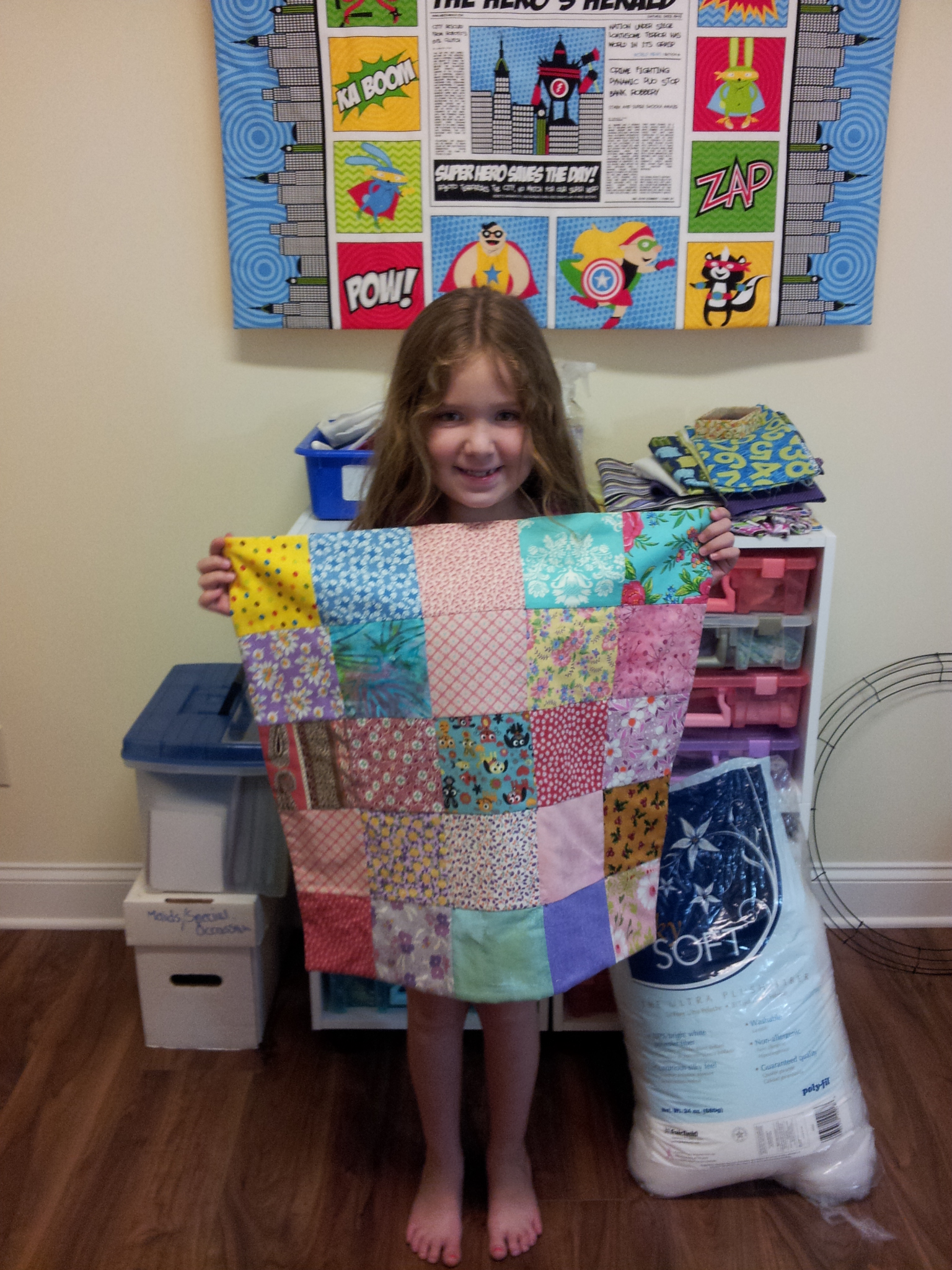
We survived Quilt Camp!

My 7-year-old niece and I now have the first of two planned summer sewing camps behind us.  For two days, we stitched, cut, ripped out, stitched again, played, laughed, ate out and made a big old mess of Aunt ‘Resa’s sewing room.  Our adventure also included a sleepover – her first at our new house.  Here are some pictures from our sewing spectacular:

pressingfabric
Carefully pressing her fabric.
dollquilt
Mission accomplished! Quilt for her AG doll.


We probably spent about six hours total in my sewing room actually sewing in the 24 hours she was here.  Her top was pieced as “homework” between January and Easter.  Our goals were to (1) complete her quilt using the envelope method and tie it by hand with yarn and (2) make a pillow case from Hello Kitty fabric she’d received for Christmas. I nixed the yarn tie method when I realized her chosen yarn had metallic thread shot through it.  It wouldn’t stay tied.  She’s also not into hand stitching at this point, so she learned how to tie via the clasp (a big star) stitch on my Janome 6600.  It worked great!

She chose the complementary color fabrics for her Hello Kitty pillowcase from my stash.  I cut out the fabrics, but she helped pin and did all of the sewing by herself.  She was so proud when she mastered pivoting the corner!  Marking pivot dots with a sharpie marker helped her to see where to plant the needle before lifting the presser foot to pivot.  I wouldn’t necessarily recommend this marking method for your competition quilts, but it serves as a great visual reminder for new stitchers.

On my Janome machines, I’ve discovered that the edge of the metal presser foot (A or general purpose foot) is the best seam allowance minder for my younger stitchers when making projects that require a 1/4″ seam allowance.  It’s close enough.  For wider seam allowances, the metal screw on guide is a real help!



Retirement planning and your craft business

Did you know that your craft business has the ability to be a key component of your retirement plan?  

If you’re like a lot of crafters (including yours truly), you have a full-time job and work your craft business on the side.  My business was set up with the intention of it remaining part-time until I decided to retire from my school library job.  By this point, the business should be established enough to provide a reliable income stream to supplement our other retirement income sources.  Yes, I plan to continue working even after I “retire.”  That’s just me.  My craft business will provide income AND give me something to do.

These are important points.  Wes Moss, a local money show radio host, recently published a book about the keys to happy retirement:  You Can Retire Sooner Than You Think. It’s an excellent book that puts things in layman’s terms: You can order a copy of it here.

Doing the exercises in the book made me realize that hubs and I might actually be able to retire sooner than we thought. Why? Because as Moss’s research indicates, you really don’t need to have millions of dollars in the bank.  What you do need are multiple sources of income, a paid for house and a plan/purpose for how you are going to spend your time/money in retirement.  Your craft business can actually help in all three areas:  (1) provide a source of income in retirement, (2) provide a source of funds to help pay down the mortgage faster and (3) provide you a purpose in retirement (whether you sew for money or charitable causes).  If your craft business is your full-time business, you have a host of other retirement planning vehicles available to you – check with your CPA or business advisor.

I am somewhat of what Dave Ramsey refers to as a money nerd.  It’s true when he says that basic money management is mostly about behavior.  Once you learn (and practice) the simple behaviors that really work – live on less than you make, pay yourself first, learn to say no and practice delayed gratification – money management (and life with your spouse) gets a whole lot easier.  It also puts you in the driver’s seat of your life.  On it’s own, money doesn’t buy happiness, but having some savings does buy you time or the ability to do/get what makes your heart sing – or allow you to leave a job that’s making you miserable.

If you, like me, are still many moons away from official retirement age, but are considering retiring early – be sure you build up the “non-retirement” accounts in addition to your 401(k).  Financial rule of thumb is you can safely expect to withdraw $1,000/month from every $240,000 in assets in an “income generating” portfolio.  For years, we’ve concentrated on putting money into our 401(k) and 403(b) plans.  Now, we’ll shift gears to put more money in the non-retirement kitty.  Who knows?  I might actually be able to “retire” before my pension eligibility date.  That would be a good thing!

Finding your inspiration

Finding your inspiration

What inspires you?  For me, it’s definitely being in nature – or in this case on vacation.  This picture is the view of Frenchman’s Bay from my room at the Bluenose Inn in Bar Harbor, Maine. Boy, was my sewing machine calling my name! Oh, how I would love to have a view like this from my studio.  Absolutely breathtaking!

At home, some of my best ideas come from taking the dog for a ride in my SUV.  Don’t laugh.  Our destination is usually one of the nearby parks for a walk, but I run through the myriad of neighborhoods in the area on the way to and from the park just to let my mind wander. For example, this morning I was trying to figure out how to best utilize the remaining wool felt project kits I’d cut for the Mustang Academy “survival sewing” class I’d taught back in May.  When I hit the QT, inspiration struck!   Why not offer this as a one hour class at the local quilt shop?  I’d already worked out the kinks while teaching the boys and the kits are already cut.  The shop owner had contacted me about teaching kid’s sewing classes while I was in Maine, so I now have a class to present when I touch base with her tomorrow.