Memory Pillows from T-Shirts

Unlike a memory pilloimg_20170212_213719_452w made from a button front dress shirt, a memory pillow made from a t-shirt will require some additional planning and prep work:

  • Let the size of the main graphic help you determine overall pillow size.
    12″, 14″ or 16″ are the most common sizes; however, pillow forms in sizes up to
    24″ x 24″ are available at the big box craft stores.
  • Determine your desired closure method before making the first cut in the t-shirt:  hand stitched closed, envelope style or zipper.
  • Launder the t-shirt without fabric softener before cutting.
  • Fuse lightweight interfacing to the back of the pillow front.  Back is optional.
  • Fuse 1/2″ strip of lightweight interfacing to the “closure” edge of the back if planning to sew closed by hand or insert a zipper.

Construction Hints:

  • Use polyester or cotton-covered polyester thread and a universal/ball point needle.
  • Use a lightning stitch (or tiny, long zig zag – W=1.0 and L= 2.5) to avoid puckers.
  • Loosen the foot pressure a notch or two if your machine offers that option.
  • A walking foot or tricot foot can also help with smooth seams.

Directions a hand-stitched closed pillow:

  • Determine size finished size of pillow. Cut interfaced t-shirt front & back sections to this measurement plus 1/2″ seam allowance (or desired measurements for envelope closure).
  • Sew on any decorations, patches or special labels as desired.
  • Pin front and back sections together.  Along the closure edge, place a pin 3″ in from either side.  This will mark your starting and stopping points.
  • Sew around 3-1/2 sides of the pillow, backstitching at beginning and ending of seam.
  • Clip corners, trim loose threads and turn right side out.  Press.
  • Insert pillow form.
  • Sew opening closed using an almost invisible ladder stitch.
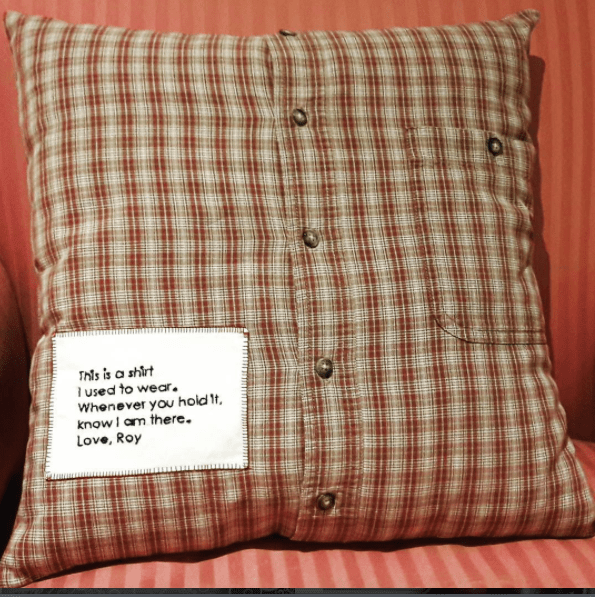
Making Memory Pillows

screen-shot-2017-02-12-at-10-41-16-pm

Believe it or not, this type of memory pillow is probably the easiest of all to make as the button placket serves as the closure.  Essentially, you cut a square to the desired size + 1/2″, place fabrics right sides together and sew all the way around. Turn inside out, give it a good press and insert a pillow form.  Instant memory pillow!  Here’s a tutorial that explains the process in greater detail, in case you need it.

Construction Notes:

  • This pillow is 16″ square.  Most L/XL men’s shirts will yield a 16″ square pillow.
  • Consider interfacing the front sections of shirts that are loosely woven or made of thin fabric.  Pellon SF-101 is my go-to interfacing.
  • Align the button placket and baste the top and bottom edges before stitching.
  • Use a 3/8″ seam allowance and finish the edges by serger or sewing machine.
  • Be aware that the button placket will likely be off-center if you want the entire chest pocket to show.
  • Take the time to match plaids along the sides.  A walking foot is your BFF.
  • If you like to taper the edges of the pillow to avoid bulk at the corners, I recommend NOT doing it on this particular type of pillow  – especially if you have an overstuffed pillow form.

Inscription Label:

This particular label is hand embroidered because I do not own an embroidery machine. The font is Century Gothic. The verse was printed on fabric using my inkjet printer and stitched using perle cotton.  Cost and turnaround time are the reasons I decided to DIY.

You do have lots of other options if you abhor hand stitching:  DIY on your embroidery machine (lucky you!). Design your own stitch pattern or buy a digital embroidery file for a couple of bucks. Having someone else make the label is also an option, but it will set you back $8-$15 per label.

Right Sizing and Adding Value

I’ve been on a mission lately to “right size” my sewing studio and the mother lode of stuff in said studio (as well as several surrounding closets!).

  • All student machines are now out of the house. One is at the quilt shop and the others are at school for my weekly sewing club.
  • All excess sewing notions are at school. Of course, some will make eventually their way home – as did my duckbill scissors – once I saw a student attempting to cut paper with them.  Didn’t realize those were in the “school” sewing box.
  • Three HUGE tubs of assorted fabrics that were gifted to me were re-gifted to a local mixed media artist who was overjoyed by all the fabric.
  • One HUGE tub of gently used sewing, craft and household books were put in the Better World Books collection bin.
  • Magazines, books and other items are being listed on Etsy on the weekly basis to get them out of the house.
  • Bid farewell to a few PhDs (projects half done) in recent weeks. Salvaged what I could out of the projects (orphan blocks & leftover fabrics) – but if I haven’t completed the top in 5 years, it’s time to let it go.

I still a work in progress, but at least all of the known excess fabric is out of the house and I can begin the process of consolidating fabrics according to precuts (charms and strips), kits, backings, minky and general fabric sorted by color/novelty/dogs.

What does come into the studio must either be for a paid customer project or add value in at least one of the following areas:

1) Will it make my process easier?
2) Will it make the process less painful?
3) Is it something that I just absolutely love?

When my 3160QDC spent almost 4 weeks in the repair shop, I borrowed a “school” machine to help with production work.  WRONG!  I wound up buying a JW8100 from Wal-Mart to help get me through the production crunch. Well…I was so impressed with this little machine that I still have it and it is now my travel/teach class machine.  I have a nice machine to take with me, but can leave my more expensive machines in the studio.