Trying new things – English Paper Piecing

icaniwill

If you follow me on Instagram, you’ll know that I recently challenged myself to try something new – using only the the materials I had on hand.  I’d learned the Lori Holt method of machine applique using Pellon sew-in interfacing and now wanted to try something involving handwork. A hexie embellished pillow on Pinterest caught my attention, so I decided to give English Paper Piecing a try.

Yes, I’m a bit late to the EPP party. Better late than never!  The good thing is there are any number of videos on YouTube that will teach you the basics, should your library not have a book on the subject, or you have time to attend an in-person class. EPP isn’t hard, nor does it require much investment on your part to get started.

Here’s what you need:

  • 1″ hexie papers.  (Templates available here.  Print on card stock.)
  • Glue stick (Borrowing your kid’s purple glue stick is perfectly fine!)
  • Needles (Applique or Milliner size 10 or 11)
  • Beeswax/Thread Conditioner
  • Thread (50 wt, 60 wt or 80 wt)
  • 2-1/2″ square fabric scraps
  • Small, sharp scissors
  • Wonder clips or pins
  • Thimble

I used the glue baste method to make my hexies. I experimented with 3 different stitches to join my hexies together to form a flower:  whipstitch, ladder and flat-back. For me, the flat-back stitch was the hands-down winner!

Helpful hints:
* Laminate the entire printed page before cutting out the individual hexie templates.
* Use a small hole punch to punch a hole in the middle of each template. This makes for easier template removal later.
* I found Milliner needles size 11 to be the perfect fit for me.
* Thread preference is 60 wt Coats & Clark Fine or Superior Bottom Line poly threads.
* My Clover desk needle threader was a godsend as the milliner needles have tiny eyes (you can buy large eye Milliner needles, but I was using what I had on hand).
* I detest sticky fingers, so I wasn’t a big fan of the glue stick method until I watched a Sue Daley video where she demonstrated the SewLine glue pen.  That glue pen, along with the laminated hexies, helped minimize the glue reside on my fingers.
*If you are cutting your squares from jelly roll strips, consider picking up a hexie template like this one.  It makes the underside of the hexie a little more uniform and easier to tack down.

Additional Video Resources:
Sue Daley EPP School
Hexie thread basting 
Flat Back Stitch 

P.S. Why EPP?  I’m taking a professional development course for the day job that requires me to watch videos each week. I need something to do with my hands while I watch the videos.  🙂
 

Kid’s Club Schedule for 2019

Believe it or not, Miss Jackie and I have set the monthly classes through December 2019!

January – Hot Chocolate Mug Rug
February – Chenille Heart Door Hanger
March – Fabric Bunny Basket
April – Oven Mitt
May – Big Chicken Door Stop/Tablet Holder
June – no club
July – Drawstring Travel Bag
August – no club
September – Lined Pencil Pouch
October –  Pumpkin Coasters (set of 4)
November – Bowl Cozy
December – Gift Bags/Card Holders

We meet the 2nd Saturday of every month from 10:30 a.m. – 12:30 p.m.
Class fee is $15 plus supplies.  Snacks are included.

We prefer that you bring your own sewing machine in good working order.  Stitch N Quilt offers machine service, as do Sewing Doc and Ashby Sewing.

A limited number of sewing machines are available for student use. Please let the shop know when you register. I bring sewing machines with a speed controller.

Policies:

  • Students must be 8 years old/rising 3rd grader to attend classes.
  • Students must be good listeners and able to follow directions.
  • Parents/caregivers are welcome to stay; however, realize your child is going to want you to participate along side them!
  • Classes are limited to six students. Payment is required at time of sign-up.
  • Some sewing machine familiarity is helpful, but actual sewing experience not always required.  That said, the January and November club projects are more involved and best suited for kids who have attended at least 3 sessions with us.


My Singer Featherweight Must-Haves

In this post, I’m referring to the original vintage 221 Singer Featherweight. 

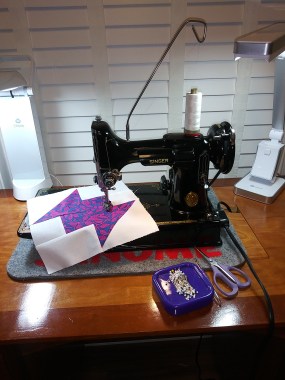
  •  A name. I’m one of those folks who names my cars, but didn’t really think to  name my sewing machines. When I joined the FW FB group, many posters had given their beloved machines a name.20190101_001219Juliette, my FW, is named for the fiercely independent, diminutive,  80-something years young woman who burst into my life so many years ago.
  • Modern accessories that really make sewing on this vintage machine a pleasure:
    • Scant 1/4″ foot with seam guide
    • Flat mount Thread Cutterz
    • Thread stand (to use with cross-wound spools like Aurifil – makes a difference!)
    • LED light bulb (personal preference is the warm light)
    • Electronic foot control
      Comments:  I always use a scant 1/4″ seam when I piece – regardless of sewing machine used. Some people prefer to use the original Singer presser foot and an acrylic seam guide. I like to use clips/pins to hold my sections together when I sew. The screw down seam guide gets in my way.  The electronic foot control preserves my original Bakelite foot controller, plus I find it WAY more comfortable to use when sewing.
  • Updated Travel Case – Many FW users I know love to take their machines with them whenever possible to sew-ins, classes and quilt retreats. Your options include  replica cases, wheeled bags and/or padded carry totes. If you don’t want to buy a bag, consider making a tote/padded cover for your original case. It will help protect it. I frequently travel with a sewing machine and prefer a padded tote with a shoulder strap. This cute project bag from Blue Fig is a great size for the FW (or any 3/4 size sewing machine) and has a bit of room leftover to hold your project and supplies. I took the bag to a recent sew-in and was able to carry a small folding cutting mat, wool press mat, SteamFast travel iron and my precut project in the same bag as the FW.  The bag will also fit in the overhead bin on an airplane and supposedly fits under most seats.  We shall see!

Disclaimer:  I am not affiliated with any of the companies linked in this post. I am merely a satisfied customer sharing which products add value to my vintage FW sewing machine experience.