Woo-hoo! I found a replacement lid for my FAVE tumbler!

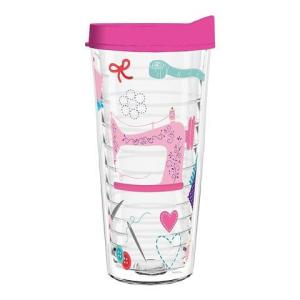
Sewing theme tumbler
purchased from A Scarlet Thread

So, I purchased this tumbler from a quilt shop in the Atlanta area last spring. It is a constant presence in my sewing studio. It even traveled with me to the JK Quilts/Featherweight Shop retreat in McCall, Idaho last summer. Do you have an idea of how much I love this particular tumbler? Besides the cuteness factor, it’s the perfect size and shape for my small hands to hold.

I lost the lid!

Since it’s not a Tervis product with lids available almost everywhere, trying to find a replacement lid that fit was like finding a needle in a haystack.

I’m happy to report that replacement lids and straws are available from Tritan USA. If you have a tumbler from your Baby Lock dealer that looks like this, then you might want to bookmark the TritanUSA site for future reference.

You’re welcome.

Heard of Cosplay, Comic-Con, Dragon-Con or SCA?

Canva - Woman Dressed As An Elf In Autumn

Picture courtesy of V. Borodinova

Home economics & school-based sewing classes may be gone with the wind; however, sewing definitely is NOT dead!  The Maker movement, coupled with a STEAM focus in schools, has made sewing “sexy” again.  High school students and young adults (< 40) have reignited an interest in garment sewing thanks to Cosplay (think dress-up and costumes for grown-ups).  Sewing, knitting and crochet clubs are spouting up as after-school enrichment clubs, in library Maker Spaces, at recreation centers, and in quilt shops/stitch lounges across the country.

While Cosplay sewing does involve garment sewing skills, it’s more costume oriented – which  means you may not have to spend as much time on the finishing details and fussing over fit. The main driver of the time, attention and care given to garment construction, fit and embellishment will largely depend on how many times you plan to wear the costume.

If you are a former garment sewer – now turned quilter or other type of sewist – do not be afraid to dust off those skills and offer to teach your DGD/DGS (and their friends) how to read a clothing pattern and how to use a sewing machine.  Costuming generally doesn’t require the precision and perfection of your high school Home Ec teacher. If you find yourself sounding like your old Home Ec teacher (unless she was nice), then just STOP IT!  Take a deep breath and remember creating is a messy process. The kids have to start somewhere. If you don’t, you’ll scare them off from sewing – and none of us wants that.  

If you are interested in Cosplay sewing classes in the South Cobb area, let me know. Classes can be held at either Mable House or at Stitch N Quilt.  

P.S. No sewing machine? You can rent one of my computerized sewing machines for $5.00 per class. 

Curious about Cosplay? Check out these links:
http://www.cosplaytutorial.com/list.php
https://cosplay.mccall.com/
https://www.sewdaily.com/?s=cosplay

If you live in the Atlanta area, be sure to check out Best Fabrics and Gail K. Fabrics for awesome Cosplay fabrics that you probably won’t find at Hobby Lobby or Joann’s. 
 

Invisible Applique Hints & Helps

For invisible machine applique, the usual process involves tracing your design onto a lightweight piece of sew-in interfacing, (remembering to reverse the design where necessary), stitching it to the fabric, then cutting a small opening in the interfacing to turn the applique right-side out. You smooth out the design using a turning tool/point turner, then give the applique a good press.  A spritz of ironing spray also helps with crisp applique shapes. The applique is then glue basted to the background, lightly touched with an iron and allowed to set for a few minutes.  Then, the design is stitched down using a narrow zig zag and invisible thread.

Applique stitching particulars:

  • Thread:  Monopoly clear from Superior (loosen top tension to 2.5)
  • Bobbin Thread:  Any 60wt polyester will work
  • Needle:  70/10 Topstitch needle
  • Stitch:  Zig Zag 1.5 wide x 1.0 long (some folks recommend 1.0 x 1.0 for stitch settings – test your machine to see what you like best).
  • Foot:  Open toe
  • Needle stop DOWN if available

For glue basting, investing in a bottle with a micro tip is well worth the money. I bought a bottle of Appli-Glue with the micro-precision tip that allowed me to twist on a different cap for travel.  The glue part of the product works well, but I’ll probably refill it with good old Elmer’s washable school glue once it runs out.

Preparing appliques:

Use a fine point mechanical pencil for tracing designs (.5 lead size)
Test a variety of sheer and light-weight sew-in interfacing to see which one you prefer. I tried Pellon 905, 910 and the Lori Holt versions.  Personally, I prefer Pellon 830, which is marketed as pattern tracing cloth. It’s a poly/vicose blend that feels similar to Lori Holt’s product, but is a little bit lighter weight.