Basic Sewing Supplies for Newbies

The shop owner asked me to put together supply lists for the class projects so she could assemble precut kits as a convenience to her customers (and hopefully, my students).  Oh man, what to include for a basic sewing kit?  I distinctly recall the old Dritz (or whatever brand it was) “start to sew” kit that had straight pins, a tomato pin cushion, a tape measure, thimble, wheel of assorted sewing needles, dull plastic handle scissors, a tracing wheel and carbon paper and a seam ripper.  I think it retailed for about $5.95 back in the day and you can still find a version of it today (minus tracing paper) at fabric, craft and mass merchandisers for about $10.00.   For a few bucks more and a little scrounging from sewing relatives/friends, you can assemble a quality sewing kit that will last you a long time.

Here’s what I think you really need:

  1. Fabric scissors (7″ or 8″ bent handle from Fiskars, Mundial or other reputable brand)
  2. Straight pins (skip the silk pins….use glass head and/or .45mm flower head pins)
  3. Pin cushion
  4. Assorted hand sewing needles
  5. All purpose thread in white, beige and black.
  6. Seam ripper
  7. Seam/hem gauge
  8. Tape measure
  9. Container to hold your supplies

Even if you decide sewing isn’t your thing, you’ll still have a basic kit that will cover your mending needs quite well.

HOWEVER, I’m going to assume you enjoy it and want the tools that make sewing a little easier.  To the above list add: thimble, beeswax/thead conditioner, needle threader, glue stick, point turner, 4″ scissors,  1-1/2″ x 6-1/2″ clear acrylic or regular 6″ ruler, washout graphite pencil, soapstone or white chalk pencil, pencil sharpener and fine point permanent marker.

If you quilt:  45mm rotary cutter, 4″x18″ or 6″x24″ acrylic ruler and self-healing mat.

If you scrounge:  ask if your donors can spare a few safety pins, snaps, and basic buttons.  These will come in handy.

A few words of wisdom…

  • Do not skimp on scissors.  Brand name sewing scissors are often discounted 50% at sewing and craft stores.  You will wind up frustrated by a cheap pair’s inability to cut fabric.
  • Long, thin pins are easier to see and pick up.  Glass head pins can be ironed over (plastic head will melt).  As an added bonus, they are less likely to break your sewing machine needle if you *accidentally* sew over a pin.
  • The majority of the supplies can often be had for less than $2.00 a piece or *gifted* from a friend or relative’s sewing basket.  Some could even come from the school/office supplies you have around the house.
If you get bitten by the sewing/quilting bug, there’s nothing wrong with upgrading your equipment later on.  What’s listed above is my “travel” kit.  It’s only a fraction of all the goodies in my sewing studio.

My most surprisingly useful notion has been my 2-1/2″ x 6-1/2″ clear acrylic ruler from Creative Grids.  I typically keep this in my travel sewing kit.  I keep reaching for it so much that I need to buy a second one to keep at my sewing machine.  Unfortunately, they no longer manufacturer this particular one.  I’ll call the shop I purchased this size ruler from to see if they have any more.

Family – the ties that bind us together

As I write this, my mom and step-dad are waiting for the call that will take them to Virginia one last time.  Miss Hazel, the 89-year-old curmudgeon with whom my mom lived during her teenage years, is peacefully slipping away from this life to the next.

Miss Hazel liked fine clothing and dressed for church in 3″ heels until well into her 80’s.  She did a lot of charity work during her life, but her sharp tongue alienated many of her friends.  Thanks to her stubborn, independent streak, she resisted moving to a senior center until three years ago.  I hope I’m able to live on my own until I’m that old.

Mom made the pilgrimage twice a year to visit Miss Hazel and always had to steel herself before each visit.  Sometimes she came back very upset because of something Miss Hazel had said during their time together.  I never really understood why she continued to go when it was obvious Miss Hazel didn’t appreciate the time and effort it took to go see her.  Mom explained that she had promised Miss Hazel’s deceased husband, Mr. Ray, that she would continue to check on Miss Hazel after he passed away.  Mom said she never dreamed the promise would last 25 years.

Mom and my step-dad went to Virginia last week because they received a call that death was imminent.  When it appeared Miss Hazel would recover, everyone returned home.  Mom relayed that on her way out of town she stopped by the cemetery to visit Mr. Ray and advise that he’d better get his affairs in order because Miss Hazel would be joining him soon.

Rest in peace, Miss Hazel.

Update:  She passed away Monday afternoon.  Even in death, she continues to stir the pot and elicit  hurt feelings among family and friends.  I wish my mom would turn the car around head home.  Thankfully, she has no more reason to ever visit that group of folks again.

School Spirit Banners

Several posts ago, I mentioned that I had been asked to make the school spirit banner that our reading bowl team members would carry at the reading bowl competition.  Here are three of the team members onstage during the parade of schools:

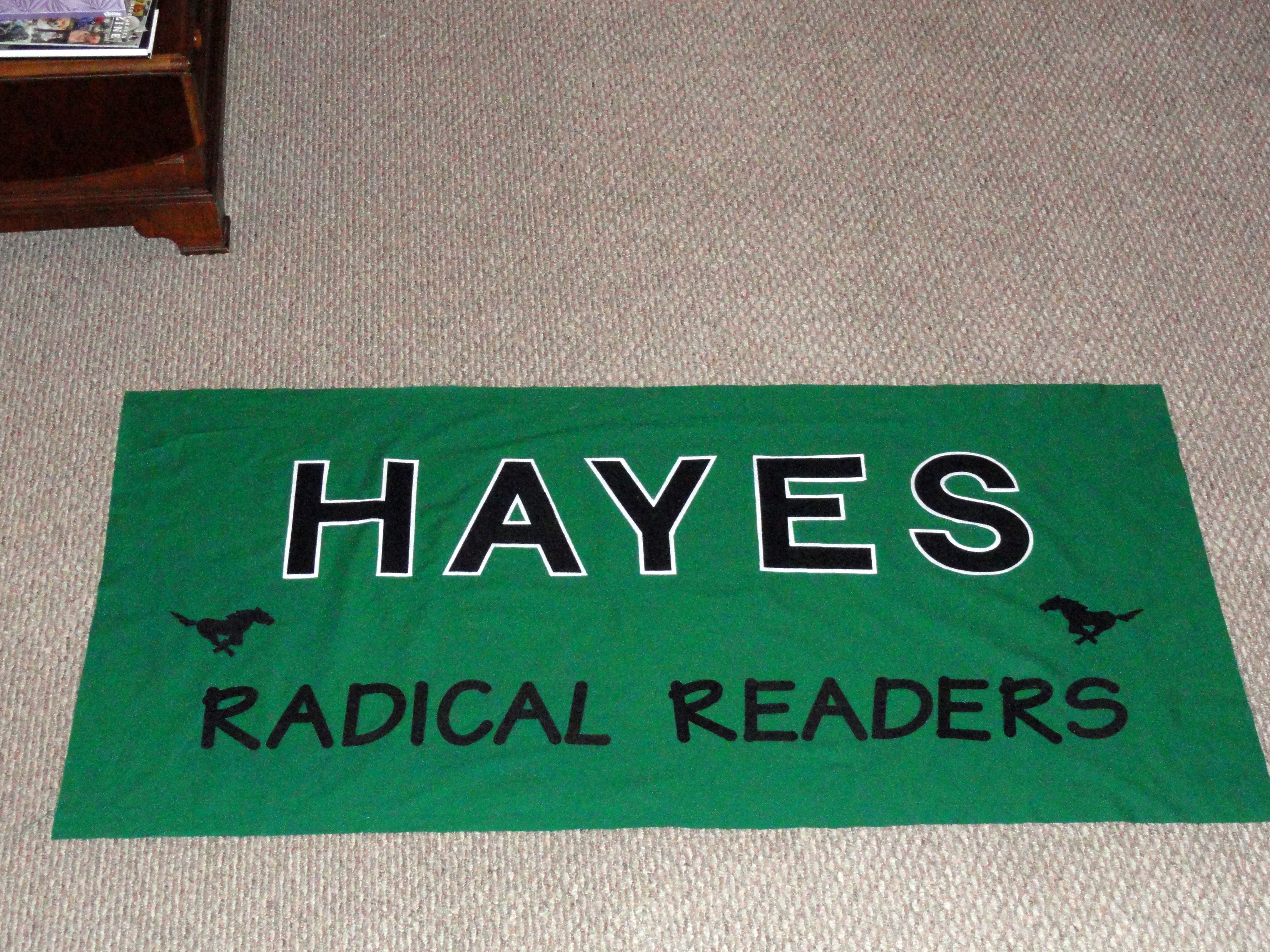
The finished banner size is 30″ x 60″.  The front and back are simply the quilting cotton from Joann’s that happened to be the correct shade of green to match our school colors.  A piece of very low loft lightweight batting is sandwiched between the two pieces to give it some body. This banner was simply stitched together along the edges and turned right side out with topstitching 1/4″ from the finished edge.  In hindsight, I think a traditional bound finish would have been easier as would using flannel instead of quilt batting.

The letters were made using the letter die-cuts at my school.  I fused lightweight paperbacked fusible web to the wrong side of a piece of wool felt.  (Wool felt doesn’t fray and withstands high iron temps needed to activate the fusible web.) Once cooled, I cut the felt into 5″ or 9″ squares (leaving paper backing intact) and ran them through the die cut machine.  Larger letters are 8″ high while the smaller letters are 4″ high.  To make the white background behind the HAYES, I simply fused the 8″ black letters to a piece of white felt and then cut them using my 28 mm rotary cutter and small acrylic ruler  to leave a 1/4″ outline.   Outline of the “S” was done freehand.  The large letters were machine stitched to the quilt banner.  The 4″ letters are simply fused in place.  I will go back and add more mustangs and some additional machine quilting before the banner is hung on the wall.  Honestly, I don’t think the 4″ letters need to be stitched down.  They remained securely attached even after a day of heavy use at the reading bowl.

A 1-3/8″ dowel rod with end caps will be used as the hanger.  I’ll add a sleeve before the banner is hung on the wall in the Media Center.  Some schools used rod & pocket casings at the tops of their banners to hold the pole.  Good idea, but with our banner layout and size constraints, it just didn’t look right on the mock-up.

Although the design is simple, it took almost as much time to work out the design details and do the mock-up on bulletin board paper as it did to construct the entire banner.  The sewing part wasn’t difficult at all.  Fusing the paper backed fusible web and cutting the letters took the longest amount of time.

Everyone was thrilled with the banner.  Final tally:  6 hours of time plus $40 in materials (not including hanging hardware). Fortunately, I was able to fuse and cut the letters during my planning time @ work.