Need a budget-friendly option to quickly cut strips, squares and rectangles?

Meet my old friend – the June Tailor Shape Cut ruler. I was introduced to her when I took my first quilting class many moons ago.

A photo showing the Shape Cut ruler from June Tailor.

This is the basic model (JT-796), which can cut strips up to 12″ wide. The cutting slits are marked every 1/2″, so I can easily cut in whole and 1/2″ increments. You can often find this ruler on sale @ Joann or Wal-Mart for about $25.00. Similar rulers are also available on Amazon under a variety of brand names. Just be aware that slit cut/slotted rulers are more flexible than a traditional acrylic quilting ruler. There’s also a similar product called Stripology rulers marketed by Creative Grids. It’s a good product, but much more expensive.

Remember, we’re on a budget here. This $25 ruler will allow you to achieve the same basic functions. The key is to learn how to use the ruler, plus a couple of ruler hacks:

(1) Watch the instructional video distributed by AccuQuilt/June Tailor. (AccuQuilt bought June Tailor in 2023.)
(2) Watch this video from Fat Quarter Shop. The demo uses the Stripology ruler; however many of the same principles apply to all slit cut rulers. I found the part on sub-cutting especially helpful. It is about the 6:15 minute mark in the video.

What if you need to cut strips in 1/4″ or 3/4″ increments? There’s a hack for that, but it depends on which version of the ruler you have. Your 1/4″ line will either be to the left or right of the 0 cutting slit. If your version is like mine with 1/4″ and 3/4″ lines to the LEFT of the 0 cutting slit, I HIGHLY recommend you download and print-out the cutting chart referenced in the Fat Quarter Shop video. These directions work well with this version of the ruler.

Photo showing offset lines for cutting 1/4" and 3/4" strips with June Tailor ruler.
My Shape Cut showing 1/4″ and 3/4″ cutting lines to the left of the 0 cutting slit.

If you have a version which has a dashed 1/4″ line to the RIGHT of the 0 cutting slit, watch this video and reference the cutting chart in the instructions found here. I’ve only found this configuration on the XL version of the ruler in my local shops, although the official AccuQuilt videos and online product literature show the regular version as having the dashed 1/4″ line to the right. Perhaps a product redesign is coming to market soon? Regardless, check which version you have before making any cuts.
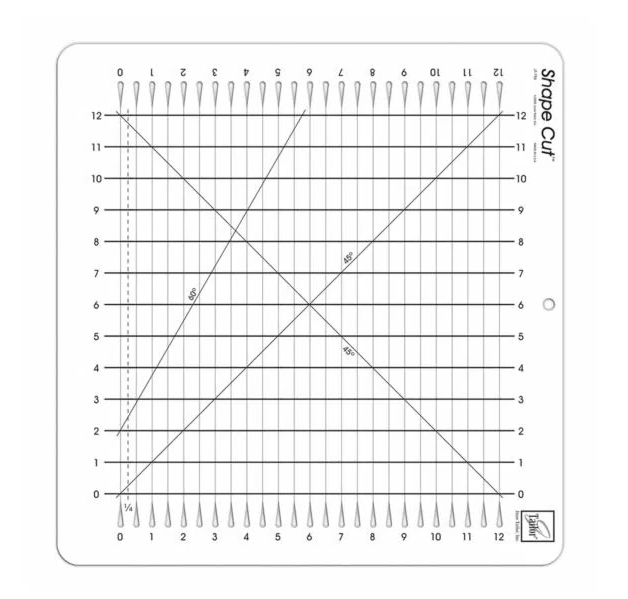
Product photo from AccuQuilt site showing 1/4″ line to the right of the 0 cutting slit.

You will essentially make two passes to cut strips in 1/4″ and 3/4″ increments. Same thing applies to sub-cutting into squares and rectangles.. All you have to do is follow the steps on the chart and cut where indicated on each pass. Make sure you are using the appropriate cutting chart for your version of the Shape Cut ruler.

Even with a manual die cutting system, I keep a Shape Cut ruler in my ruler inventory. It’s a handy size and easy to transport to classes/retreats. For small projects or those involving fat quarters, it’s often faster than getting out the Sizzix machine and corresponding AccuQuilt/Sizzix dies.

Tip: If you find you like using slit cut rulers, but want something more substantial like a traditional acrylic ruler, take a look at the Stripology products. They are a lot less “bendy” than the June Tailor versions. The ‘tweens at SQTM Summer Quilt Camp were much more confident with a rotary cutter when they used the Stripology (slit cut) ruler versus a regular quilting ruler.

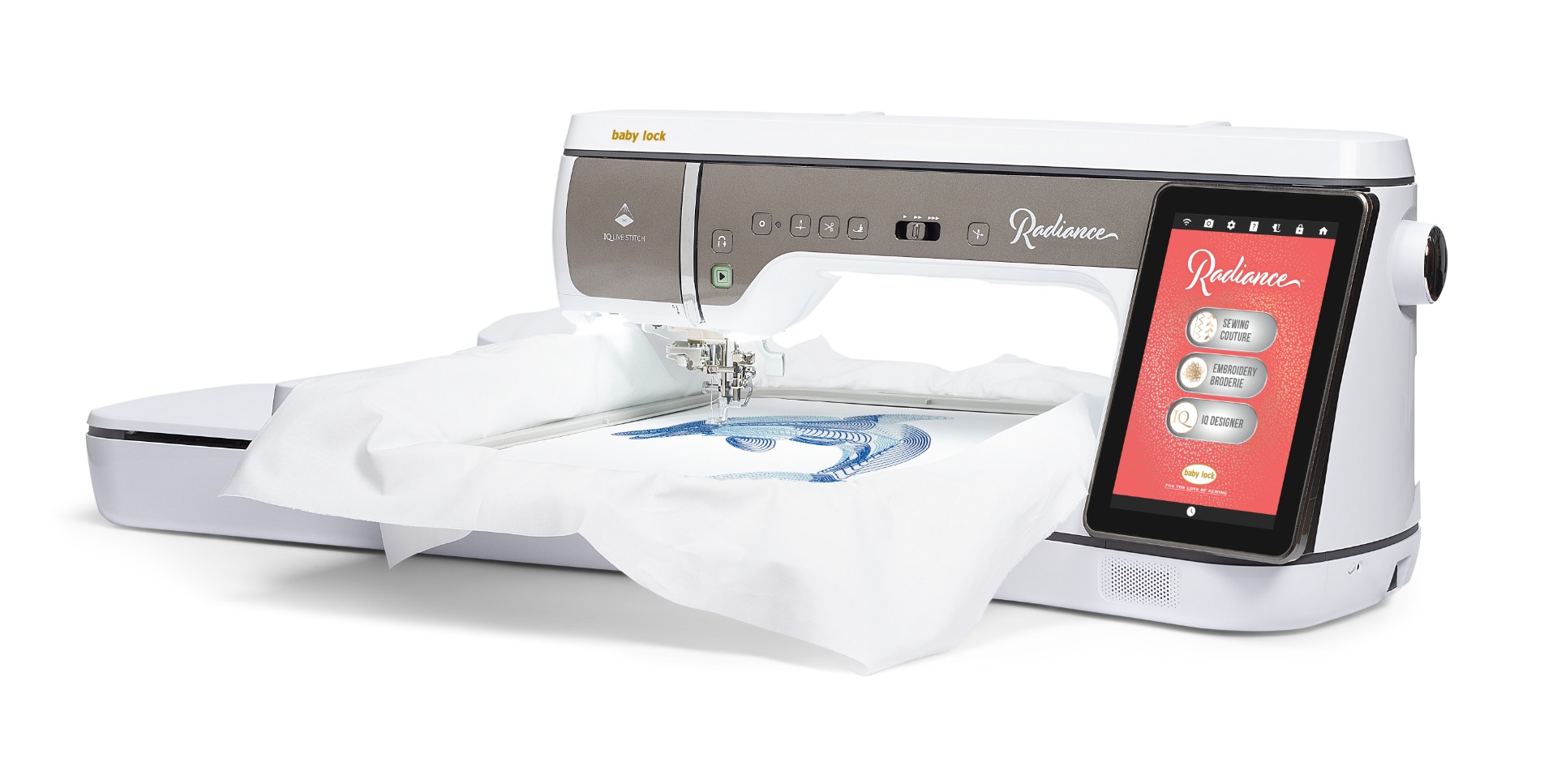
New TOL sewing machines – who’s buying?

Bernina, Brother and Baby Lock have recent launched new top-of-the-line sewing machines with price tags in the $20,000+ range.

When the new Bernina 990 came out, a local dealer required a $1000 deposit just to attend a launch party to decide whether or not you want to buy the machine. Retailers make a big deal all over social media on congratulating the “lucky” customers who purchase one of these machines. I’m curious – who are these customers? Cottage business owners? Retirees treating themselves? Sewists with a severe form of FOMO?

I personally know of only two people who’ve spent big $$ like this on a machine in the past two years. One friend with arthritis issues purchased a Janome M17 with the lift table to make sewing more comfortable for her. Another friend purchased a computerized HandiQuilter after her husband passed away, so she’d have a way to earn income from home. She now quilts for hire (and does a good job at reasonable prices).

Sadie’s (my Labradoodle) preferred local dealer is sitting on a good-sized inventory of sewing machines. During a recent visit, I toured the back room of the shop. We discussed the new Brother Aveneer and how well the new high end Janome machines were selling. The owner shared his thoughts that potential buyers already have a machine they bought during COVID lock downs. Inflation has definitely impacted customers who typically upgrade to a newer machine every 3 years. They are bringing in existing machines for service & repair versus buying new. (And yes, he has several rows of machines waiting for repair and/or pick-up.) This is what’s keeping his business afloat – not customers who can afford to drop $15-$20k on a sewing machine. Machines that sell are usually priced under $1000.00. In his opinion, sewing machine manufacturers are out of touch with the average customer. He suggested they concentrate on Incorporating more high end features in the mid-level machines rather than adding more bells and whistles to the upper end machines that few people can afford.

Said dealer and other Janome dealers in my area have lowered prices in-store to move inventory. The 9480 now includes a stitch regulator and is VERY attractively priced. The M8 is now only a little more than the 9480, but would require the purchase of a new cabinet because my existing cabinet is too small. I imagine prices will drop even more between now and next spring. So, I’ll continue to play the waiting game. My 8900 is working fine. Besides, other things like working a/c and property taxes have priority right now.

New Bernina 990 sewing machine
New Baby Lock Radiance sewing machine

Back to school time – will your kids be sewing this fall?

Hard to believe, but our local public schools start back later this week. Classes for my hybrid homeschool group resume 8/19 and I’ll be teaching “Travel Stories” – exploring maps & geography through picture books. I’ve had a lot of fun researching read-alouds and activities for this class. The number of students in each class will decide how many “craft” activities I can do with them. I’m hoping for a sewing unit with my 4th & 5th graders!

CraftLAB and private lessons resume in late August. Most of my students are now middle school age – which is great. They’re more independent and our projects are definitely driven by their interests. I do require a community service project – which is to make a pillowcase for Ryan’s Case for Smiles or a placemat for Meals on Wheels. My guild makes up the pillowcase kits and I provide materials for the placemats. If you are in Smyrna, Vinings, or NW Atlanta, you are invited to reach out about lessons. I have limited openings for students in third grade & up. After school sessions are available.

I’m on email lists for just about every fabric shop, quilt shop, sewing machine dealer and maker studio in the area. Not much has been advertised in the way of fall kid/teen classes just yet. Here’s what I have found:

  • If you’re in Loganville, Monroe or Watkinsville and homeschool, Sew Sew Studio in Bogart has a reasonably priced 6 session course available for homeschool students. Everything is included in the class fee.
  • If you live in the Suwanee and Duluth areas, several stitch schools have recently launched. Google “sewing classes Gwinnett” to find them.
  • For those closer in to the city, Fabricate Studios (Howell Mill Rd/Chattahoochee Industrial area) and Topstitch Sewing Studio (newly reopened in Decatur) also offer kid and teen classes at times to suit working families (after school and weekend classes).
  • If you live in Cobb County, the local library system offers free sewing classes at the Switzer and Northwest Regional library branches several times per year. These classes, designed for teens and adults, are led by volunteers from the American Sewing Guild and other experienced sewists. Feedback on classes offered through the library has been very positive.
  • Cottontail Quilts and Tiny Stitches offered youth sewing classes over the summer. The Stitcher School sponsored summer sewing camps at Covenant Church (located near Campbell Middle School). So far, I’ve not seen or heard about any plans for fall sewing classes.

There is one more option: if you have a sewing machine, rudimentary sewing knowledge and patience, you CAN teach your child (plus a friend or two) how to sew. Classes can be expensive. Classes can be offered at times that don’t work with your schedule. Classes may be too far to justify the drive in Atlanta’s notorious traffic.

Show your child how to use the machine. Start them stitching on notebook paper without thread in the machine (or search for free printable cute sewing practice pages online). Beginner projects like a pillowcase, pocket tissue holder, bookmark, drawstring bag or simple tote bag are confidence builders for newbie stitchers. A small investment of time spent researching tutorials/projects for kids on Pinterest and YouTube will be well worth it. The money you’ll save by teaching the basics can go toward your child taking more advanced classes to learn skills you’re not comfortable teaching or for attending sewing camps.