A new school year begins…

The 2025-26 school year kicked off in a number of metro Atlanta school districts today. I enjoyed scrolling through the first day of school pictures on FB while drinking my morning tea. For the first time in two decades, I no longer have a niece in school. The youngest graduated in May and she’s moving into the dorms at Georgia Tech next Sunday.

Personally, the month of August will be spent learning more about Adobe Illustrator and EQ8, experimenting with some sewing techniques and renting time on the longarm machine at Tiny Stitches. Yes, you can say I’m big supporter of lifetime learning!

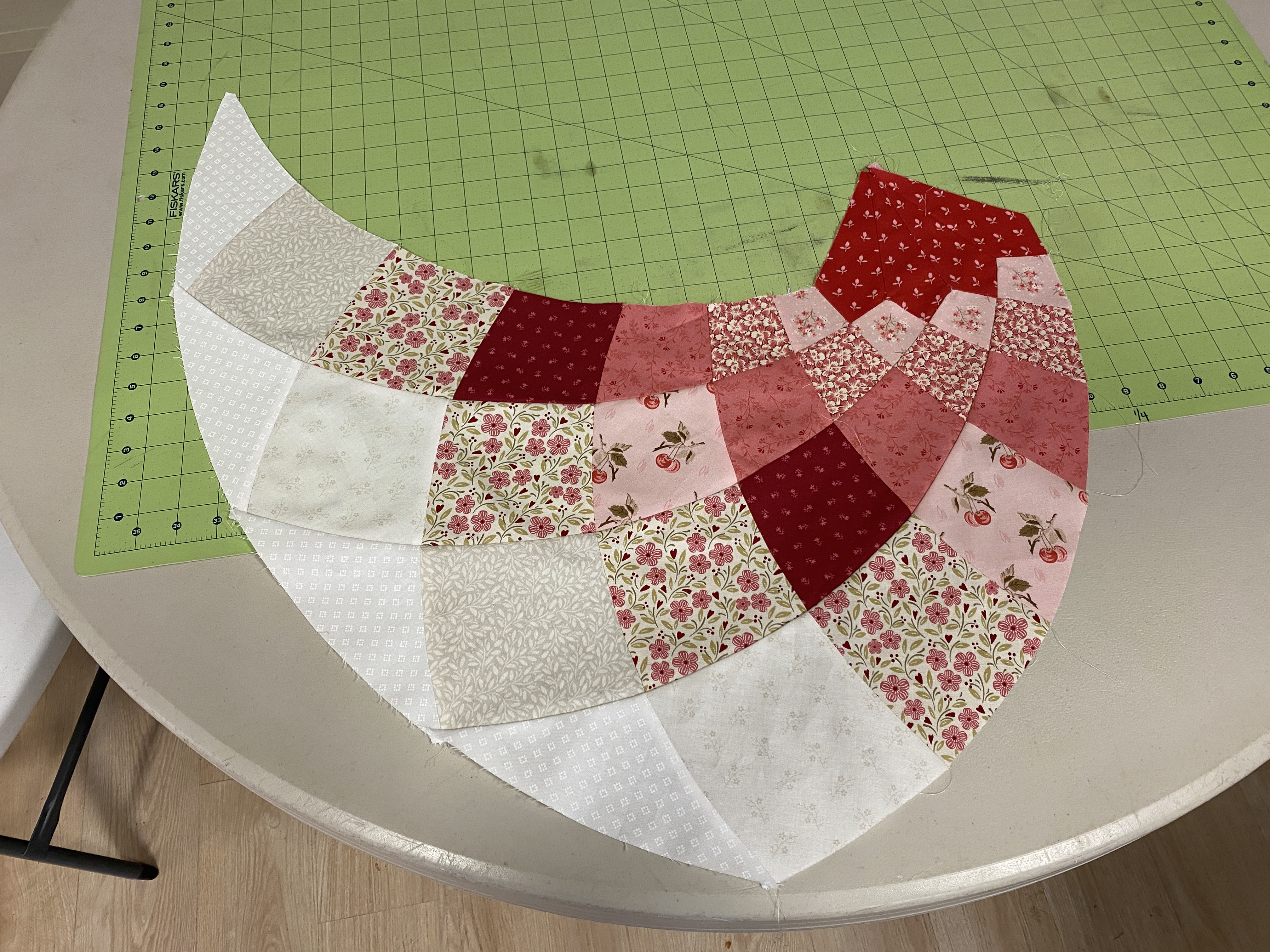
Using bits from my scrap bin to try a braid block pattern and binding with my new left bi-level foot.
One quarter of my Giant Dahlia quilt is complete – 7/26 ECQG class with Michelle Yeo from Australia

September brings a return to teaching classes and private lessons. Two fall classes are scheduled with the SQTM and I may teach a Saturday morning members-only machine maintenance workshop with my guild. I’ll also be partnering with a couple of local shops to host free Block Party workshops during school breaks so kids can come work on blocks to enter into next year’s quilt show. Preparations for the June 2026 show begin to ramp up with required monthly meetings of the entire Show Committee.

A return to school also means an uptick in therapy dog visit invites. Sadie is definitely ready to get back to work. We took six weeks off this summer from therapy dog activities. It was much needed. The public library READ visits are already scheduled, as are the usual visits with Georgia Tech. I’m waiting on the local elementary school where we did a weekly READ last year. It’s still in limbo. I’ll be bummed if it doesn’t continue; however, that’s outside my control. My friends to the north have plenty of visit opportunities available within my 30 minute drive window. That’s a good things.

Fair warning to those not familiar with ATL and back-to-school traffic. School is in session and traffic definitely heavier, but the real scary show comes after Labor Day. If you commute long distances to work, use the restroom before you leave. Bring a snack, a drink and some patience. You’ll need all three if you get stuck in bad traffic. Oh, you might also look into a Peach Pass, if applicable to your commute.
Be your own designer – start simple

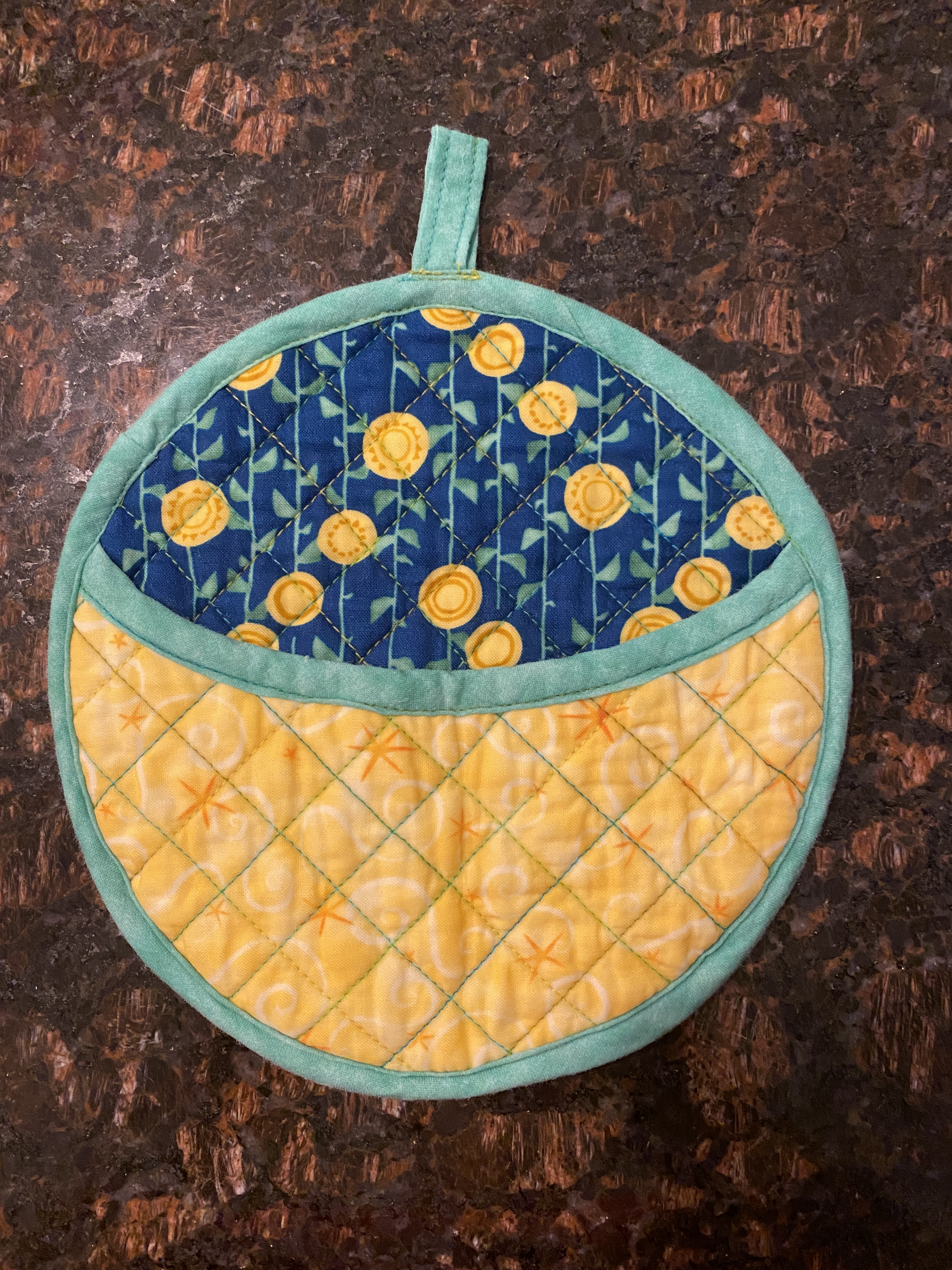
Round potholder – first attempt at using Adobe Illustrator to create pattern templates. Note to self – need to raise and soften curve of pocket piece.

My kitchen is in dire need of new potholders. Thanks to home and car insurance renewals this past month, I’m going to have DIY if I want new ones. I already have all the materials, including the heat resistant batting, in my sewing room. For inspiration, I headed to Pinterest. I kept seeing a really cute round potholder with a pocket and hanging loop. All of pins directed me to various blogposts, which in turn redirected me to purchase a pattern for $10.95. No thanks. I’ll try drafting my own. While I used Adobe Illustrator to create my 8″ circle and pocket piece, you do not need a computer to draft your own pattern templates.

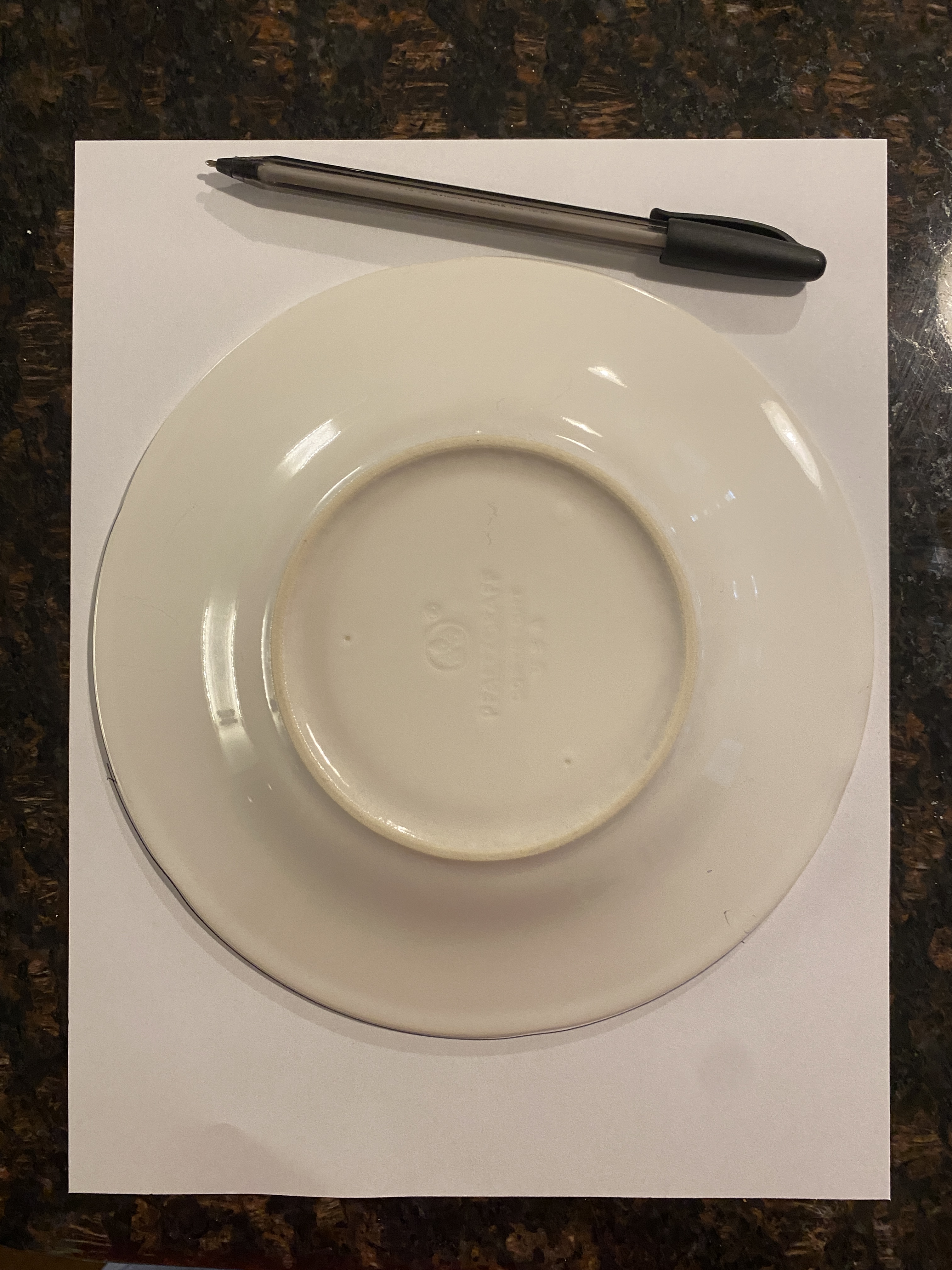
There’s an old-school, analog method for drafting your own patterns. It involves pen, paper, a ruler and usually something round. A round potholder is 8″ in diameter. Head to your kitchen: a luncheon plate is usually 8″ in diameter. Or try the lid to a large pot, a mid-size skillet or a 2-2.5 quart round casserole dish. Your lid can be a little under/over 8″.

You’ll need two circles – one circle per page. I traced around a luncheon plate to make my circles.

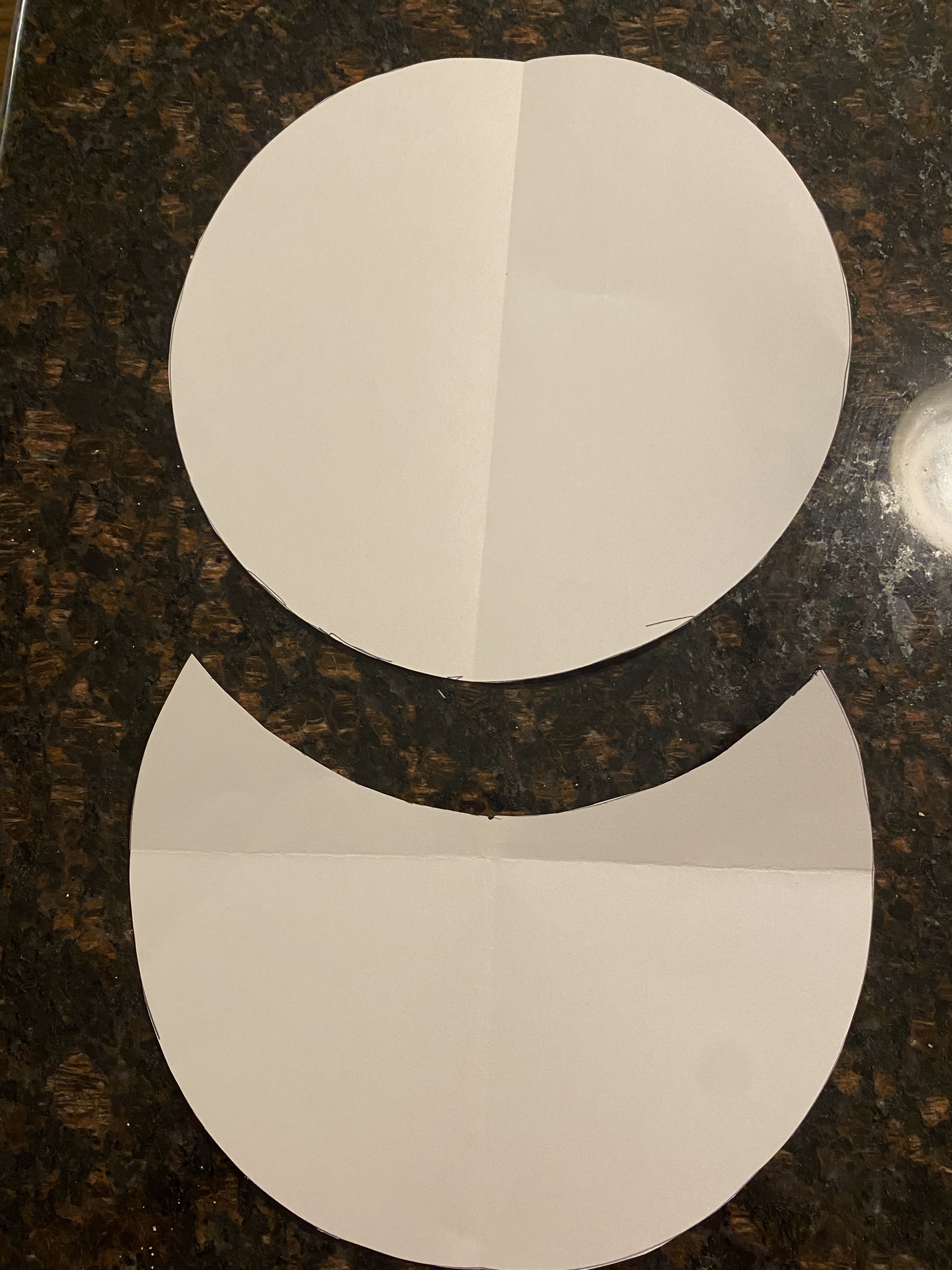
Cut out one of the circles. Leave the other circle intact (as a full-sheet of paper). Fold each circle in half lengthwise and make a crease along the fold.

On the full-sheet circle, place a ruler along the crease and make a mark approximately 4.5″ from the bottom. Place the cut circle on top of the full-sheet circle. Align both circles along the crease. Slide the cut circle up until the bottom of that circle meets the mark you made at the 4.5″ point on the other circle. Confirm that your creases are still aligned all the way to the top (fold down the top circle a bit to check). Trace the bottom of the circle to form the top arc of the moon shaped piece that will be the pocket template for your round potholder.

Cut out your moon shaped piece. You should now have two pattern templates.

What else do you need per potholder?

  • (4) 9-1/2″ squares of coordinating fabrics
  • (2) 9-1/2″ squares of Insul-Bright or Insul-Fleece
  • (2) 9-1/2″ squares of cotton batting
  • (1) 2-1/2 x 5-1/2″ strip for hanging loop (optional)
  • Approximately 45″ of 2-1/2″ bias binding

Basic construction notes:
a) Make 2 quilt sandwiches – one for the main body and one for the pocket. Include a piece of Insul-Bright/Insul-Fleece and a piece of cotton batting in each sandwich. Quilt as desired – a 1″ grid is commonly used in kitchen textiles.
b) Cut out the body and pocket pieces using the templates you drafted.
c) Add binding to curve of pocket piece using your preferred method.
d) Place pocket piece on top of body, align and baste in place.
e) Make hanging loop, fold in half and baste in place at center top on front or back of potholder.
f) Attach bias binding back to front and sew down – this video will be VERY helpful.
g) Flip up the hanging loop and stitch in place to secure (optional).

Here’s a helpful tutorial for an oval shaped potholder, but it’s essentially the same as for a round potholder with a pocket.

Helpful hints:
– Use a longer stitch length (3.5 mm) when quilting and topstitching.
– A left bi-level foot (or quilt binding foot) will help keep topstitching uniform when applying binding back to front.
– If the binding has a difficult time turning to the front and providing enough coverage, try grading the seam allowance along where the pocket and body are sewn together.

Live life on your own terms

You only have one life. Live it to the fullest. Stop trying to meet other people’s expectations at the expense of your own peace. It’s not sustainable. Quit worrying what other people think. The only person you need to answer to is yourself. Did you do your best? Are you happy/satisfied? Did you leave things a little better than you found them today? For me, this is what truly matters.

We’re encouraged to “do our thing” while various well-meaning folks proceed to tell us what they think we should be doing instead. It’s a no-win situation with these people. The best way I’ve found to deal with it is to limit any information shared, maintain a healthy distance and keep on doing my thing.

My retirement “thing” is constantly evolving. Therapy dog work and quilting are still the main activities, but they, too, have changed over the past 3 years. I truly enjoy the read to a dog program that finally got established at Park Street School earlier this year. Sadie definitely thrives on having 1-2 visits per week. Should the school-based READ program suddenly go away (not expecting it to, but things can change on a dime), there are plenty of other visit opportunities available. As next summer’s big quilt show gets closer, my involvement as a committee chair will certainly increase. I’m in the midst of planning those activities now. Rest assured, I’m engaged, learning new things and doing what I love to do.

Mid-August brings a return to therapy dog activities, new private sewing students and classes at the SQTM. I’ve had two referrals about memory quilts in recent weeks. Spent some time today running the numbers to see what services I could offer that make cents for me. 3 sizes: baby, lap or throw. 3 pattern choices: grid, mosaic or stacked columns. 3 FMQ designs: puzzle meander, loopy meander or boxy meander. Binding sewn by machine. Lots of infant items = extra charge. Personalization w/applique or embroidery = extra charge. By concentrating on smaller size quilts that work with my studio space and equipment, I can be competitive and profitable – at least on paper anyway. We’ll see what happens.

Photo by Brett Jordan on Pexels.com