Fall vibes

Cool, crisp fall days are upon us. It’s my absolute favorite time of year! This afternoon, I spent time piecing blocks on Fiona, my white Singer Featherweight. I had the windows open and smooth jazz on the playlist. It was glorious!

Fiona is a special machine. Like many FW enthusiasts, I wanted a machine that was manufactured the year I was born. I was fortunate to find a celery/white FW in extremely good cosmetic condition. Mechanically, she had more than a few quirks. Learning to address those issues taught me a lot! Now, she sews as beautifully as she looks.

On Friday, I was tasked with servicing a 1938 Featherweight that one of my Friday Sew Squad had purchased from a casual visitor to the library’s quilting group. It was untested, but the seller assured my friend that it had worked prior to being packed away for at least 10 years. Yep, she was right about it being packed away for at least a decade. The machine had been sitting in the case so long that the lug belt disintegrated. The tiny, rubbery bits literally superglued themselves to the motor pulley. I had to soak the hardened mass in sewing machine oil and remove it bit by bit. The rest of the machine was in decent shape – oil, lube and a good wipe down were the main things she needed.

I suspect tension issues are what caused the machine to be packed away. This old girl may have a 1938 chassis, but she also sported a number of parts from newer machines – chiefly, the motor, bobbin winder and tension assembly. Someone had installed the parts to the upper tension assembly in the wrong order. I fixed that. Still had issues with the tension. Tried a different bobbin case. Problem solved.

My next task will be to disassemble and clean the original bobbin case. I’ve never done this before, but something seemed off on the bobbin case latch. I ordered a new tension screw and bobbin case spring just in case. Fun bit of trivia: a business card in the FW accessory box was from a quilt shop in south Georgia that has long since closed. Put it this way – the web address listed on the business card was a page hosted on Compuserve. It’s been a while.

Tinkering on Featherweights and teaching machine maintenance classes make me happy. My “shade tree” sewing machine mechanic activities now account for about 20% of my business revenue. I think that’s kind of cool.

Why take a sewing machine maintenance class?

  1. Sense of empowerment gained from learning how properly maintain the machine.
  2. A more pleasant sewing experience because the machine is well-maintained.
  3. Confidently troubleshoot and resolve common mishaps as they occur.
  4. Extend the time between professional service appointments.
  5. Save money.

There’s a shortage of qualified sewing machine repair technicians. Long-time sewing machine folks are retiring and no one is waiting in the wings to take offer that service. Customers now must travel farther and pay greater fees to have their machines serviced.

Sewing machine service in my area is $125.00+ for a basic clean, oil and lube. The good sewing machine service shops are backed up and not currently taking any in more machines in for repair and service. Given that 90% of machine issues are related to dust bunnies, improper threading and bad needles, it never hurts to try a few things first before automatically assuming you must take your machine in for repair.

Basic troubleshooting steps:

  1. Unthread and rethread the top thread with the presser foot up. Test sew. Repeat for bobbin.
  2. Check presser foot to make sure it’s the right foot and installed correctly. Tighten screw as needed.
  3. Check to see that needle is inserted correctly. Bent needle? Change the needle.
  4. Clean out the dust bunnies underneath and give it a drop of oil.
  5. Check bobbin winder to make sure it’s not accidentally engaged.

The previous steps should get you up and running again. If not, do a machine reset.

Computerized models: turn off machine, wait 5 minutes and turn back on.
Mechanical machines: turn stitch selector to straight stitch, length 2.5. Make sure tension dial is 3.5-4

Still no resolution? Refer to the back of your sewing machine manual. That’s where you’ll find additional troubleshooting steps and error codes specific to your machine.

Never apologize for your sewing machine

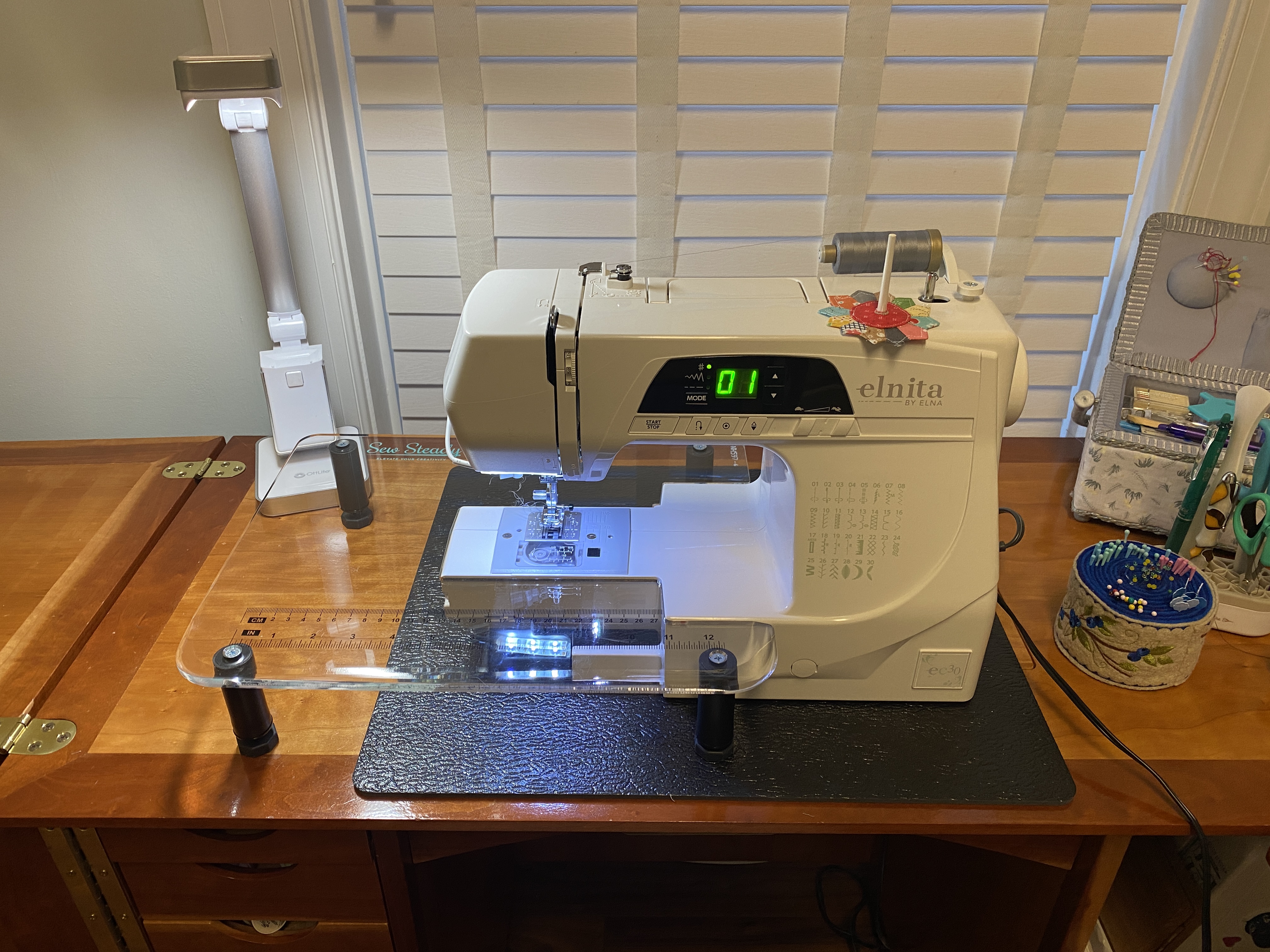
Yesterday, my guild hosted a charity sew day. There were several new faces at this event. One person set up her machine next to my friend and me. While we were chatting, the newcomer apologized for her sewing machine. She said it wasn’t fancy like others she’d seen in the room, but she liked it. Her particular model of machine (a computerized Brother machine that retails for $250.00 at Wal-Mart) is one I often see at retreats and in classes I teach – not much different from my Elnita EC30 or my friend’s Janome 740. I assured her that her opinion of her sewing machine was the only one that mattered.

Our conversation brought back memories of when I first joined a sewing group. I had a mechanical Kenmore 30 stitch machine that I loved. I walked into a room of ladies with expensive Pfaff, Viking and Bernina machines. I knew exactly how she felt. A kind lady noticed my discomfort and told me that it’s what I can do with the sewing machine that counts, not the brand of sewing machine. That’s always stuck with me.

I scanned the sewing machines in our room. Yes, there were a couple of Berninas and high-end machines at the event – including an aqua Kaffe edition Bernina 475 (retail $2,999). Most attendees had brought either a vintage machine or a small modern machine that probably cost less than $450.00. This is typical of what you’ll find at classes, retreats and sew days. The travel machine might be grandma’s Singer Featherweight, their very first sewing machine or the $100.00 big box store special they had to buy to finish a project because their main machine had a hissy fit. A straight stitch only machine is usually fine unless you are taking an appliqué or decorative stitching class. This is why so many quilters have a Singer Featherweight or a 301 as their travel machine.

Remember, it’s what you do with the sewing machine that counts – not the label on your sewing machine. Chances are, the serious stitchers with the vintage and budget friendly machines at the retreat have an upper tier sewing machine or longarm at home. (As did our newcomer with her Brother machine – she had recently purchased a long-arm.)

A budget-friendly Elnita EC30 sewing machine that is my go-to machine for classes.