Label your quilts!

Label from a recently finished quilt

Yes, this is the label from the quilt referenced in two recent posts. The red you see was added with editing software to preserve my niece’s privacy. The original label was created using printable fabric sheets and my ink-jet printer. I like to use the free templates available from June Tailor/AccuQuilt as a starting point to create most of my labels. Now that AccuQuilt owns June Tailor, the templates may be found at the bottom of the Iron On Quilt Label product page (see bottom of screenshot below) rather than on the support page.

What info to include on your label? The Quilt Alliance has information about documenting your quilt and hints on making quilt labels. Simple or fancy? That’s up to you. Here’s a video that you may also find helpful.

Personally, I like to “name” the quilts I make. I also include the recipient’s name, quilt pattern name/designer, and the names of folks who helped make the quilt. I make sure to include city, state and month/year the quilt was finished. Depending on the recipient, I may include a photo of the quilt, cute graphic, quotes, or special notes about items used in making the quilt (silk ties, baby clothes, fiber content – wool, silk or bamboo batting, etc.). Recipients have told me they appreciate having care instructions on the quilt label. I like being able to customize care instructions for each quilt.

For this specific label, my sister-in-law got as far as she could before her advanced stage cancer left her too weak to continue. An extended family member was able to help me figure out when she last worked on it. I received the quilt bundle on Father’s Day. The quilt was finished and shipped to my niece yesterday (less than two weeks from receipt!). My niece approved the mock-up of the label and mentioned that she really appreciated the detail I was able to provide on the label.

Fifty years from now, my niece’s daughters will have documentation of the quilt’s history.

The Joy of Solo Quilty Travel

My favorite type of quilty travel happened this week – an event with classes, shopportunity and pretty quilts to see – Mountain QuiltFest in Pigeon Forge, Tennessee. It’s a regional quilt show that attracts national teaching faculty. I really like the work of two west-coast based instructors teaching this year, so I took advantage of the opportunity to take classes with them close to home.

At least one solo quilty adventure each year seems to be the norm for me since retirement. It’s a time to focus exclusively on quilting and whatever else I want to do. Outside of classes and viewing the quilts, I can be as social as I choose to be. This year included a dinner event with Edyta Sitar (where I ran into four members from my quilt guild who’d come up to get quilt appraisals and check out potential instructors for the guild to bring to ATL in 2026 and 2027). There was also an evening show & tell, antique quilt lectures and a local quilt tour. Severe thunderstorms arrived just as my final class ended. I took myself out to dinner at a local Italian restaurant and spent the stormy evening stitching in my hotel room.

Classes with Edyta Sitar and Krista Moser were wonderful. I completed all the log cabin blocks in the Pioneer Log Cabin class with Mrs. Sitar. I even won one of her autographed books as a door prize!

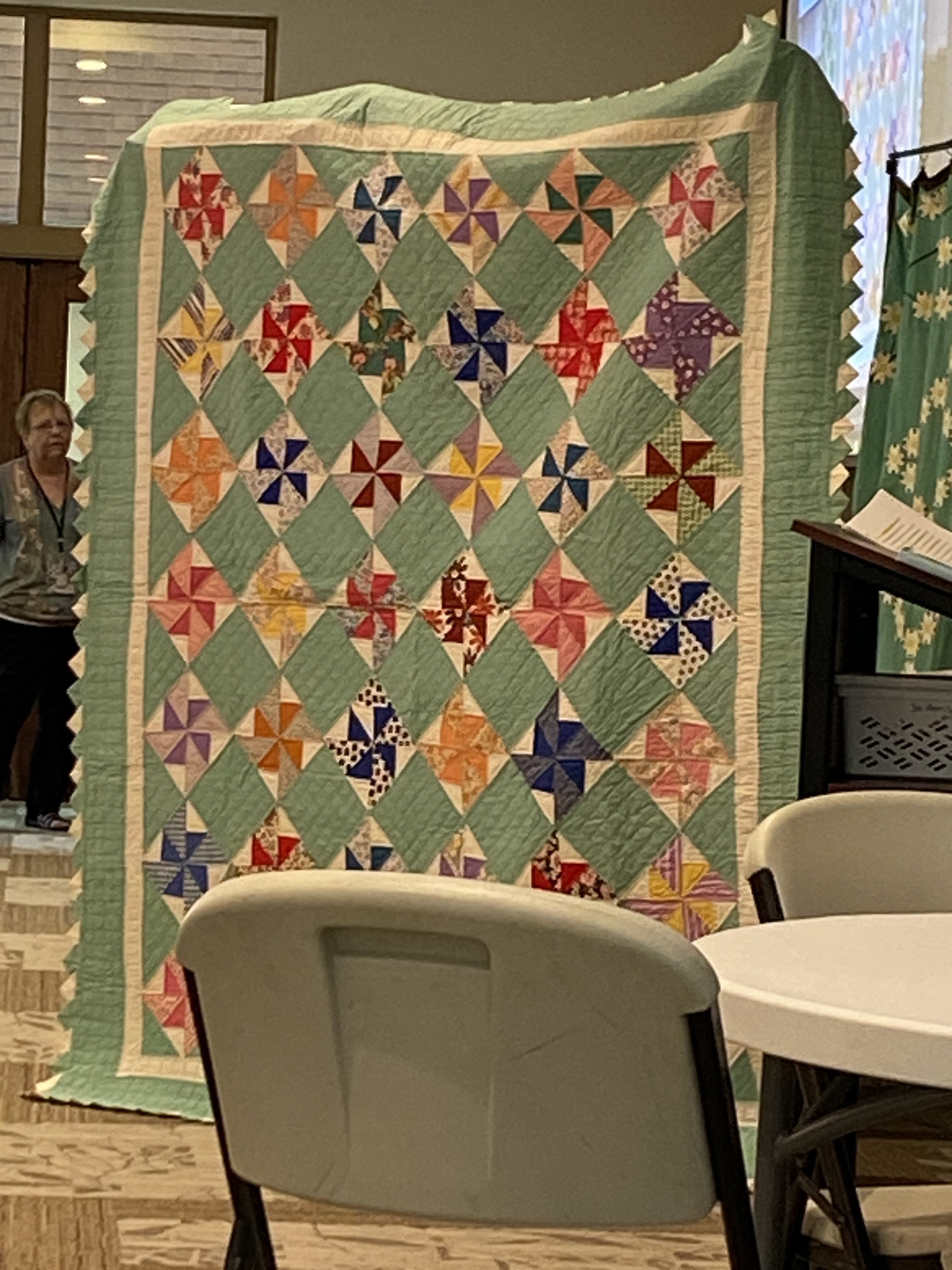
For Krisa Moser’s class, once I understood the preparation and process for handling diamonds and pieced equilateral triangles, block assembly went quickly. The goal was for each student to complete at least 3 blocks by the end of class. She demonstrated how to assemble the quilt top by using all of the student blocks as her example. Here’s a sample Vintage Windmill layout utilizing blocks from 17 students:

Here’s one of my blocks:

I completed the required 3 blocks in class. The rest of the time was spent cutting diamonds from my pre-cut strips and assembling strip sets/cutting equilateral triangles for each hexie block. Next week will be spent getting the rest of the diamonds cut out and the pieced triangles made (12 required for each block).

Everyone I met in classes and in the show area was raving about how good this year’s event was. I concur. It was definitely the right call to attend this event in lieu of some other events I typically do this time of year. A return in 2026 depends how it works with my guild’s big quilt show to be held June 4-6, 2026.

Random stuff:
My stay at the Best Western Plus Apple Valley Lodge on the Parkway was comfortable and convenient. Tips: Request a non-balcony room on an upper floor if you like maximum quiet and privacy. The parking garage exits to a street that runs behind the property. Go two blocks over toward the Hampton Inn. There’s a traffic signal that will make left turns much easier. Traffic on the Parkway can be a nightmare. My plan is to stay at a hotel closer to the LeConte Center next time.

Learn new things

My second attempt at creating an SVG file. Thinned the cut line to .25 and 3rd time was perfect (no excess left on the mat)

This week I did two things on my retirement “to-do” list.

Learn how to create an SVG file from a paper pattern/template. My guild makes little teddies for the local children’s hospital. I knew this was something that I could do faster on my Cricut if I had an SVG file. No one in the guild had created one. Perfect project while waiting on the HVAC company to service and repair our a/c units on Tuesday. It took three tries and a few choice words, but I now have a SVG file that works and takes less than 2 minutes to cut both parts of the teddy bear.

Take a longarm certification class from a local quilt shop. Said shop is the only one in the area that allows folks to rent time on their longarm machines. A four-hour “certification” class is required prior to renting time. I spent 4 hours standing on a concrete floor while the instructor lectured about proper quilt preparation and introduced us to the different machines. Three of the students already had longarm machines at home, so the instructor geared most of the class towards them. I got about 20 minutes of hands-on time total across all 3 machines. I was a little disappointed, but with the way the rental process works, the instructor (or another employee) will actually load the quilt and set everything up for me. All I’ll do is hand guided E2E quilting following a pantograph. We are not allowed to use the Pro Stitcher (boo-hiss!) It’s very different guiding a 40-60 pound longarm machine head versus moving the quilt to FMQ on my domestic machine.

E2E meander following a pantograph using a HandiQuilter Amara 20 longarm machine.

I did learn 3 things: (1) A stitch regulator is a game changer for me, (2) I do not want my own longarm and (3) I’ll still be quilting by checkbook for specialty computerized quilting designs and really large quilts.

After yesterday, my personal preference is still for a sit-down machine where I maneuver the quilt. The photo above shows improved stitching after only 20 minutes, so I’m not going to rule out getting used to a long-arm. The benefits of using a longarm include a much faster turnaround time and no need to baste the quilt.

I’ll buy a block of 10 hours machine rental time and what happens. If nothing else, I should be able to finish 5-7 lap size quilts in that amount of time. At the going rate of 2.5 cents per square inch, it would cost me $75-$100 per quilt to send each one out. That’s $375-$750 versus $180 for a block of 10 hours.

And I have a stack of quilt tops needing to get finished.