Projects made from my fabric stash

Stitchin’ Heaven New Year’s Day QAL Blocks 1 & 2 made from fabrics in my patriotic bin
Curvy, lined zipper pouch for class sample. Pattern drafted by me using Boxed Bag template by Carolina Moore.
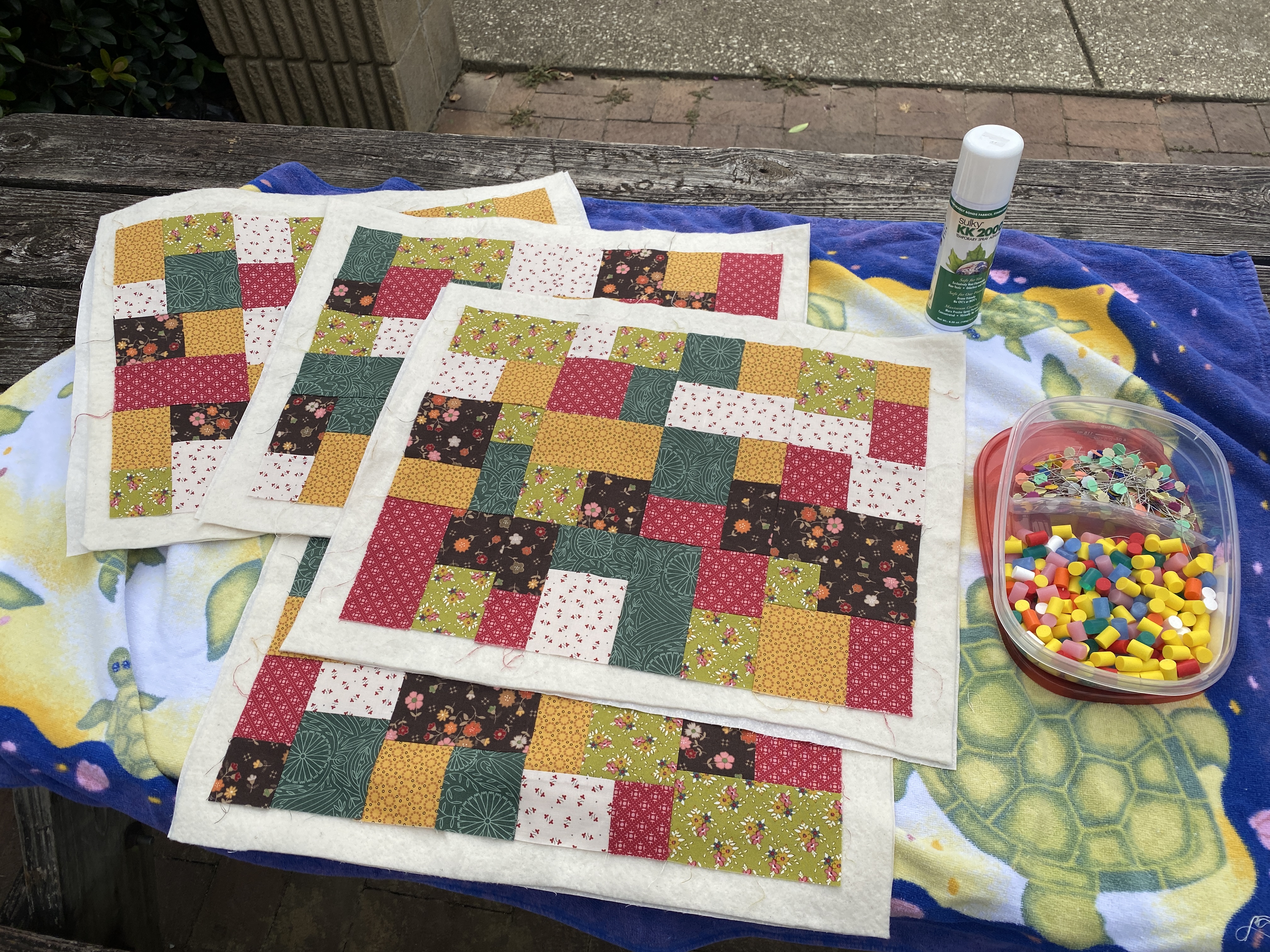
Placemats using Mini Yellow Brick Road pattern (basting outside at the library during Sew Day)

What do you do with leftovers from previous quilt projects?
How about using them in new projects? It doesn’t have to be an entire quilt.
1. Make mug rugs, pot holders, placemats, table runners, journal covers, pillow covers or zipper pouches.
2. Use the larger leftover bits make quilt sandwiches for FMQ practice.
3. Use some of the smaller leftover bits to make a practice blocks to try out new patterns before cutting into your project fabric.

How to store your scrap and leftover fabrics?
Your system can be as decorative and elaborate as you wish. Personally, I prefer simple. I keep small bits and partial strips in a pretty basket. Random 5″ and 10″ squares are kept with my charm packs and layer cakes. Cut strips that are WOF are stored with my jelly rolls. Larger chunks are stored by color with FQs and yardage. Novelty, dog and patriotic theme fabrics are kept separately.

Periodically, I will go through my scrap bin and cut the leftover jagged pieces into 2-1/2″, 3-1/2″ and 4-1/2″ squares. The smallest size kept is 1-1/2″ strips and I’ll cut 1-1/2″ squares from them as needed because they tend to get lost in the scrap bin.

With the current Bonnie Hunter Winter Mystery quilt, I’ve made good use of random charm squares, forgotten FQs, white/cream hunks leftover from previous quilt tops, and turning all the leftover triangles from trimming stitch & flip units into 1-3/4″ HSTs.

The key to managing your fabric scraps is to organize them, then actually use them.
Quilting through the holidays

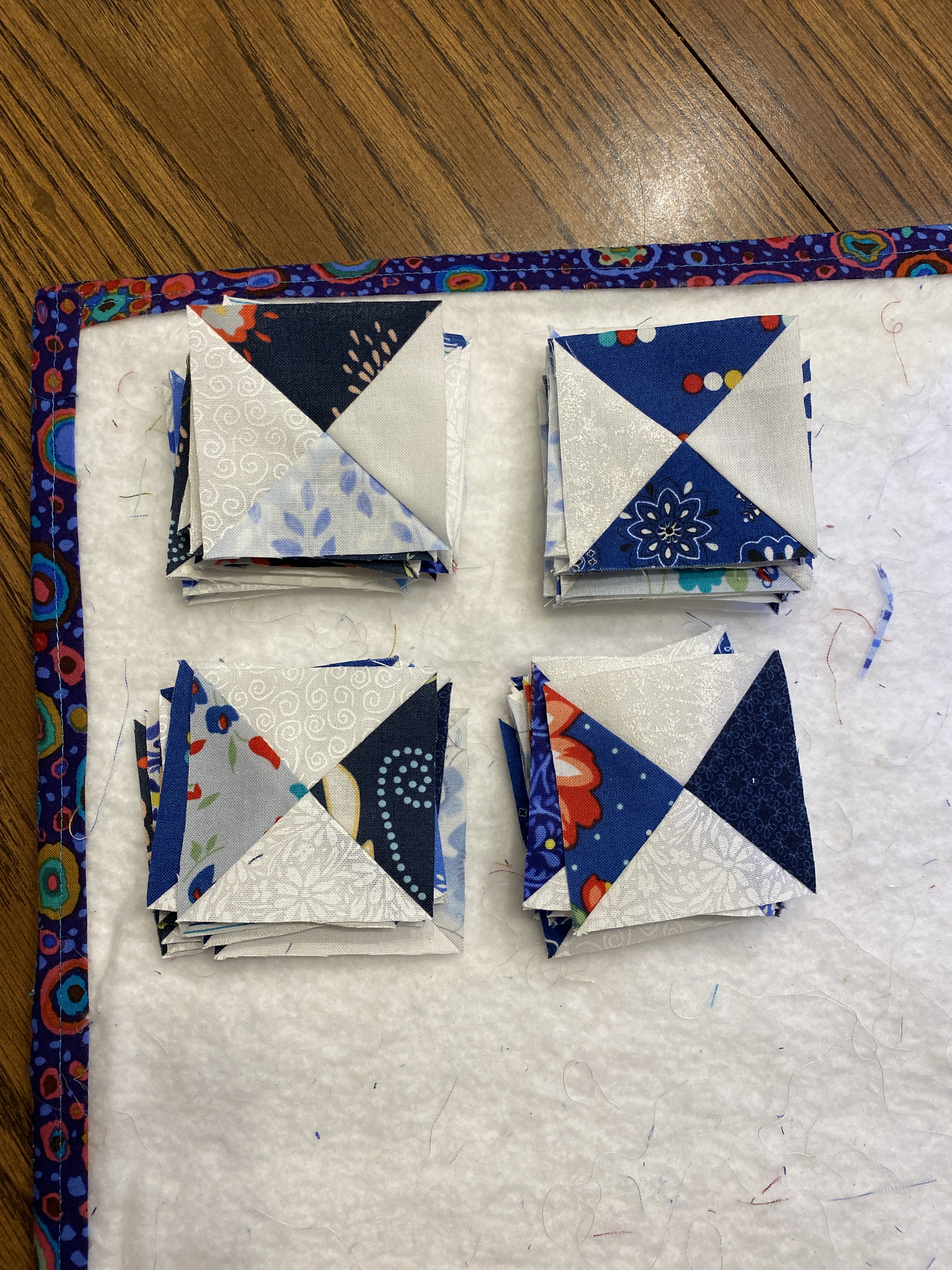
Stacks of Hourglass Quilt Blocks – Week 3 of the Bonnie Hunter Old Town Mystery Quilt

I’m tired. No wonder. I’ve made about 400 little bits in total for this quilt over the past two weeks. I’m all caught up and I’ve successfully figured out how to cut QSTs for the hourglass blocks using Bonnie’s Essential Triangle Ruler. Minimal unstitching and everything turned out the correct size, with only a tiny bit needing to be trimmed away. Last time, I used my Featherweight and the blocks turned out too small. This time, I used my Elnita EC30. Having the ability to adjust the needle position made all the difference for me.

I’m thankful that Bonnie Hunter offers a mystery quilt along during the Christmas season. This is my first time participating in one of her annual mystery quilts. The project has helped keep me engaged and in relatively good spirits during what can be a hard time of year. Family drama isn’t pleasant – especially when it causes a rift among family members on my side. Five years later, I will say the peace that comes with not having to deal with certain folks during the holidays is a gift in itself. This year, there are signs that some of the younger family members as they reach adulthood are interested in rekindling the familial relationship. This is welcome news.

The next two weeks will be a flurry of activity, but Christmas will be spent at home with hubs and Sadie. Christmas and New Year’s fall mid-week, so I’ll be able to stitch with some of my Friday Sew Squad at the library between Christmas and New Year’s. Are you joining the Stitchin’ Heaven crew on New Year’s Day? I’m with Team Rob and have already pulled my bin of red, white and blue fabrics. It’s a fun day and you don’t have to complete the quilt unless you want to. Last year, I made a handful of blocks, which became placemats to donate to Meals on Wheels. Placemats in patriotic colors are always welcomed by the staff.

Oh, and I’ll be working on the Bonnie Hunter Mystery Quilt until it ends in January.

Cutting Quarter Square Triangles

There are many ways to cut QSTs. In this case, I wanted to cut my QSTs from leftover strips – like Bonnie Hunter does – without having to buy another ruler. QST math formula is finished size of block + 1-1/4″ equals the size square to cut. You then cut on both diagonals to yield 4 QSTs. I did just that and compared one of the QSTs to every ruler I had. I’m sure there a mathematical formula to figure out this out, but it’s Saturday and I didn’t feel like mathing that hard on the weekend.

A QST has a 90 degree angle at the peak. If you have a companion angle ruler, you could give that a try. I do not have one of those, but my Clearly Slotted Trimmers Ruler B (even numbers) provided the solution. The original strip was cut at 1-1/2″ and the hourglass blocks finish at 2″. If you see the comparison with the QST sample I cut, the 2-1/2″ line is where I need to align the ruler with the bottom of the strip to cut the correct size QST. The little bit (point) at the top that’s missing is okay, because the hourglass unit will end up slightly oversized and need to be trimmed to 2-1/2″. I cut full sides on the legs of the triangle – not cutting off the dog ears as I would for a regular HST.

My preferred trim down tool for hourglass blocks is my Tucker Trimmer from Studio 180 Designs. As you can see, the end result after trimming is a perfect 2-1/2″ hourglass block waiting to be sewn into a project. Now to make a few dozen more. The bonus: I used up short strips of fabric I would have otherwise thrown out.

Challenge yourself to figure out solutions using what you have on hand.