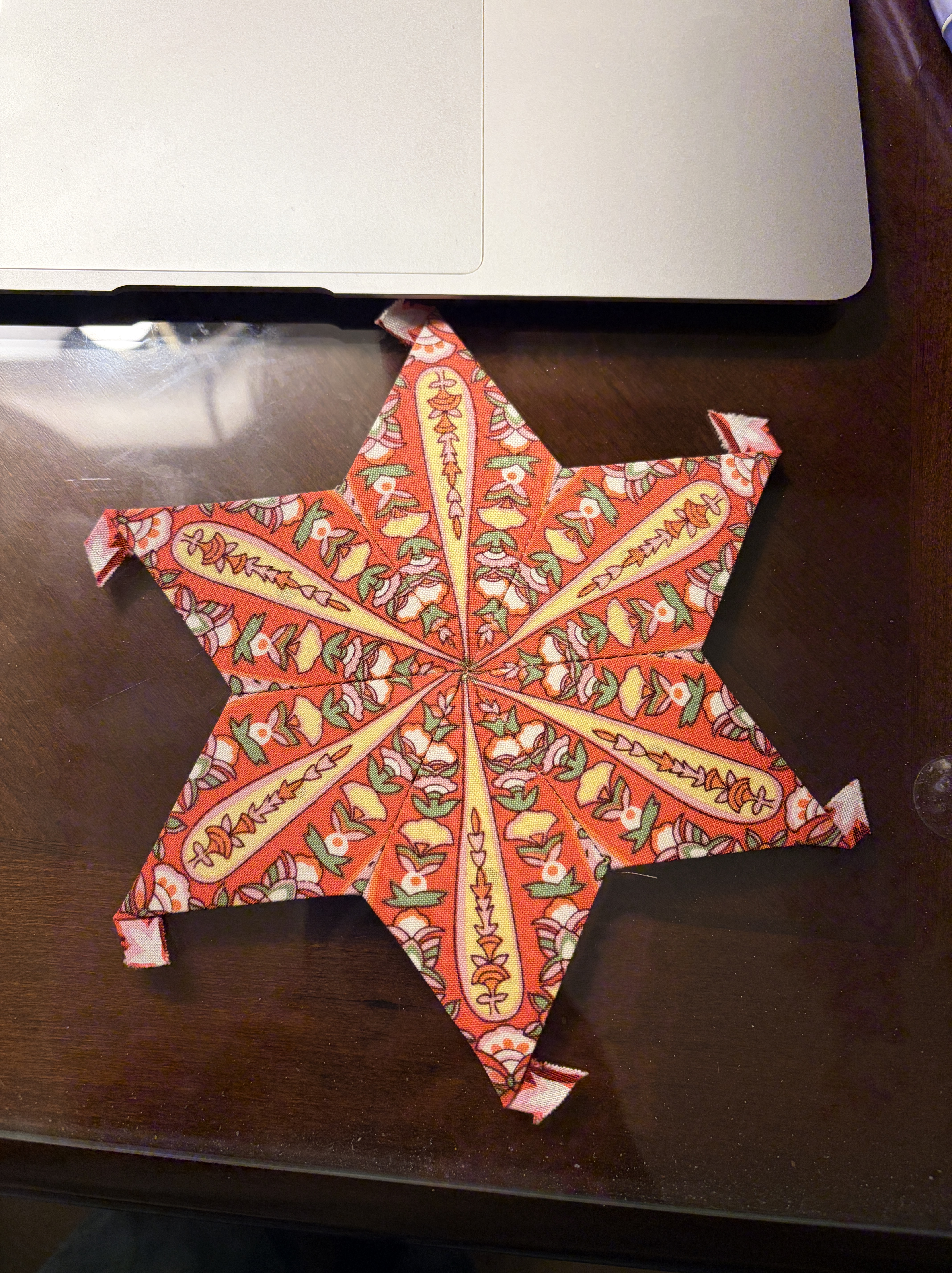
Design boards are essentially a hand-held version of a design wall. I first learned about design boards at a retreat with Lori Holt back in 2019. We actually made our own design boards as one of the retreat projects. For quilters, they are great for holding bits and pieces of blocks or smaller projects. Ready-made design boards in a variety of sizes are available through Riley Blake Designs. Retail prices range from around $15 to $30 per design board.
You can DIY multiple designs boards for the cost of a single ready-made one. Basic supplies needed: a piece of foam core board, scrap batting and a couple of jelly roll strips. You will need either a glue gun or Heat & Bond Ultra (in the red package) with a mini iron to affix the border trim.
I prefer to make my design boards using self-adhesive foam core board (I find it at Hobby Lobby), felt and the Heat & Bond Ultra (on the roll) method. Note: a glue gun will still come in handy to hold the mitered corners in place. If I can’t find self-adhesive foam core board, I’ll use spray baste to hold the batting/felt in place.
Foam core board can be found in the school supply section at Dollar Tree, Wal-Mart, Office Depot, Hobby Lobby and Michael’s. It usually comes in a 20″ x 30″ sheet and quality can vary, so compare before you buy. I cut mine to the desired size using a 60mm rotary cutter. Personally, I like an 18″ to 20″ square board for larger quilt blocks and a 10″ to 12″ square board for smaller quilt blocks. And yes, I have been known to Frankenbatt leftover pieces of foam core board to make one more design board.
Design board made from leftover foam core board pieces (taped together with painter’s tape).
Over the past year, I’ve noticed my personal sewing space at quilt retreats and classes shrinking. Shared space seems to be the new normal rather than having a table all to yourself. Before packing, contact the event organizer and ask about the amount of sewing space allotted per participant. Do you get a 6′-8′ table all to yourself or do you have to share with another person? If shared, are you side-by-side or offset on opposite sides of the table? (Psst, offset & opposite gives me more room to work).
My set-up in about 36″ of workspace at a quilt retreat. At a retreat with an entire table to myself – a wonderful experience!
Ways to deal with tight sewing spaces:
(1) Bring a smaller sewing machine. Leave the 30″ wide Baby Lock Allegro at home. Most sewing machines with up to an 8″ throat space should work in a 3-4 foot workspace. If you plan to take a sewing machine on an airplane, make sure it fits in a case that can go under the seat in front of you. While you may not experience issues getting overhead bin space, planning ahead might avoid the dreaded “gate check” on full flights (especially if you are in a later boarding group). Airlines are typically not responsible for any damage that may occur in a gate checked situation. Alternatives: Ask about machine rental. Have your machine professionally packed to ride in the cargo hold or ship it ahead of time.
Travelpro Maxlite 5 underseat rolling tote with my sewing machine ready to fly to a retreat.
My travel machine of choice is an Elnita EC30. In the past, I took a 3/4 size Elna STAR edition (similar to the Janome Jem 720). It’s a great choice for retreats & classes; however – for me – the Elnita EC30 offers more features, prettier stitches, sews faster and also fits in the same Travelpro rolling case. There are several other machines that fit this smaller size footprint (machine width less than 15.25″) from the vintage Singer Featherweight to the mechanical Janome Signature Charm at Wal-Mart to the new computerized Bernina 325/335. Pick what works best for your needs, preferences and budget.
(2) Cull your presser feet. Do you really want to schlep ALL your presser feet to a retreat or class – especially if you are flying? Not me.
Based on my experience, the following presser feet should have you covered in most scenarios*:
Presser Foot
Description
All purpose/zigzag foot
Versatile and useful for various stitches.
1/4″ foot with guide
Ideal for accurate seam allowances.
Open toe foot
Great for visibility while sewing.
Zipper foot
Specifically designed for inserting zippers.
Walking foot with guides
Helps feed multiple layers evenly.
*Always check your project directions/retreat instructions to make sure you pack any specialty presser feet required. Occasionally, you need an edgestitch foot, darning/FMQ foot or buttonhole foot.
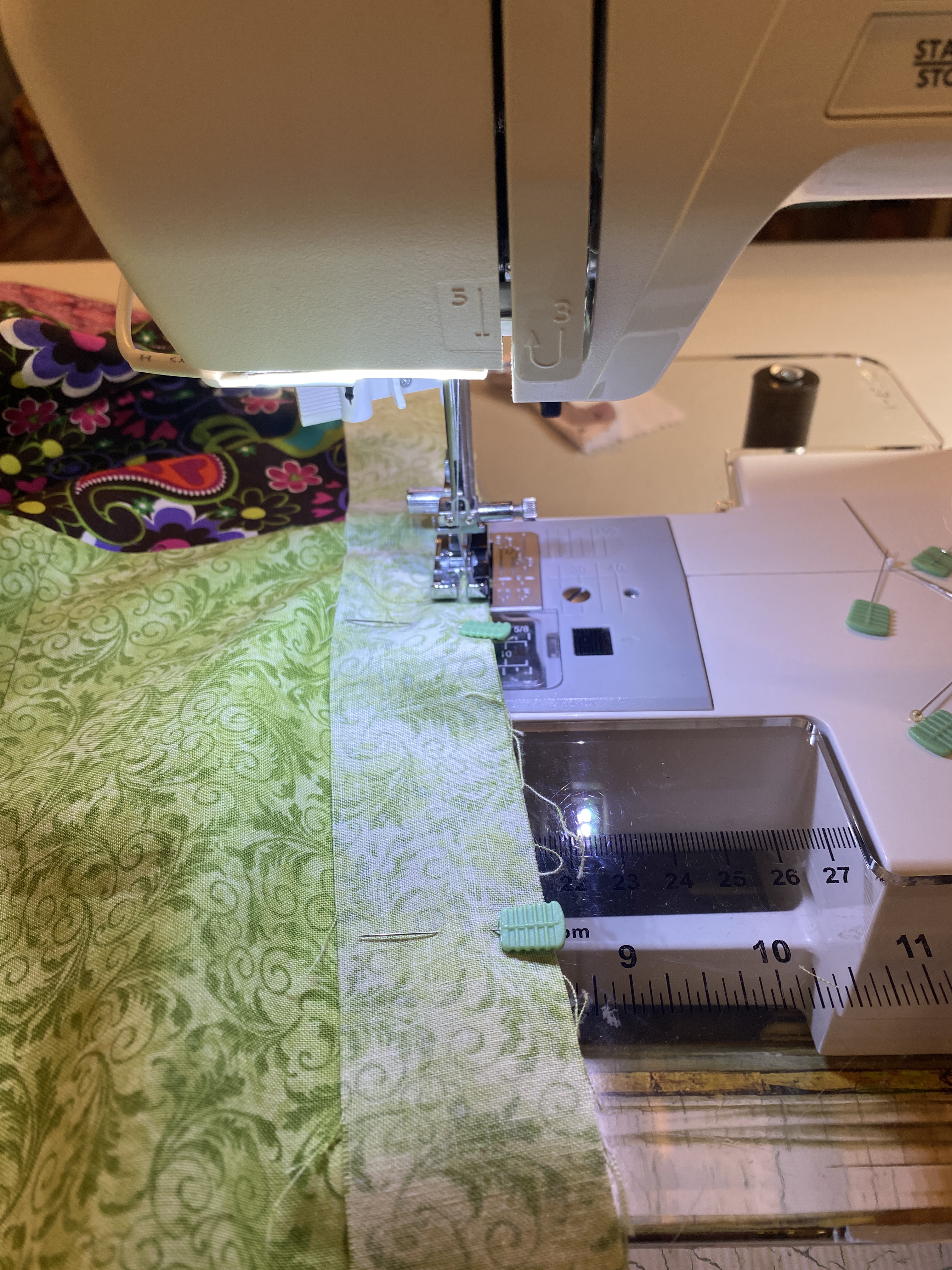
(3) Bring a smaller extension table. Think 12″ x 16″ or less. I have a Sew Steady Junior Size table (11″ x 15″) that I take to retreats and sew days.
(4) Add a stick on LED light strip strategically placed round the needle area to illuminate a dim sewing area. This can make a task lamp optional, unless you plan to sew at night.
(5) Pack a small power strip or extension cord with at least 4 outlets and USB connections. This helps corral all the power cords for your sewing machine, LED light strip, travel iron and task lap, while still charging your phone.
(6) Create a sewing machine first aid kit: Two packs of extra needles, bobbins, spool caps, hump jumper, small oil pen, lint brush, screwdrivers, tweezers or hemostat. Include spools of off-white, beige or light gray thread. You could even keep your presser feet in here.
(7) Keep a digital copy of your sewing machine manual on your phone or tablet. This cuts down on paper clutter and is one less thing you have to keep track off.
(8) Precut your projects, label everything and place them in small baggies or lay them out on design boards.
(9) Bring a folding TV tray to use as a cutting/pressing station. This really extends your work area, especially when you are assigned half of a 6 foot table.
(10) Streamline the sewing notions you bring to the retreat. In a 36″ space, a small pair of scissors, seam ripper, pins/pincushion and a purple thang will be all you have room to keep to the right of your machine. Pack all other notions in a tote bag that you can easily retrieve them and return as needed.
My personal mantra for packing for sew days, classes and retreats is “Less is More.” I keep a basic set of sewing supplies/rulers/mats for travel and add/subtract to this based on the event. I’ll either take my Elnita EC30 or my Singer Featherweight. If driving, I’ll add a task lamp and folding TV tray. I always make sure to pack my memory foam seat cushion – even when flying.
Round potholder – first attempt at using Adobe Illustrator to create pattern templates. Note to self – need to raise and soften curve of pocket piece.
My kitchen is in dire need of new potholders. Thanks to home and car insurance renewals this past month, I’m going to have DIY if I want new ones. I already have all the materials, including the heat resistant batting, in my sewing room. For inspiration, I headed to Pinterest. I kept seeing a really cute round potholder with a pocket and hanging loop. All of pins directed me to various blogposts, which in turn redirected me to purchase a pattern for $10.95. No thanks. I’ll try drafting my own. While I used Adobe Illustrator to create my 8″ circle and pocket piece, you do not need a computer to draft your own pattern templates.
There’s an old-school, analog method for drafting your own patterns. It involves pen, paper, a ruler and usually something round. A round potholder is 8″ in diameter. Head to your kitchen: a luncheon plate is usually 8″ in diameter. Or try the lid to a large pot, a mid-size skillet or a 2-2.5 quart round casserole dish. Your lid can be a little under/over 8″.
You’ll need two circles – one circle per page. I traced around a luncheon plate to make my circles.
Cut out one of the circles. Leave the other circle intact (as a full-sheet of paper). Fold each circle in half lengthwise and make a crease along the fold.
On the full-sheet circle, place a ruler along the crease and make a mark approximately 4.5″ from the bottom. Place the cut circle on top of the full-sheet circle. Align both circles along the crease. Slide the cut circle up until the bottom of that circle meets the mark you made at the 4.5″ point on the other circle. Confirm that your creases are still aligned all the way to the top (fold down the top circle a bit to check). Trace the bottom of the circle to form the top arc of the moon shaped piece that will be the pocket template for your round potholder.
Cut out your moon shaped piece. You should now have two pattern templates.
What else do you need per potholder?
(4) 9-1/2″ squares of coordinating fabrics
(2) 9-1/2″ squares of Insul-Bright or Insul-Fleece
(2) 9-1/2″ squares of cotton batting
(1) 2-1/2 x 5-1/2″ strip for hanging loop (optional)
Approximately 45″ of 2-1/2″ bias binding
Basic construction notes: a) Make 2 quilt sandwiches – one for the main body and one for the pocket. Include a piece of Insul-Bright/Insul-Fleece and a piece of cotton batting in each sandwich. Quilt as desired – a 1″ grid is commonly used in kitchen textiles. b) Cut out the body and pocket pieces using the templates you drafted. c) Add binding to curve of pocket piece using your preferred method. d) Place pocket piece on top of body, align and baste in place. e) Make hanging loop, fold in half and baste in place at center top on front or back of potholder. f) Attach bias binding back to front and sew down – this video will be VERY helpful. g) Flip up the hanging loop and stitch in place to secure (optional).
Helpful hints: – Use a longer stitch length (3.5 mm) when quilting and topstitching. – A left bi-level foot (or quilt binding foot) will help keep topstitching uniform when applying binding back to front. – If the binding has a difficult time turning to the front and providing enough coverage, try grading the seam allowance along where the pocket and body are sewn together.