Reflecting on snap bag class with 3rd – 7th graders

Snap Bags

We used the Snap Happy Bag pattern from Stitchin Sisters for our class. While each student brought her own purchased copy of the pattern to class, I made some modifications to the cutting and construction sequence to make it a little bit easier on the girls.  My goal was to get one large bag completed before the end of class.  We managed to do just that – barely.

I made kits for each student consisting of full-size freezer paper templates of the rectangles and squares needing to be cut for the bag, precut batting and fusible interfacing.  I also provided snap parts and practice fabric.  I charged a nominal fee for the kits.  The reason behind the freezer paper templates was simple – the shop doesn’t allow kids to use rotary cutters in class;  nor would I be able to cut fabric pieces for each girl in the allotted class time.  Students got to practice pinning and cutting pattern pieces out the correct way – something none of them knew how to do.   I was able to quickly even things up with a rotary cutter, if necessary.

Notes to self for next time:
1) Precut the snap parts to  7″ for the large bag, round the corners and wrap the ends with electrical tape. Will save much time and mess to clean-up.
2) Allow students to iron fabric.
3) Provide mini-lessons on proper cutting techniques, fusible interfacing and 1/4″ seams at the beginning of class.  Cut large rectangles of ugly fabric so students can practice sewing a 1/4″ seam all the way around.  If student doesn’t have a 1/4″ foot, use the outside edge of the presser foot as a guide to keep it consistent.
4) Stop and make everyone do prairie points at the same time.  Demonstrate how to edge stitch and maybe bring some folded scraps for them to practice on.
5) Provide baggies of scrap fabrics for girls to use while they are waiting their turn for instructor assistance (this was a huge godsend as two girls consistently kept losing their top thread every time I turned around).
6) If a mom offers to stay and help – accept her offer.  She can press fabric, fuse interfacing and help keep girls on track.
7) If funds become available – buy 2 machines (like a Janome 3128) for 3rd-5th graders to use.  Super simple machines and great for beginners.  I got my hands on a Hello Kitty version to use for the class and was very surprised at how well it sewed AND how quickly the girls learned to use it.  It was one machine I didn’t have to consistently “fix” during class.

If I weren’t moving in less than 2 weeks, I would have scheduled another one of these classes in July.  It was a LOT of fun for both the girls and me!

Note to Ava and Ada:  One of you left your pattern directions sheet at the shop!  Pls call Miss Robin to retrieve it!
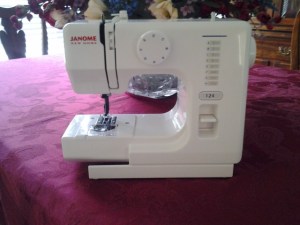
A few thoughts about the Janome 124 (Sew Mini)

I picked up one these because I wanted to see if the claims on the box were true.  The packaging claims it’s “perfect for quick mending jobs, quilting, scrapbooking, costumes and doll clothing.”  For $50.00 I simply had to find out for myself.

sewminiI also had an inkling that one of my students on Friday might show up with one of these sewing machines and I wanted to be prepared.

Honestly, this thing reminds me of the 1960’s era Singer Sew Handy sewing machine that I purchased at an antique shop.  The Sew Handy is an electric toy sewing machine that can actually sew a nice straight stitch. To me, the Sew Mini is a modern version of the Sew Handy with a zig zag stitch.

The bottom line: if you like to embellish greeting cards or scrapbook pages with stitching, this will definitely fit the bill.  If you need to repair lightweight seams or make simple doll clothes and felt crafts, you are probably okay.  Restitching a hem on blue jeans?  Probably not.  Making buttonholes or inserting a zipper?  Uh-uh.  Piecing a twin size quilt?  Nope.

Pros:
Good stitch quality with minimal tension adjustment needed
Uses standard Janome bobbins
Uses regular sewing machine needles
All purpose sewing foot included

Cons:
Only sews at one speed
No needleplate markings for seam allowances
Noisy
Bobbin winder does wind bobbin evenly (you have to help guide the thread)
No light
No carry handle

I know the price point makes the Sew Mini seem like a good investment for a newbie stitcher.  Just be aware that if your little stitcher gets bitten by the sewing bug, you will soon be trading up to a machine with more features, increased needle power and greater stitch variety.

And yep, in case you hadn’t already guessed, the Sew Mini has already been boxed up with the receipt and is ready to be returned to the store.

Laundry Equipment Conundrum

I have to buy a washer and dryer for the new house. The last time I purchased a new laundry pair was in 2003 when I bought a Maytag Atlantis washer and dryer for the current house. My how things have changed in laundry land over the past decade:

Front loaders
HE top loaders
Traditional top loaders
And the wash basket size has really increased!

My new laundry room is a good size room with a door located on the second floor right next to the master bathroom. This rules out front loaders (best for concrete floor installation) and I have to make sure the new washer is quiet. I also have to be able to reach the bottom of the basket to retrieve wet clothes without needing a step stool. This means I’ll either stick with a traditional size washer (under 4.0 c.f.) or select a larger basket that is shallow and wide instead of narrow and deep.

I have narrowed it down to two contenders:
1) GE 7350 HE washer with 4.6 c.f. shallow/wide basket highly rated by Consumer Reports; OR
2) Speed Queen AWN542 traditional washer with 3.3 c.f. basket not so highly rated by Consumer Reports, but everyone seems to absolutely LOVE this old-school washing machine.

There are two people in my household. Right now, I have to drive 30 minutes to the nearest laundromat to wash oversize quilts and the king comforter. I could wash both in the GE washer. However, at the new house there are at least 5 laundromats within a 10 minute drive.

My chief concerns with the HE washers are (1) their ability to clean dirty clothes with such little water and (2) how long will they last before the computerized circuit board needs replacing? Most of the reviews for the GE washer were actually quite good; however, not cleaning and problems with the circuit board were the most often cited reasons for the low review. I only found 2 negative Speed Queen reviews and the inability to get clothes clean was NOT one of them.

Both laundry sets actually cost about the same. The Speed Queen washer actually costs more than the GE right now because HD has the GE washer on sale.

Any insights you’d like to share? I’m really not sure which way to go.