Sewing Scout Badges – a primer
boyscoutpatchessleeve
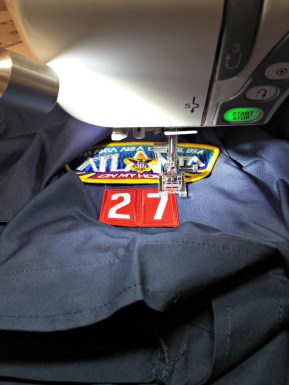
Sewing patches on sleeve

Scout Troop 27 meets at the elementary school where I work. We’re a Title I school in a high poverty area. The admin team wants our kids to have access to the same extracurricular experiences as their peers in wealthier areas do. Several of our boys and their families expressed an interest in scouting. Today, five teachers share leadership duties in tandem with BSA reps to lead 67 boys in Troop 27.  All I can say is our administrators are masters at getting things funded via grants and donations.

The lead teacher was able to get many of the uniform shirts donated and asked me to sew on the patches. She offered to pay, but I refused. After sewing nearly 216 badges on shirts over the past month, I consider myself well versed in sewing on patches. If anyone other than a member of Troop 27 asks me to sew on a patch, it’s now a flat fee of $3 per patch.

I thought I would share some hints I garnered from my experience sewing on patches.

Time required per shirt to attach 3-4 patches:  about 15 minutes because determining exact placement of World Council patch takes extra time.

Machine: Almost any sewing machine will work, including flatbed machines. Needle down, auto scissors and wide throat space features will make the job easier. (My 8900 was the best machine followed by the Elna Carina and 3160 QDC.) All patches can be sewn flat without the need for a freearm. I found youth XS/S to be the most challenging sizes to work with because those shirts are T-I-N-Y. I did have to break out the smallest freearm machine I had for the XS shirt to sew troop numbers on the sleeve.

Foot:  Open toe or clear foot, if you have one.

clearfoot
Clear foot makes it easier to see where you are going!

Thread: Use invisible polyester thread as the top thread. Match polyester or cotton covered polyester thread to the scout shirt in the bobbin.  Invisible poly thread is available from Sulky and Superior Threads. Use it on a vertical spool pin for best results.

Yes, you can match your thread to each individual patch, but clear thread is the way to go especially if you are sewing on many patches.

Needle: Size 14, preferably a topstitch needle.

Patch placement: Refer to the BSA uniform inspection sheet for placement guidelines. Or ask the scout leader. FYI – the World Council patch is centered above the pocket halfway between the top of the pocket and the shoulder seam. The middle of the fleur-de-lis aligns on the vertical center (right edge of ruler). The “tie”  or “belt” around the middle of the fleur-de-lis is at the exact midway point between the top of the pocket and the shoulder seam. The measurement will likely be 3.25″ to 3.5″ for most youth L/XL and adult S/M shirts. I found the  6-1/2″x 12-1/2″ ruler I use in quilting to be quite helpful with correctly placing this patch.

worldcouncilpatch
Aligning World Council patch

Temporarily hold patches in place with washable purple or clear glue stick – the kind you probably already have at home. I like purple because I can make sure I have covered the entire patch with glue stick. You can also pin thinner patches in place, but the thicker ones are almost impossible to pin in place. DO NOT hot glue the patches in place. It makes it extremely difficult to sew through the patch once the hot glue hardens.

20160223_214742
A purple glue stick was my BFF for this project!

Special tip for Troop numbers: Zig zag the numbers patches together FIRST, then attach them as a single unit to the sleeve. I also recommend stitching them together with thread to match the patch – at least in the bobbin.


Planning for unexpected business disruptions

I missed 3 days of school this week due to whatever upper respiratory malaise is currently making the rounds.  My school district has a procedure where we report our absences electronically and the system finds a substitute to cover for us. Lesson plans were already done for the week, so all my parapro had to do was make the copies they’d need and fire up the reserve laptop to cover classes.  I returned on Friday (still without a voice) and tweaked the lessons so my kids could read Valentine stories to their classmates instead of me.

As I laid in bed (now on my second box of tissues), I thought about how would I handle my small creative arts business if I were out of commission for a couple of weeks dealing with my own illness or that of a loved one?  Or what about fire, theft, machinery breakdown, bad weather, etc.  I’m a solo business owner – it’s all on me. If I had assistants things would be different, but this is what I came up with:

(1) Manage what I can – I learned the hard way to keep two reliable back-up machines in the studio (a Janome 3160qdc and an Elna Carina) in case the main machine goes AWOL while making a commissioned quilt.  I keep extras of commonly used supplies on hand so I don’t have to run to the store in the middle of the night or be at the mercy of the weather when I’m snowed in.  I also use cloud based services for accounting, financial and contact management. Heavily used files are uploaded to Google Drive so I don’t have to worry about my laptop malfunctioning. I also backup my computer on a regular basis.

(2) Have a buddy for referrals – I have a couple of friends to whom I can refer a project if I get in a pickle. Of course, I’ll have to pick up the costs associated with having them finish the project, but at least I will keep my promise to my customers.

(3) Communicate with your customer about what’s happened if you aren’t able to keep the deadline. 95% of the time, most will be understanding and aren’t on that time sensitive of a deadline. Shift things around if you must to keep those firm deadline projects on track or outsource the 5% that will help you keep your sanity.

(4) If you really suffer a devastating loss such as a fire, flood or death of a family member, communicate with your customers as soon as possible. I have at least 2 referral buddies I could count on to handle this for me (and I’d do the same for them). If not, a virtual assistant can be a godsend. Hopefully, you also carry a business insurance policy on your home-studio because chances are your homeowner’s policy won’t cover business losses (unless you have a special rider or endorsement).  In this sort of situation, there’s really not much you can do except to communicate with your clients.

Do you have any other things you’d like to add?


Watching costs improves your bottom line

I love quilting and often create things for the sheer joy of it.  Lots of time, love and extra special fabrics go into quilts for loved ones without considering the cost. Moving from hobby to business quilter required a change in mindset.

My goal is to provide a quality service for my customers at fair price for both of us.  So far, so good, but materials costs are rising and I am afraid I’ll lose some of my customer base if I raise my prices too much.

Basically, I have two ways to improve my profitability – cut costs or increase prices. (Remember, the purpose of being in business is to make a profit?) Cost cutting can include buying supplies at cheaper prices or investing in equipment that will save production time without sacrificing quality.  I do have some wholesale suppliers, but the fabric wholesalers currently have minimums that are out of my reach.

What’s a micro business owner to do?  
(1) Limit customer options.
(2) Shop retail on sale and stock up.
(3) Some combination of 1 & 2 with upcharges for certain things clearly spelled out.

I choose option #3.

I limit customer options with regard to:
(a) overall design (grid, wonky or mosaic)
(b) machine quilting (straight line at 1″ intervals, simple meander or loopy meander)
(c) thread color

Upcharges:
(a) Fabric above a certain price point. This allows the customer to use any fabric they want, but means I don’t have to absorb the cost of the fabric they must have and can only be found at the LQS for $13.75/yard.
(b) Fancy machine quilting or anything over a twin size. Most of my orders are for lap size quilts (roughly 50″x66″), so anything over a twin automatically goes to the local longarm quilter. Customers are told this when they first inquire about my services. (Note: I now have a mid-arm machine and am practicing my quilting designs).

My interfacing and batting come from the big box craft stores when they are on sale and there’s either an additional 20% off the purchase or I use my 15% teacher discount.  If I find a backing fabric that I really like at a quilt shop or the big box craft store, I may buy the entire bolt if it’s at a really good price.

Cost comparison for a 3 x 4 grid t-shirt quilt (50″ x 66″)

6 yards of interfacing, 6-1/4 yards of fabric and a twin package of batting from Joann:
Full retail:  $130.00  Carefully shopped: $86.00

THIS MEANS $44.00 more in your pocket by watching how/where you shop.

You might even save a few more dollars if you hit things on sale at the right time. 

In my area, the going rates for a 12 t-shirt grid style quilt with sashing and a border range from $195.00 to $380.00.  That’s a pretty wide range of prices. The person at the high end is rumored to have to turn away business. I’m somewhere in the middle. I’d really like to see how the company that charges $195.00 makes any money. Are they able to save on supplies, have super speedy construction methods or are they paying themselves $3.00 an hour at the end of the day?  Yes, there are times when I’ve probably averaged $3.00 per hour on some projects in the beginning stages, but thankfully, not anymore. 🙂