What are your 3 pillars?

What are the 3 most important areas of your life through which you filter all your actions and decisions? I listened to a podcast over the weekend where the interviewee discussed his 3 pillars:

  1. Family
  2. Business/Career
  3. Community

He went on to say that some people have more pillars, but for him, this keeps things simple. For him, faith was not a separate pillar, but was woven through the others.

I’m all for simple. I can’t say that I agree with him in that the 3 pillars always remain in this particular order. Now for him, perhaps they do, but they don’t for me. The pillars are more fluid.

Take family. There are certain family members and friends for whom I would drop everything at a moment’s notice to be there for them. Others – not so much. Certain parts of my extended family are so estranged, I’m not sure the chasm will ever be bridged. This definitely factors into decisions with regard to estate planning and beneficiaries. We don’t have kids. Why would I want to list certain family members as secondary beneficiaries on pension and life insurance benefits if they can’t give me the time of day now?

Career/job was drilled into my head as the most important thing from childhood – well into adulthood. Go to college. Get a job. Work hard. You need the paycheck/benefits. Work comes before anything else. Start a side hustle. Busyness is viewed as a status symbol. So much of our personal identity is tied to our jobs. As the end date gets closer, I’m having a much harder time with this one than I thought. I’ve never gone more than 2-3 months without working. I’m definitely ready for an extended break to enjoy time with hubby, but I also need to have a purpose. If that can’t be filled via future “community” endeavors, possible part-time employment has been discussed. Hubs is good with whatever I decide.

Volunteering and giving back to my community has always been in my top 3 priorities. No arguments from me there.

I think there also needs to be a category for SELF. If I don’t make filling my own bucket a priority, then there’s not much left for family, career or community.

As I get closer to retirement, the people part of the pillars has become the priority. I no longer think twice about taking off from work if home/family requires it. At work, it’s more about student connections and and helping coworkers than completing my lengthy to-do list. As we resume in-person therapy dog visits, I’m trying to participate in more group activities and get to know other members. Not surprising, it’s work that offers the most social connections. Filling that void is going to be a challenge once I stop working, but a good chunk of it can be replaced through various volunteer activities. And working my side hustle. 🙂
Making it work

Well, the big, fancy sewing machine will be in residence a while longer. The fact is, I haven’t really found a machine in a similar price range that I like sewing on as much as I do this one. The cost to purchase the “dream” replacement machine is not in the budget either. So, I’m making it work.

Backstory: The issue was never really with the machine. It was with the manufacturer bringing politics into my sewing room, uninvited, when it decided to partner with a particular individual whose passion is to push their own personal political agenda at every opportunity. This person, who is not a Georgia resident, even held a fundraiser for one of the PACs here in Georgia. The senate run-off elections were ugly. There was no getting away from the ads – internet, television, radio, mail, newspaper, billboard, podcast. Every time I looked at my sewing machine I was reminded of the nastiest Georgia political campaign of my lifetime. I literally didn’t touch the machine for six months.

My local dealer is the one who suggested I “tattoo” the machine and give it a name like I did my Featherweights. I covered the logo with a piece of tape. It worked well enough to allow me to complete a quilt on it. I upgraded the tape to cute sewing “tattoos” and named the machine Gretchen. Hubs also wisely pointed out that I’d had the machine long before the company partnered with this person and that association was likely to end before I needed to purchase a new machine. Hubs totally understands why I won’t buy another machine from this particular brand, though.

So Gretchen and I got reacquainted this evening. I pieced a quilt block with her. I forgot how much I appreciate (1) scissors function, (2) needle down and (3) ability to move the needle position to fine-tune my scan 1/4″ seam. We’ll be experimenting with some ruler work tomorrow.

Here’s to making it work!

Invisible machine applique

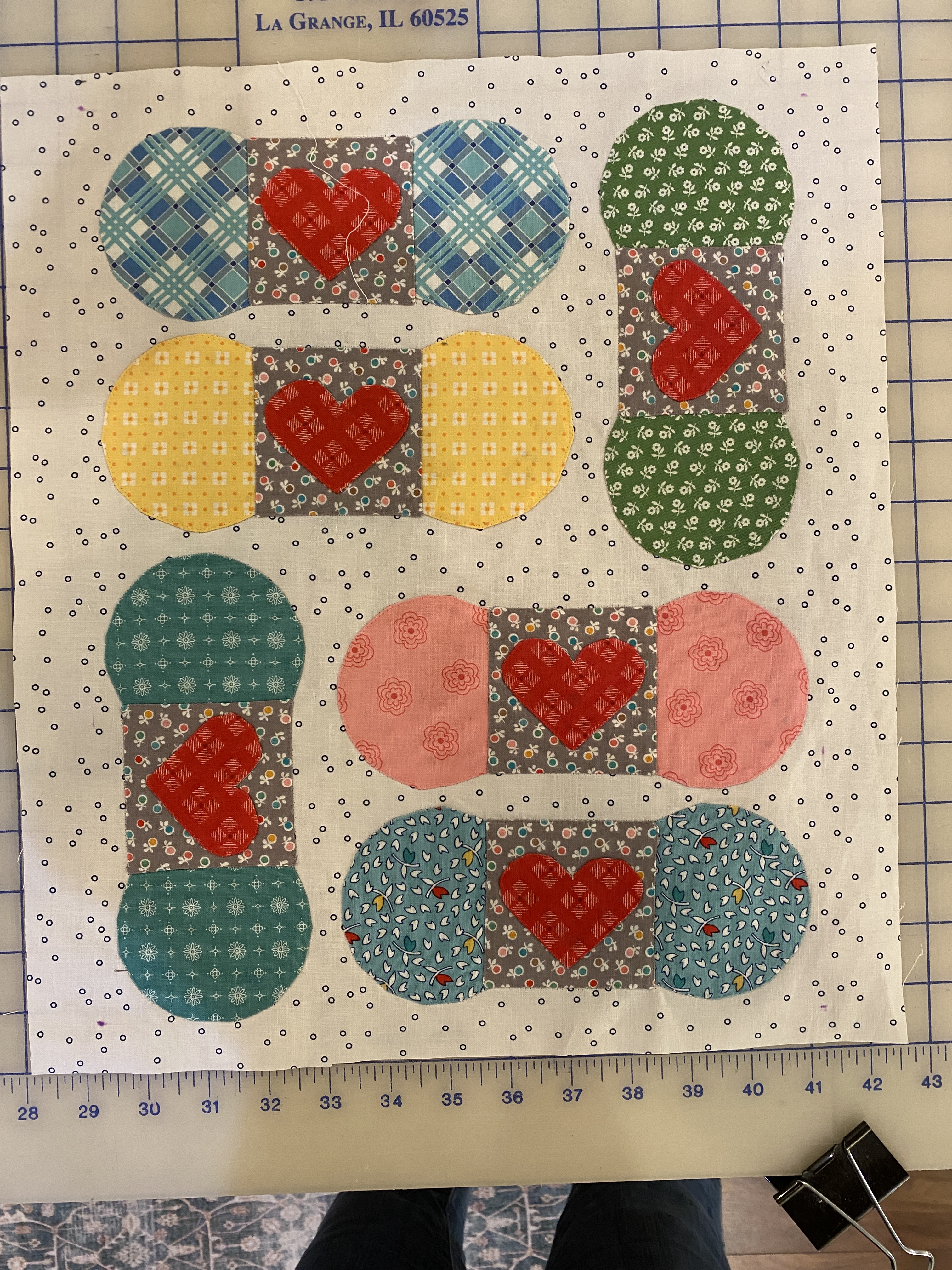
Yarn Block

Love the look of appliqué quilt projects but don’t have the time, patience or hand strength to stitch all of the individual appliqué pieces down by hand?

Invisible machine appliqué to the rescue! This technique uses a tiny zigzag or appliqué stitch of your choice to stitch down the appliqué pieces using a monofilament polyester thread. There are any number of ways to prepare your appliqué shapes for this method; however, the actual sewing process is the same. Sharon Schamber is probably the best known quilter associated with this method of appliqu

Supplies:
1) Mono-poly thread from Superior Threads (or clear thread of your choice)
2) 50-60 wt thread in the bobbin to match/blend with background fabric
3) Topstitch/microtex needle size 70/10 or 80/12
4) Gift tissue paper or tear away stabilizer to support more delicate appliqué pieces (optional)
5) Purple thang, wooden chopstick or sewing awl to help hold appliqué pieces in position as you sew (optional)

I prepare my appliqué shapes using turned edge and/or the Lori Holt interfacing method. Small circles are my nemesis. I discovered Applipops at the Kansas City Quilt Show. Any circles 2″ or smaller can be made using the metal Applipop rings. They work well! Karen K. Buckley also offers Perfect Circle templates that are a similar concept, but have a different construction method. See if either method might make small circles easier for you!

I glue baste my appliqué shapes using Elmer’s school glue with a tiny applicator tip I purchased at a local quilt shop. I allow everything to dry overnight. Multilayer designs are often placed under a stack of books while drying.

Machine settings:
1) My preferred stitch is a zigzag stitch with the length and width settings somewhere between 1.0 and 1.5. With my Baby Lock Jubilant, I use L= 1.2 and W = 1.0. On my Elna Star, it’s L = 1.5 and W = 1.5.
2) I use an open toe foot.
3) I reduce the top tension to 2.5.
4) Mono-Poly is a stacked spool, so it needs to be in a vertical position for best results. I use the auxiliary spool pin that came with my machine.

Thread considerations:
I use Mono-Poly thread in clear from Superior Threads. I have used this thread to sew patches on scout uniforms and to attach trims to projects. It is a very fine polyester thread with more of a matte finish than most other clear polyester threads. It is also the thread recommended by Sharon Schamber.

A friend of mine likes the Aurifil invisible thread and others like Invisafil from Wonderfil Threads. YLI Wonder Thread is another option, but it is nylon, so you have to be a little more careful when using an iron on projects made with this thread. Here’s an article I found helpful when choosing invisible thread. Buy a spool of each and experiment to see which product gives the look you prefer.

Many folks, including myself, find handwork relaxing. However, invisible machine appliqué is another tool in your quilty tool box that can help you make projects you may not have otherwise considered due to time and amount of handwork involved.