One of my favorite features of our daily school news show was the “Today is…” segment. The kids and I highlighted the weird and wacky celebrations taking place that day, week or month (all school appropriate, of course). So, let’s have a March edition for sewing, quilting and crafting. All events are pulled from the National Day Calendar site.
March is National Craft Month – try a different craft or work on one skill for 10 minutes every day this month.
March 6th – National Dress Day – wear your favorite or sew your own
This week is also National Read an e-Book Week. Use your Libby app to see if your library has a good quilting mystery!
March 14th – National Children’s Craft Day – make something with your favorite little person
March 18th – National Quilting Day – visit your LQS, sew with friends or join a virtual QAL
This week is also National Button Week – organize your button stash.
March 31st – National Crayon Day – break open that new box of crayons and color away
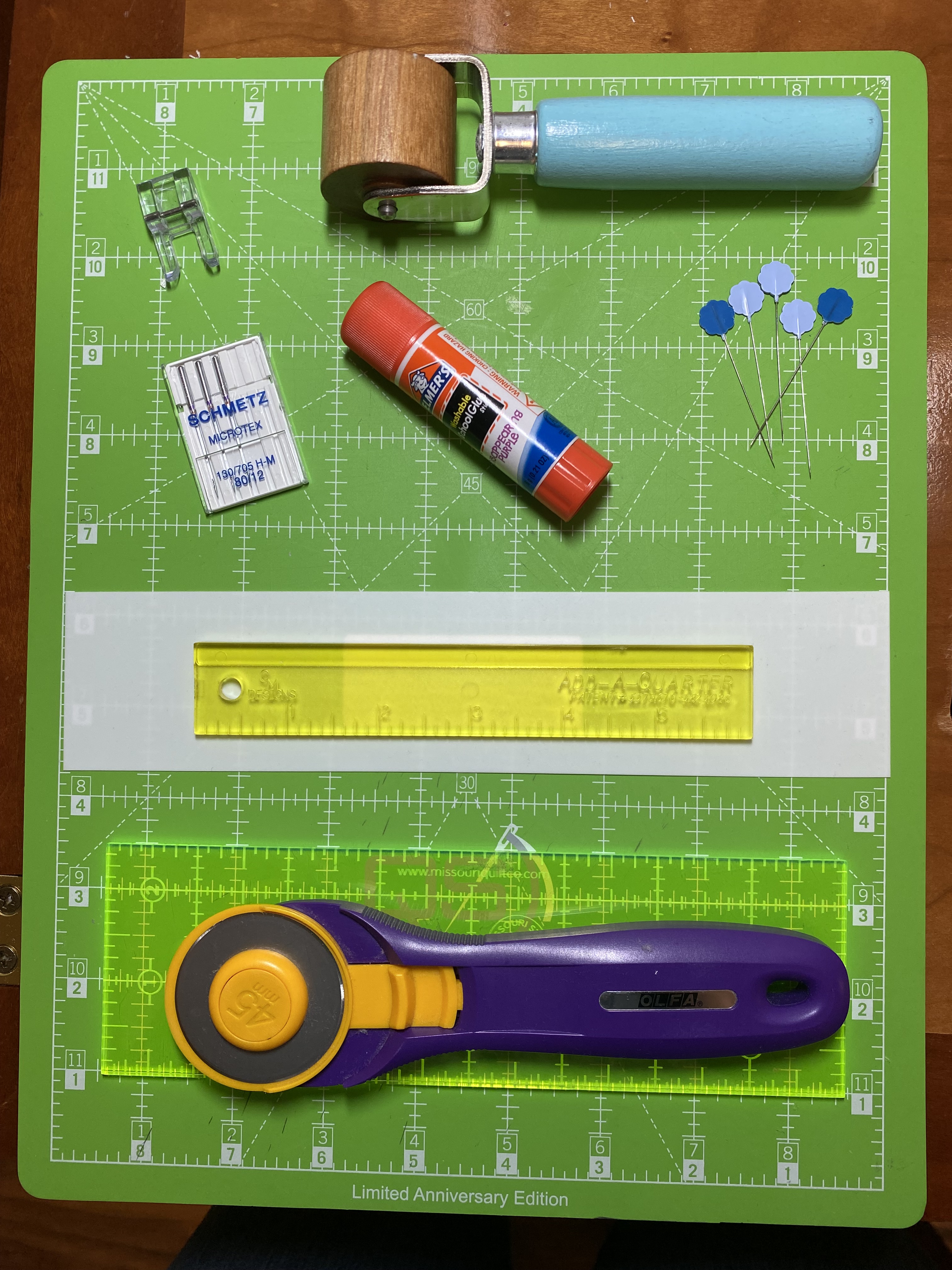
My essential supplies for EPP. Just add fabric (and a small pack of baby wipes)!
Supplies:
There are a myriad of ways to do English Paper Piecing (EPP).
I prefer glue basting, but hate sticky fingers, so I carry baby wipes for clean up.
I use a combination of Wonder clips and Sew-Tites to hold my pieces in place while I stitch.
Needles: Size 11 Milliners
*Thread: Deco-Bob (80 wt) from Wonderfil in Antique White or Nude
Thimble- vintage sterling silver thimble bought at Renningers Mt. Dora Flea Market many years ago.
Needle threader – a must have for me nowadays!
Scissors – Tiny snips from Tacony work great in my travel EPP kit
Papers – 1″ hexies from Paper Pieces.
Glue pen/refill – Sew Line is preferred, but I have used purple disappearing glue stick in a pinch
*Personally, I think polyester thread holds up better than a cotton thread when it comes to EPP. I’ve tried them all from 50wt to 100wt, cotton to silk to polyester. 80wt DecoBob from Wonderfil is my favorite, but it can be hard to find, Check your LQS for 60 wt from Superior Threads or Quilter’s Select. Some big box craft stores also carry a 60 wt from Coats & Clark (often referred to as fine thread). Any of these should give you satisfactory results.
Cutting fabric for EPP
1″ hexie papers is a very common size. This is what I’m currently using. Fabric for this size hexie is usually cut from a 2-1/2″ strip. Mini-charm packs (pre-cut 2-1/2″ squares) work great. If you think you might want to do some fussy cutting of your fabrics, then investing in a hexie acrylic template is well worth it. I purchased mine from Paper Pieces. The mini cutting mat is 4″ square (one this size that turns would be ideal). I use a 28mm for cutting fabrics with my hexie template.
Here’s the difference in using pre-cut hexies versus pre-cut squares when basting over the paper template:
There’s absolutely no difference on the front – the only difference is how things look on the back. Mini-charms are SO convenient, but I’ll admit I much prefer the look of the pre-cut hexies on the back. I might even be tempted to thread baste my hexies if the edges were all even like this. 🙂
Tip (see pic #3 in slideshow): If you stitch like I do using the flat back method, don’t glue all the way to the edges of the paper. Leave a slight gap between your glue line and the edge of the paper. It will make your work easier to stitch and lay flatter once stitched.
EPP makes a great take-along project, especially if you precut your fabrics. My supplies travel in a 7″x11″ box from Craft Options. This box is only 1-1/2″ deep and I find this size works best for me. I place the box in my lap, using the top as a work surface. If traveling by air, I remove the rotary cutter and add a mechanical pencil and small pair of scissors in case I need to cut fabric using the acrylic template.
This is a variation of a Grandmother’s Flower Garden quilt that my mother-in-law’s grandmother made before my MIL was born. This queen-size quilt is one of my MIL’s most cherished possessions. It was a treat to see and study it up close.
I compared the fabrics in the quilt with my fabric dating guides published by AQS. I also looked at the block construction, quilting and binding. This quilt was made from old clothing, curtains, tablecloths, sheets, dishtowels and whatever else was available at the time. Some of the scraps dated to the early 1900s, but most were from the 1920s – 1940s. The majority of the blocks were probably made by my MIL’s grandmother, but the quilt was most likely completed by someone else.
Why do I think this?
The GFG blocks are two different sizes. Most of the blocks were made by the same skilled quilter, with fabrics carefully chosen to coordinate and precisely stitched together. The remaining blocks were made from larger hexagons with random color placement and not as precise hand-stitching. It could be that my MIL’s grandmother made the blocks over many years and the larger blocks were made toward the end of her life when her hand-stitching was less precise. However, I really think someone else made the remaining blocks due to (1) differences in stitching and (2) some fabrics dating to the late 1940’s/early 1950’s in the quilt when compared to my AQS guides. The primary quilt maker passed away in the early 1940s and probably left an uncompleted quilt top. To me, it appears as if someone else pieced additional blocks from scraps and added those blocks to get the top to a certain size, then hand quilted it and had the purple binding applied/sewn by machine. The backing fabric is a single flat sheet.
Vintage quilts are always a mystery and all we can do is look at the clues to try to uncover the story the quilt is trying to tell us.