A few thoughts about the Janome 124 (Sew Mini)

I picked up one these because I wanted to see if the claims on the box were true.  The packaging claims it’s “perfect for quick mending jobs, quilting, scrapbooking, costumes and doll clothing.”  For $50.00 I simply had to find out for myself.
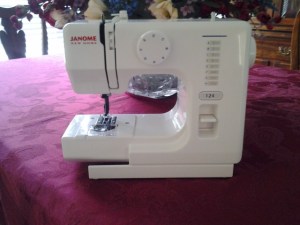
sewminiI also had an inkling that one of my students on Friday might show up with one of these sewing machines and I wanted to be prepared.

Honestly, this thing reminds me of the 1960’s era Singer Sew Handy sewing machine that I purchased at an antique shop.  The Sew Handy is an electric toy sewing machine that can actually sew a nice straight stitch. To me, the Sew Mini is a modern version of the Sew Handy with a zig zag stitch.

The bottom line: if you like to embellish greeting cards or scrapbook pages with stitching, this will definitely fit the bill.  If you need to repair lightweight seams or make simple doll clothes and felt crafts, you are probably okay.  Restitching a hem on blue jeans?  Probably not.  Making buttonholes or inserting a zipper?  Uh-uh.  Piecing a twin size quilt?  Nope.

Pros:
Good stitch quality with minimal tension adjustment needed
Uses standard Janome bobbins
Uses regular sewing machine needles
All purpose sewing foot included

Cons:
Only sews at one speed
No needleplate markings for seam allowances
Noisy
Bobbin winder does wind bobbin evenly (you have to help guide the thread)
No light
No carry handle

I know the price point makes the Sew Mini seem like a good investment for a newbie stitcher.  Just be aware that if your little stitcher gets bitten by the sewing bug, you will soon be trading up to a machine with more features, increased needle power and greater stitch variety.

And yep, in case you hadn’t already guessed, the Sew Mini has already been boxed up with the receipt and is ready to be returned to the store.

Laundry Equipment Conundrum

I have to buy a washer and dryer for the new house. The last time I purchased a new laundry pair was in 2003 when I bought a Maytag Atlantis washer and dryer for the current house. My how things have changed in laundry land over the past decade:

Front loaders
HE top loaders
Traditional top loaders
And the wash basket size has really increased!

My new laundry room is a good size room with a door located on the second floor right next to the master bathroom. This rules out front loaders (best for concrete floor installation) and I have to make sure the new washer is quiet. I also have to be able to reach the bottom of the basket to retrieve wet clothes without needing a step stool. This means I’ll either stick with a traditional size washer (under 4.0 c.f.) or select a larger basket that is shallow and wide instead of narrow and deep.

I have narrowed it down to two contenders:
1) GE 7350 HE washer with 4.6 c.f. shallow/wide basket highly rated by Consumer Reports; OR
2) Speed Queen AWN542 traditional washer with 3.3 c.f. basket not so highly rated by Consumer Reports, but everyone seems to absolutely LOVE this old-school washing machine.

There are two people in my household. Right now, I have to drive 30 minutes to the nearest laundromat to wash oversize quilts and the king comforter. I could wash both in the GE washer. However, at the new house there are at least 5 laundromats within a 10 minute drive.

My chief concerns with the HE washers are (1) their ability to clean dirty clothes with such little water and (2) how long will they last before the computerized circuit board needs replacing? Most of the reviews for the GE washer were actually quite good; however, not cleaning and problems with the circuit board were the most often cited reasons for the low review. I only found 2 negative Speed Queen reviews and the inability to get clothes clean was NOT one of them.

Both laundry sets actually cost about the same. The Speed Queen washer actually costs more than the GE right now because HD has the GE washer on sale.

Any insights you’d like to share? I’m really not sure which way to go.

Rotary cutters…and kids

Obviously the two don’t mix, but how can a sewer or quilter help keep the small fry safe?

1. Keep your rotary cutters in a safe (and locked if necessary) location.
2. Always retract & lock your cutter blade when not in use. (And who has time to remember this 100% of the time?)
3. Use a pressure sensitive rotary cutter from Dritz or Kai Scissors (the royal blue handled stick cutters) where the blade is only exposed when you press down to cut. And it’s not only a safety feature for kids. I can’t tell you the number of times I’ve been at sewing classes/retreats to find a rotary cutter left wide open on the cutting mat.
4. Teach older children how to use a rotary cutter properly, including the rule that the rotary cutter may only be used under adult supervision. If your child is a bit of a klutz, have him/her wear a protective glove on the non-cutting hand.

In one of the shops where I teach, the owner doesn’t want any student under the age of 16 using a rotary cutter. Also, any cutters that I bring must also be the pressure sensitive kind. I do the cutting during class or trace off pattern pieces on freezer paper that students can cut out with scissors (like traditional dressmaking patterns).