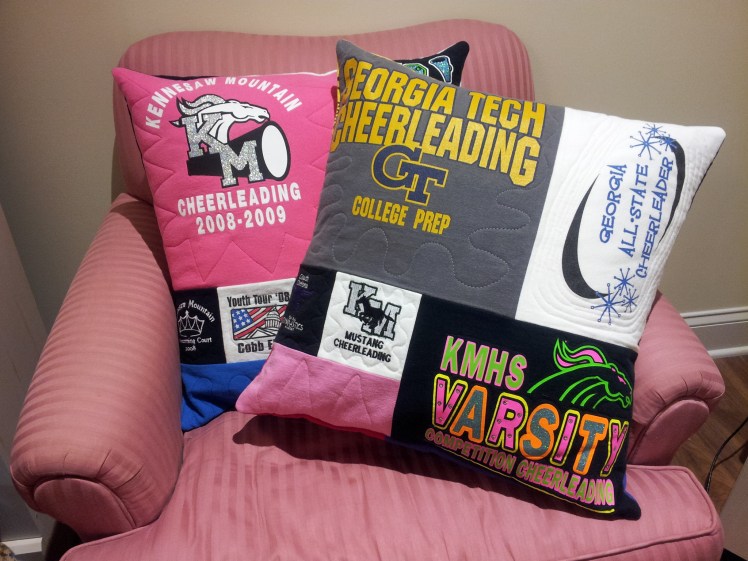
All Mixed Up (mosaic style) pillows made from t-shirts

All Mixed Up (mosaic style) pillows made from t-shirts

It all started with a pile of t-shirts and a picture on Pinterest.

Missy asked if I could make two big (20″) pillows for her daughter from old cheerleading t-shirts that she’d collected over the years.  She wanted them in a mosaic style and showed me a picture of a quilt online that she liked.  Sure, I was game.  I’d never made a t-shirt quilt quite like this, but I was willing to experiment with some pillows for a Christmas present.

As I’ve said before, my co-workers and friends think I can do almost anything when it involves a sewing machine.  It seems I get one project a year that stretches my limits.  Cynthia…Megan…and now Missy.

Well, the pile of old t-shirts was E-N-O-R-M-O-U-S.  I now have a full-size quilt top sandwiched and ready for quilting.  I start on that tomorrow night once we discuss the quilting design (all over meander or individual block quilting).  Will post a picture of the quilt and write-up of the my experience making this type of quilt after Christmas.

In case you were wondering, yes, the daughter is a Georgia Tech cheerleader.

Interfacing for T-Shirt Quilts

November 2015 update:  I now use Pellon SF-101 interfacing almost exclusively in my baby and t-shirt quilts. Why? It’s 100% cotton, made in the USA and works well with my steam press.  My customers are pleased with the finished result. To keep costs reasonable, I buy it by the bolt when it goes on sale. 

[Original post follows]

A couple of my local quilt shops carry a 100% cotton woven fusible interfacing that they swear is the best thing for constructing t-shirt quilts.  When one is accustomed to paying $1.50 – $2.00/yard for non-woven Pellon interfacing on sale at the big box craft stores, it is a bit daunting to see $6.59 to $7.99/yard retail on the fusible woven interfacing carried by the LQS.  I bought 2 yards of Bosal Fashion Fuse to experiment with.  It was a pleasure to work with.  I swallowed hard and went back to buy 3 more yards to complete a small lap-size quilt.

The product I used is an apparel interfacing, so I knew that Pellon and HTC had to make something similar.  A little online searching under the apparel sewing blogs yielded the information I sought. Bingo!  Pellon’s Shape-Flex (SF-101) is also a 100% cotton woven fusible interfacing made here in the USA.  Similar in price, but carried at the big box craft stores where one can use a coupon (or a teacher discount if the item is already on sale) to bring the price per yard down to what I consider reasonable.

I had to buy some Pellon SF-101 to complete my project since the quilt shop is closed until Tuesday.  It’s very similar to the Bosal interfacing in hand and drape, but appears to have a little more fusible on the back side, requiring a little more pressure and time to get it to “stick” than the Bosal interfacing.

There is no one best interfacing for t-shirt quilts.  It depends on the type of quilt and how soft you want it to be.  Some people do not interface the backs of their t-shirts.  This is a personal choice.  I choose to interface mine because it makes the quilt a little sturdier and easier to machine quilt, IMHO.

If you want a super-soft, drapey quilt, try Pellon 906 nonwoven fusible interfacing with a bamboo blend batting.

For most t-shirt quilts, a fusible knit or 100% cotton woven fusible interfacing is a great choice with a cotton or cotton-blend batting.

If you like things a little stiffer, then try Pellon 911 nonwoven fusible interfacing.  Use a cotton or poly batting.  I use the Pellon 911 with flimsy knit t-shirts – even if I’m using the 100% cotton fusible on the rest of the shirts.  I also use the Pellon 911 on wall hangings.  It increases the sturdiness factor.  The Missouri Quilt Company mentions this specific interfacing in its t-shirt quilt construction video.

The bottom line:  I already have bolts of Pellon 906FF and 911FF on hand.  I will be adding a bolt of the SF-101 to my stash when I see it 50% off.

You might wonder why the price of interfacing is such a concern?  Consider that it takes 1/3 to 1/2 yard of interfacing per t-shirt.  I went through about 15 yards of interfacing on a full-size mosaic t-shirt quilt (or my version of the Tool Cool T-Shirt quilt).

The Math:
Fashion Fuse 15 yards @ 6.59/yard = $98.85

Pellon SF-101 15 yards on sale @ $2.75/yard = $41.85 (regular retail is $5.49/yard)

The Pellon 911FF averages $2.25/yard every day, so that’s even cheaper than the woven SF-101 on sale.  When it is on sale, that same 15 yards of interfacing costs less than $20.00.

Bottom line:  The project, the recipient and your budget dictate the type of interfacing that you chose.  By careful shopping and brand substitution, you can save at least half on your interfacing.
A busy week indeed

This was our last official week of summer break.  An oxymoron of sorts as I spent three days dealing with school stuff (unpaid, of course since our contract doesn’t start until Monday).  I managed to squeeze in some sewing and actually taught sewing classes this week.

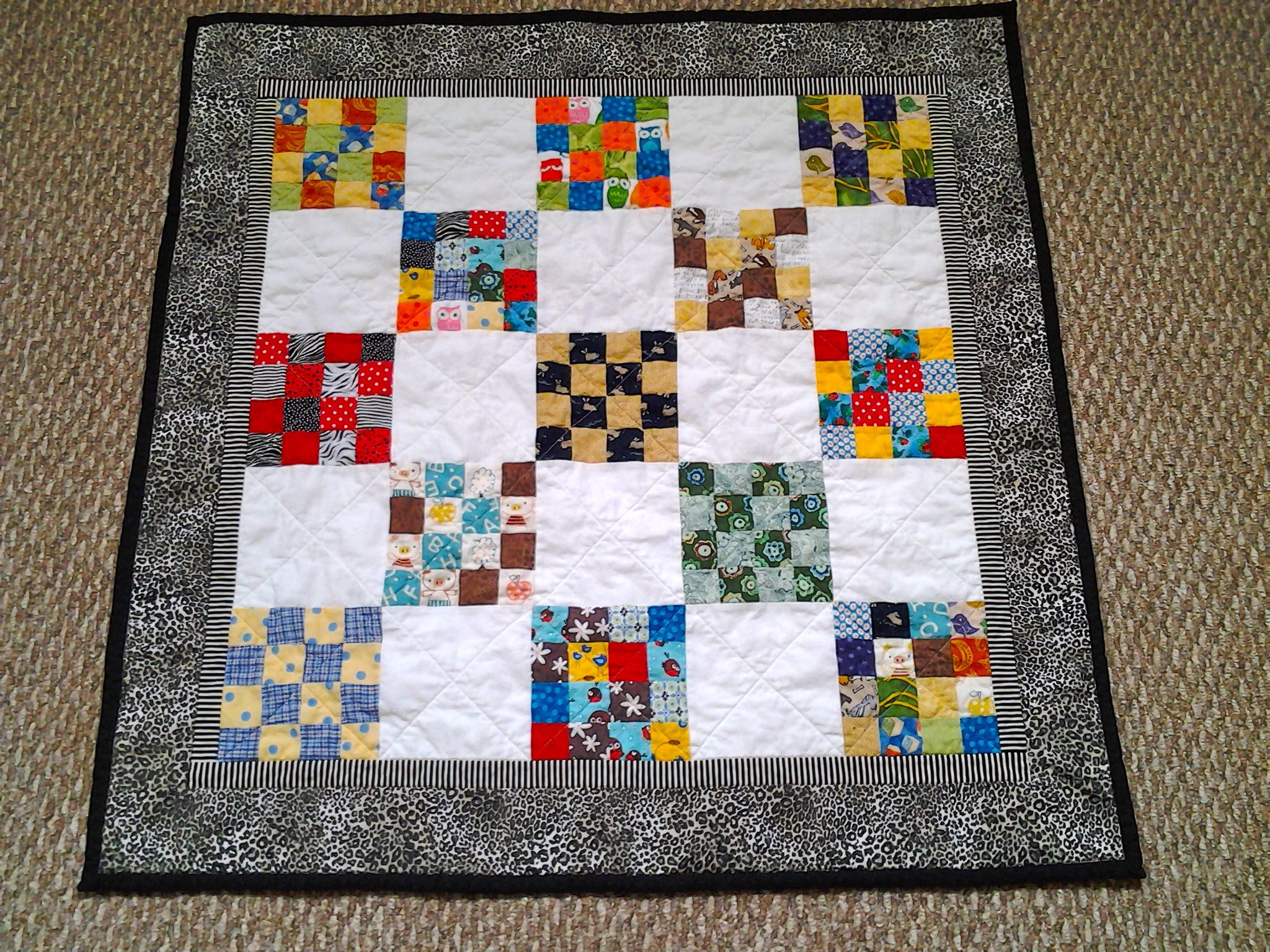
Levi’s Story Time Quilt
from the stash and very scrappy

First off, I made a very scrappy baby quilt for a library colleague of mine who recently adopted a child.  Our former library media supervisor hosted a baby shower for the new parents.  Attendees were asked to bring a favorite children’s book to help build the baby’s library.

I decided Levi needed a story-time quilt to snuggle up with while he listens to all of those great stories.  The 16 patch blocks are made up from 2″ squares cut from fabric scraps.  In fact, I cut all of the pieces for this quilt using my Accuquilt GO! cutter. It made quick work of cutting all of those 2″ squares from various size scraps.  Sewing them together was a breeze.  Can’t say the same thing for the white squares, though.  Some came out 1/8″ short, forcing me to “make it work” while assembling the rows.  I had a similar problem with the 5″ charm square die, which the company replaced at no charge.  Hopefully this was a case of operator error not equipment error.  The 6-1/2″ size is quite handy.

I taught not one, but TWO sewing classes this week.  The first was a mother-daughter private and lesson and the second was to a class full of ‘tweens learning to make t-shirt pillow covers.  What a blast.  My friend Shannon was shopping in the store and popped in the classroom to say, “Hi!” when she heard my voice.

T-Shirt Pillow Class with Anna and Shelbea

The shop owner took a number of pictures of the class in action.  I’ll write up a post when I have permission from all the parents to post the pictures.  Meanwhile, enjoy this photo of my 8th grade friends proudly displaying their handiwork.

Lastly, equipment failure forced me to seek out a better fabric organization solution for my stash.  The oversize 3 drawer rolling cart I’d inherited from a teacher friend finally broke.  I purchased color coded fabric bins from Home Depot and a Martha Stewart 6-cubby organizer to replace the plastic cart.  The color of the bin indicates which color family of fabric is stored inside.  I can tell at a glance what I have.  And yes, the fabric bins come in a wide range of colors.  The 6 drawer plastic organizer to the right  of my new cubby organizer is a really good one – but I really, really like the ease of finding fabric in the bins.  And the bins hold a lot more fabric than the plastic drawers.  Hmmm…

Stash organization using color coded fabric bins and cubby organizer from Martha Stewart available at Home Depot (on left).