Recent reads

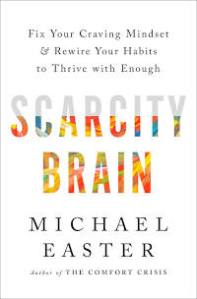
This book caught my eye on a recent visit to the Smyrna library. It’s not quite what I thought it was going to be about, but it’s still a worthwhile read.

I was reading it while my color processed at my last hair appointment.  Trey, my hairdresser, got excited when he saw what I was reading. Turns out, it’s one of his favorite books.

There’s a lot of science and research that goes into keeping you engaged in video games, playing the slots and mindlessly scrolling on social media. Humans are constantly scanning and comparing to see if they are missing out (FOMO anyone?). The author refers to it as a scarcity loop – a behavioral pattern that encourages people to repeat behaviors that can be fun in the short term but harmful in the long term.  The author suggests that we change our thinking to an abundance loop instead.

My takeaways from the book in no particular order:

  • Quit worrying about what other people think.
  • Forget about status.
  • Take 60 seconds to make a decision to buy or not buy.
  • Buy “gear” that will help you in an area of your life that brings you joy – not stuff to sit on a shelf or be tucked away in the back of a closet.
  • Eat simply – ultra-processed foods are harming you.
  • Practice mindfulness.
  • Focus on gratitude.
  • Make a game to use what you have on hand instead of automatically buying something new.

Some of these takeaways were most helpful in deciding which SUV to buy.  The 60 second decision rule helped narrow it down to the final two contenders.  Both were within budget, but I went with the slightly more expensive one that made me smile the most when I drove it.  It’s red because I love the color. I care not one iota that my red SUV sticks out in the sea of predominantly white, grey and black vehicles in my local community.

Managing your sewing & quilting library collection

Much discussion went back and forth on the CREATE2014 ICAP board about managing our personal magazine collections.  I think a lot of it has to do with how one utilizes magazines in his/her creative arts endeavors.  I use magazines for inspiration and ideas.  I keep them for about 3-6 months and either (1) pass the magazine along to a quilty friend or (2) tear out the pages that inspire me.  These pages are either filed away or encased in a plastic holder and put in a 3 ring binder.  I take the remaining parts to school for use in various student projects.

As much as I love print products, I have personally moved the bulk of my magazine subscriptions to a digital format where available.  I read them on my NOOK HD or on my MacBook Pro using a NOOK or Kindle app. Most, if not all of the electronic publications, offer pattern pages on their websites for a free download.  I do have a handful of magazines that are intact and remain part of my permanent collection.  These are housed magazine bins that you can buy at any office supply store or IKEA.

Every so often, it is essential that you cull your books and magazines.  If not, your reading matter stash is going to rival the fabric stash!  Yes, I hate to get rid of books as much as the next person, but it’s an essential part in the care and feeding of a collection. Donate items to your quilt guild, ASG chapter or Friends of the public library.  Gift the books to newbie stitchers. Trade the books in at a place like Charles & 2nd or McCray’s books so you can buy other books.  Donate the books to Goodwill.  Try to sell them on Etsy or Ebay.  If the book is dog chewed, mildewed or otherwise falling apart – please do everyone a favor and throw it in the trash!I

As I work as a children’s librarian in my day job, it should come as no surprise that I have one bookcase full of nothing but sewing and quilting titles.  I weeded my collection prior to our move last summer.  Last month, I donated a number of older titles to my quilt guild’s fledgling library.  I will probably donate more after spring break.  My books are cataloged using Library Thing.  They are arranged on the shelf by subject – general quilting, machine quilting, kids sewing, garment sewing, business, home dec, techniques, etc.  No way am I going to put Dewey numbers on the books!

My personal collection also includes a handful of vintage sewing books that I collect as a hobby.  One of the classes I’d love to take is an archival course on antique book repair.  That’s not something that was taught via distance learning when I was in library school.  You Tube is great for general repairs, but antique books are a little trickier.