Collaborative Projects

Group sewing projects are fun. My bee group has made a handful of quilts to donate to our guild’s community service in the two years our group’s been in existence. We work on blocks independently, then schedule sew-ins at a local quilt shop 2-3x per year to lay out projects and assemble the top(s). We get to use their big classroom space for a modest fee of $5 per person.

Today’s quilt top was made from alternating 9 patch and snowball blocks. The blocks were suppose to be 6-1/2″ unfinished. Some had to be set aside because they were either too small or too large. Many others had to be “stretched” or “centered” with the adjacent block so the two blocks could be sewn together. We all started with the same 2-1/2″ and 6-1/2″ squares. The differences are basically attributable to varying 1/4″ seam allowances and pressing with steam.

So how can you consistently make your blocks the correct size?

  1. Starch, Best Press or Magic Spray fabric before you begin. Allow it to cool and dry before cutting.
  2. Cut accurately. Use a nonslip ruler and rotary cutter with a fresh blade. Use a die cutting machine or specialty ruler such as the Shape Cut by June Tailor.
  3. Use a fine piecing thread like Aurifil 50wt with an 80/12 Microtex needle. Wonderfil’s Efina 60wt and Hobby Lobby’s 50wt cotton thread (on the cross-wound spool) also work well.
  4. Sew with a scant 1/4″ seam. I have to move my needle position 1 or 2 clicks to the right to get a scant 1/4″ seam allowance. Test your machine with your preferred piecing foot.
  5. Sew a sample block before cutting everything out. It’s okay to have to trim it down slightly. It’s even okay to come up occasionally 1/8″ short on a side. This variation can easily be worked into a row of blocks. Anything more and you’ll need to make adjustments to your piecing process.

Making snowball blocks here. I trimmed the corners using my Simple Folded Corners Ruler from Doug Leko. Stitched seams using O2 Janome 1/4″ foot and my needle position one click to the right.

Before leaving our sew-in today, I made a sample block for our next collaborative quilt – Puzzle Box. Used the same needle position as I did for the snowball blocks, only my block was a tad small. I made another one at home. The second sample block using a needle position of 3.5 yielded a near perfect 8-1/2″ square with only slivers needing to be trimmed away. Winner!

Packing for a quilt retreat that requires air travel

Do you ever fly with your sewing machine? I have on five occasions – twice with my Featherweight and three times with my Elna STAR edition (3/4 size machine similar to the Janome Jem Platinum 720). I prefer to take the computerized Elna because it has features the FW lacks. For me, the Elna also goes through TSA security without the need for additional screening.

With Delta’s new boarding rules and a main cabin ticket for my recent quilt retreat in Idaho, overhead bin space for my carry-on sewing machine was a concern. Here’s the thing: in ATL, more than half the plane will be boarding before me because I’m a general Skymiles member without a co-branded credit card. I anticipated overhead bin space but packed my 3/4 size Elna STAR edition sewing machine in an underseat rolling tote in case she had to ride under the seat in front of me. At no time do I want my sewing machine to ride as checked luggage! I actually had no issue getting overhead bin space on either flight.

Packing for a retreat where I’m driving is definitely easier. I can take whatever I want in my SUV. Flying requires a more minimalist approach. I took small projects to work on – Mini Brightly in spring colors and 4 blocks from the Middle GA Shop Hop. Everything was precut and bagged. Projects in baggies, batting and FQs are packed along with the sewing machine, foot pedal, power cord, machine accessories and manual. Everything else goes in my checked luggage.

Post retreat update: Retreat swag and other souvenirs had to be shipped home or I would’ve exceeded the weight limit for my suitcase. I definitely plan to return for future retreats. I’ll bring the same machine, but with fewer feet (all-purpose, 1/4″, open toe, zipper and a walking foot with guides). Sewing supplies will be kept to a minimum: thin heat resistant pins, magnetic pin cushion, wonder clips, purple thang, seam ripper, glue stick, small scissors, 8″ scissors, pencil, frixon pen, thimble, hand sewing needles, rotary cutter, 12X18 folding cutting mat, 8-1/2″ x 12-1/2″ ruler, 10″ square, 5″ square, 2-1/2″ x 6-1/2″ ruler, mini-iron, press mat, mini clapper, small extension cord and travel Ott light. Of course, I’ll bring extra thread, needles and bobbins plus my extension table. I’ll also include any specialty rulers or notions my projects may require. Anything else, I can borrow or buy at the retreat.

The retreat organizers taught a new project each day. Skill building and fun, but they didn’t think the logistics on the train case all the way through. If they had, we would’ve been told to bring a 9-1/2″ square ruler and a larger cutting mat. I took my 8-1/2″ square and my 9″x12″ cutting mat. Not good when 30+ retreat attendees are trying to use the 2 cutting stations.

Let’s go to the book fair

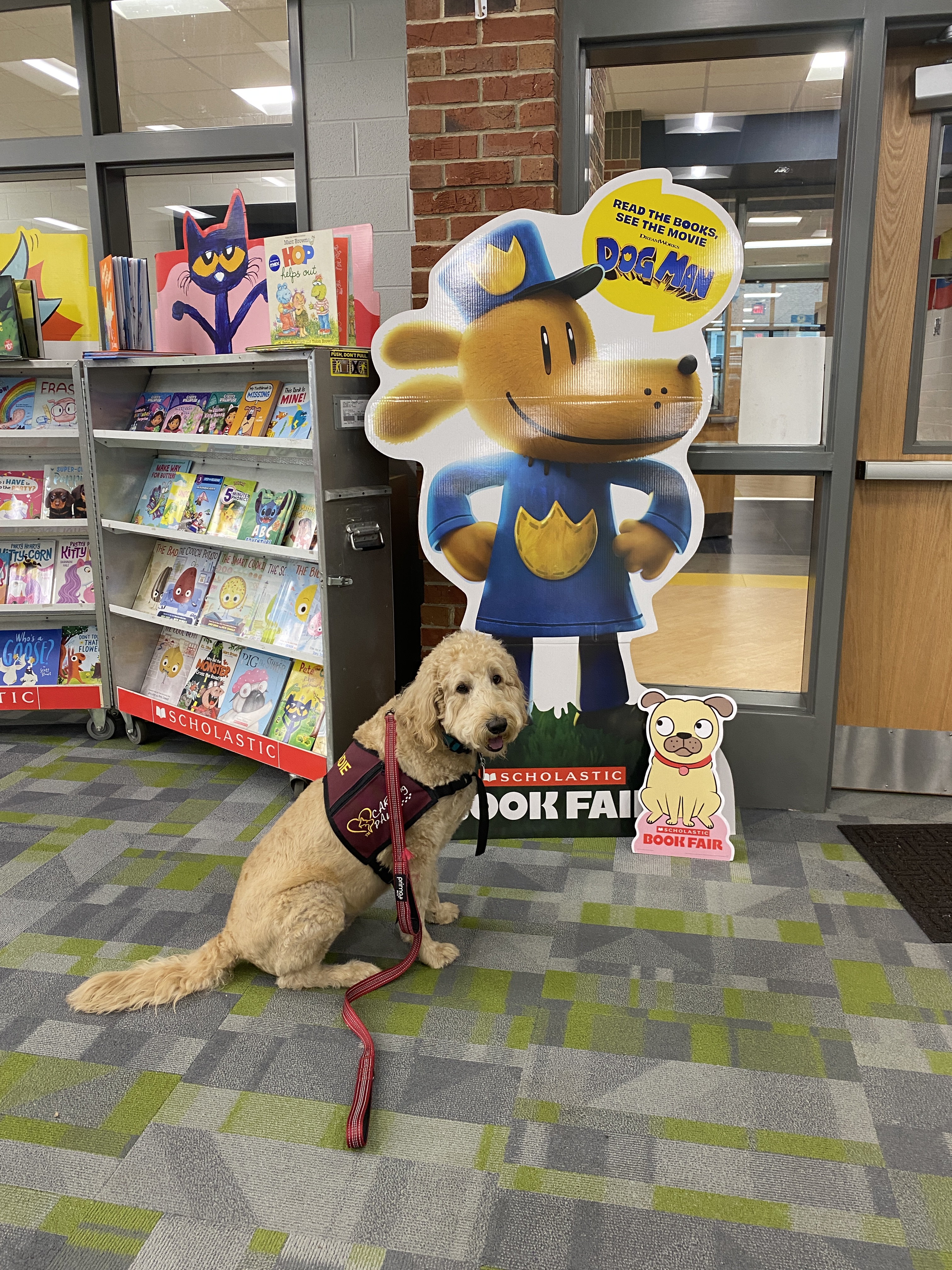
Today, Sadie and I took our four R.E.A.D. students shopping at the school’s book fair. The kids weren’t expecting it and were SO excited to pick out a book and bookmark of their very own. Lots of hugs as we said good-bye. Due to EOY testing, spring break and special events, we’ll only have one READ session in April. Then, it will be May with only 3 weeks left in the school year. Summer’s not far away!

Therapy dog activities typically follow the academic calendar, so our summer visit schedule is much lighter. ATD rules require 1 visit every 90 days to remain in good standing. One visit in June or July will help us do that.

Summertime also means more time to quilt. Sadie looks forward to having new quilts for her READ sessions. The tops are done, they just need to be quilted and bound. The 3 yard quilt patterns & books from Fabric Cafe are easy and make great size quilt for therapy dog work.