Sustainable Sewing Tip #1: Meet Libby, your new BFF, courtesy of your local public library

How much do you spend each month on magazines? What happens to those magazines once you’ve finished reading them? Even if you clip projects from the magazine, how often do you ACTUALLY make the item?

Hmmmm…

Libby is a free reading app available through your local public library. [It’s the grown-up equivalent of SORA, if you have kids who are doing summer reading for school.] You can borrow books, magazines and audiobooks for FREE! Each library subscribes to various packages of magazines via an electronic serials provider, so the titles may vary from library system to library system; however, here’s a sampling of sewing/quilting magazines available via Libby through my library consortium:

Quilt Sampler
McCall’s Quilting
Make Modern
Simply Sewing
Love Patchwork & Quilting
Quilting Arts Magazine
Fons & Porter’s Love of Quilting

Quilter’s World (and other titles available via Annie’s Publishing)
Sew News

Note that there are over 3,000 magazines available on a variety of topics in Libby.

What I like about using Libby:
(1) I can set up automatic notifications when a new issue is available.
(2) I can read the issue on my phone, tablet or computer at my leisure over the next 3 weeks.
(3) The item is automatically returned at the end of the loan period.
(4) I save money by not buying so many magazines (almost $100 on the titles listed above alone!).
(5) There’s no stack of used magazines to recycle, donate or sell.

Noticeably absent are American Patchwork & Quilting and Quiltmaker magazines. Not to worry – these titles are often available on the newsstand at your local grocery store. Don’t know about you, but I still go to various grocery stores on a frequent basis to try to find things we need that are sporadic due to supply chain issues. Reward yourself by spending 5-10 minutes flipping through the magazine of your choice. I’m willing to bet the magazine stays at the grocery store unless there’s something in there that REALLY grabs your attention!

If there’s any magazine that you REALLY like that’s not available via Libby, then subscribe to it to save the most money. My husband gifts a Quilt Folk subscription to me each Christmas. It’s one of my favorite magazines to sit and savor. And worth every penny. I’m planning to sell the back issues once I’m finished with them.

The not so-fun part of reading magazines online:

Electronic access to my fave quilty mag is great…but what about the project templates? Copyright law and the publisher drive this bus.
Suggestions:
(1) See if you can print the templates directly from your device.
(2) Read through the project directions or general quilt making directions often included at the back of the magazine to see if there are instructions on how to obtain a printable pdf of the templates from the magazine’s website.
(3) Call/visit your local library to see if they have a print issue where you can photocopy the project templates.
(4) If the above suggestions don’t work, buy a physical copy of the magazine.

The Libby app can help keep you sustainably sewing by saving you time, money and precious natural resources needed to make paper and gas.
Small, consistent steps over time can make a huge difference!

Want to improve your piecing, free motion quilting or other quilty skill? Keep a project ready and practice for 15-20 minutes per day.

Want to learn applique? Commit to learning one applique method a week – fusible/raw edge, needle turn, Lori Holt, prepared edge, invisible machine, etc. In about a month, you’ll know which method you prefer. Try both hand and machine methods. Experiment with different machine stitches for your applique – straight stitch, zigzag, blanket, pin stitch, satin stitch. Which look do you like best?

Want to improve your free motion skills? Use leftover layer cake pieces (ugly fabric also works well for this!) and batting scraps to create a stack of 10″ x 10″ quilt sandwiches that you can use for practice. Spray baste those sandwiches and stack them by the machine you use for quilting. Practice a FMQ stitch on at least 2 sandwiches every day. 25 Days to Better Machine Quilting by Lori Kennedy is a great resource. I found this at my local public library and liked it so much I bought a digital copy from Amazon that I can reference on my iPad. Here’s a link to 365 free motion designs from Leah Day to provide inspiration for your FMQ practice. Also be sure to check out YouTube videos from Angela Walters.

Want to improve your piecing skills with HSTs and FG? Find a quilt block that has lots of them and spend 15-20 minutes a day piecing blocks. HSTs: Carpenter’s Star block (video) Flying Geese: Dutchman’s Puzzle block (video) You can also try different methods for making HSTs and FG. There are numerous tutorials available online. If I am making tons of HSTs and FG, I prefer to cut the patches using my Sizzix Big Shot Plus machine and the appropriate dies. If I can’t access my die-cut machine, then it’s 8 at a time HSTs and no waste (4 at a time) Flying Geese for me when I need to make numerous HSTs and FG from the same fabrics. I sew patches together using a stitch length of 2.0 and my needle position one click to the right of center needle position. When sewing blocks together, I often move the needle one additional click to the right (W= 3.5 for 5mm wide and 4.5 for 7mm wide machines) and place the side with the most match points on top for easier viewing while sewing.

The takeaway here is to practice the skill you want to master. Teachers stress 20 minutes a day of reading as one of the best ways to improve reading skills. This also applies to quilting, sewing, embroidery, cross-stitch, knitting, crochet – basically any other craft out there.

Given our current heat wave, I can think of nothing better than to schedule some Crafternoon time in your nice, air-conditioned sewing space.

Keep sewing and stay cool!

Figuring quilt border size

Homebody Quilt from Cozy Color Quilts

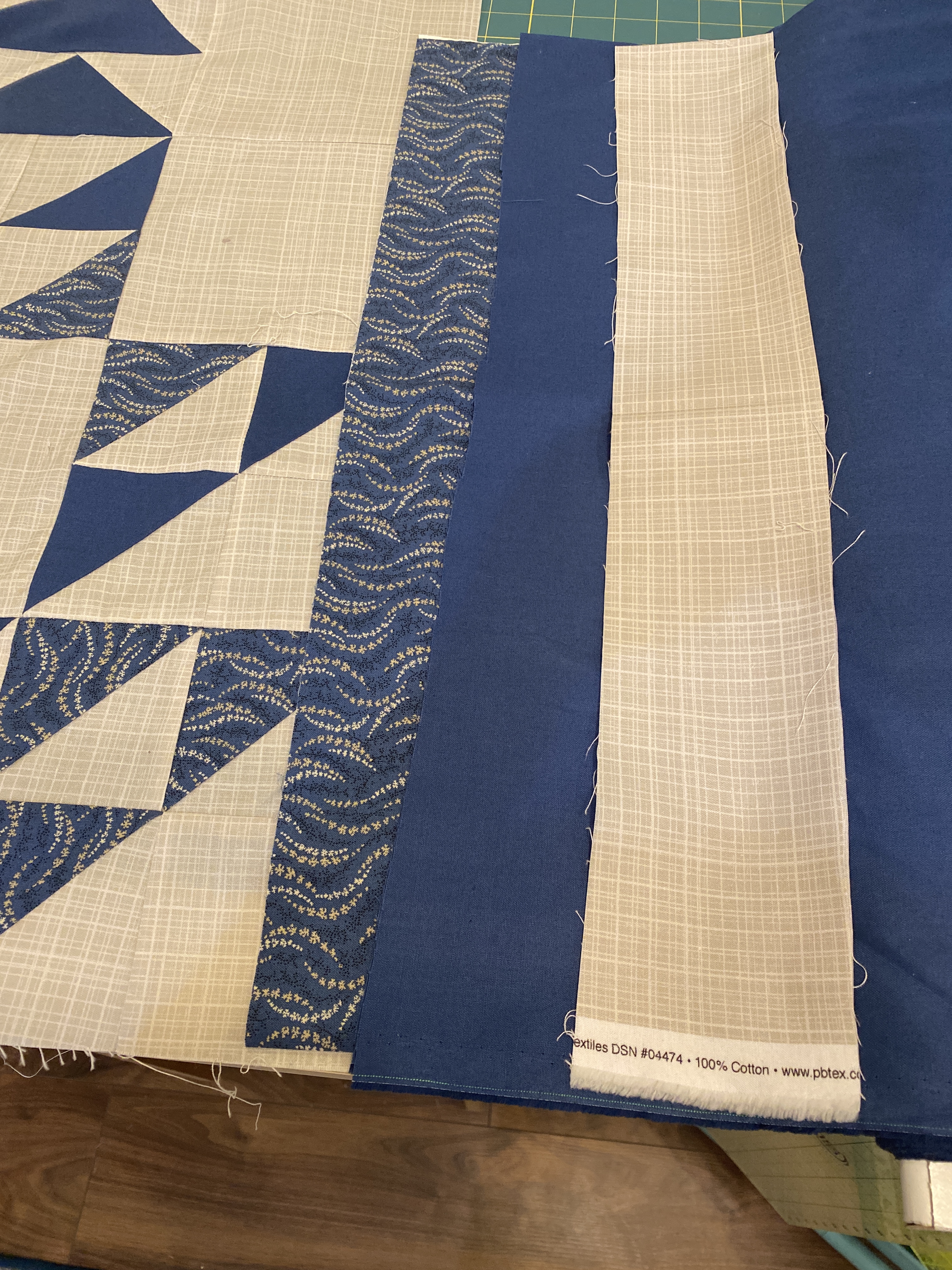
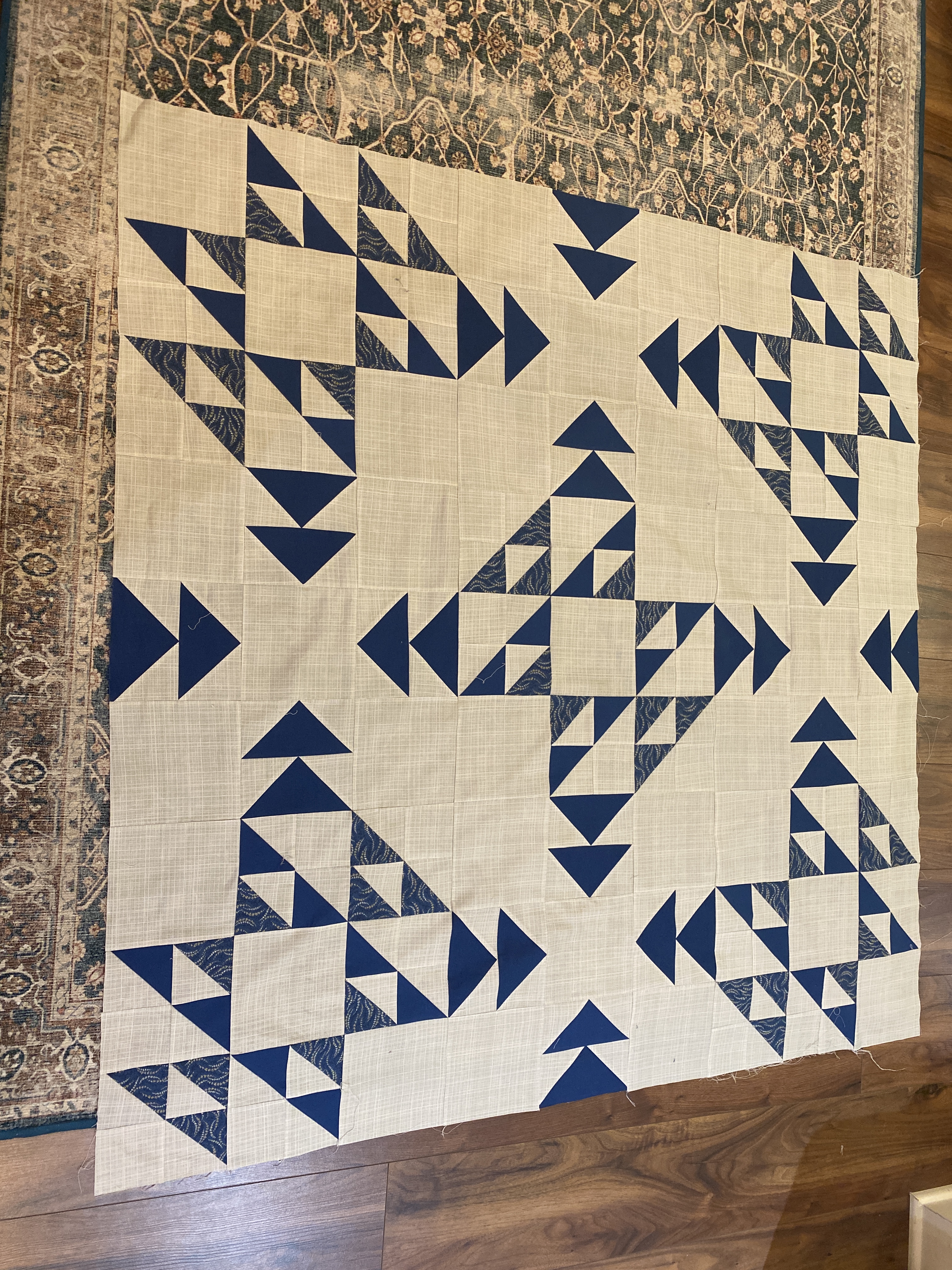
This is hubby’s retirement quilt. It’s my second quilt using this pattern. The last one was a totally scrappy quilt from my stash. Limiting yourself to only three colors is definitely WAY easier. The pattern calls for a small border from the background fabric, followed by binding. The finished quilt is actually a throw size, but hubby is tall, so I need to add about 10″ extra all the way around to make it long enough tuck under his feet.

I figure the Golden Ratio based on the block size. There is no right or wrong way to do this. This quilt is made from 18″ blocks with the units finishing at 6″ each. I calculate a range for the border: 6 x 1.618 = 9.708 and 18 x .618 = 11.24 (drop the 1 when multiplying by larger blocks).

My Golden Ratio Range for this quilt is 9.75″ to 11.25″. The 10″ I need is within this range. CHECK!

I’m not cutting a 10-1/2″ wide single border, so I know I need multiple borders. Three is a good number. There are two ways to do this: (1) Pick a starting border size and multiply by 1.618 to get the next side up (1.5″, 2.5″, 4″ – great for 8″ border, but I need 10″ – start with 2″ width and recalculate) or (2) Consult the Fibonacci number sequence: : 0, 1, 1, 2, 3, 5, 8, etc. Whichever option you choose, remember to add 1/2″ to get the actual cutting measurement.

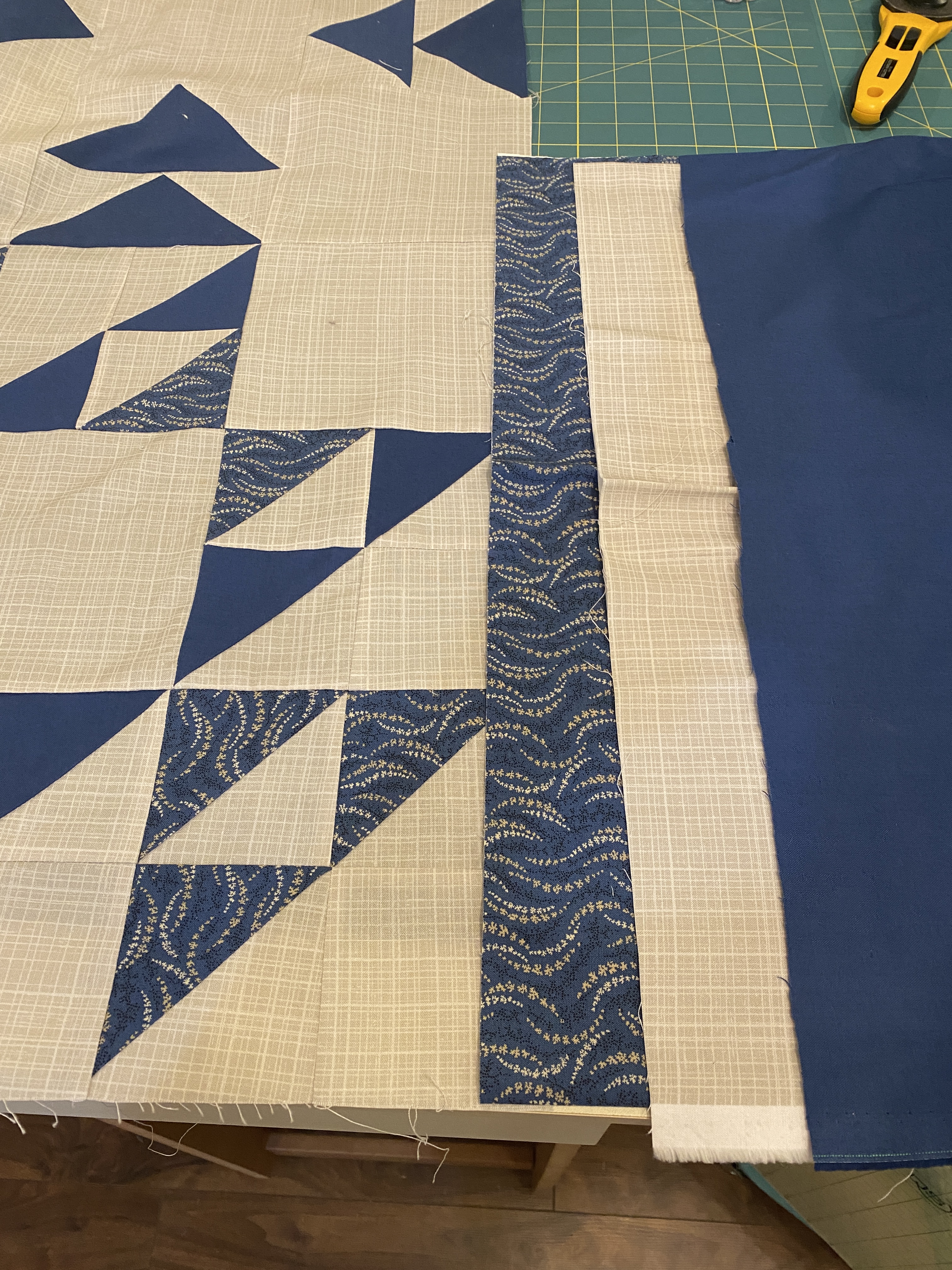
I chose option 2: three borders of 2″, 3″ and 5″ will equal 10″ of border. CHECK!

Decided to mix things up a bit and go with 3″, 2″ and 5″ outer border placement with solid dark blue as the binding. I consulted with my art teacher for the color placement. I like either one, but hubby chose option #1. Hey, it’s his quilt after all!

Option #1
Option #2

Hopefully, this real life example helps you with figuring out your borders. Always remember, you are the boss of your own quilt! The pattern and all these math rules are suggestions. You do what makes you (and the recipient) happy!