Fabric Postcards

Yesterday, my quilt guild hosted a workshop on how to make fabric postcards. It’s a fundraiser for the guild and postcards sell for $5.00 each. I’ve made fabric postcards with the kids, but was curious to learn their method of construction. I gathered my fabrics scraps, printed out the 3-1/2″ FPP Christmas blocks I planned to work on and took the Elnita EC30 with me.

Once I arrived, I quickly realized this is a serious endeavor for the guild. Most of the postcards on display as inspiration pieces were truly miniature works of art. One workshop participant even remarked that she’d spent two days on her postcard. Honestly, I thought this lady was kidding until I accepted the workshop leader’s invitation to learn how to create the postcard pictured above. It took me almost 3 hours!

I guess the style would be loosely known as “mixed media” or “art quilt” – not a style I typically do. Now that I understand the design process and learned how to FMQ on my Elnita EC30, I’ll be able to construct future “art quilt” type cards much faster. It was also a LOT of fun and a great way to use up scraps.

Hints:
1. Create your 4-1/2″ x 6-1/2″ miniature quilt top FIRST, except for quilting and other embellishments.
2. Add batting (fusible or glue baste regular batting)
3. Machine quilt and embellish, including adding ribbon border/trim
4. Attach postcard back printed on 110 or thicker cardstock with glue stick.
5. Sew around perimeter of postcard using thread to match ribbon border.

This little Elnita EC30 never ceases to amaze me. Anything I ask it to do, it does beautifully once I figure out how to set the machine up for success. For FMQ, it likes a 90/14 quilting needle and a thread tension of 3. I also use the convertible quilting foot so I can adjust the foot height to skim just above the quilt top. I worried about FMQ with a 5mm wide zigzag plate instead of a straight stitch needle plate, but it did fine.
Do you prefer your 1/4″ foot with or without a guide?

I LOVE a foot with a flange on the right side to help me keep a consistent 1/4″ seam, as does most every child I’ve taught how to sew. Need a scant 1/4″ seam allowance because I’m making FG and HSTs? No problem! Increase the stitch width 1-2 clicks to move the needle over and keep on sewing.

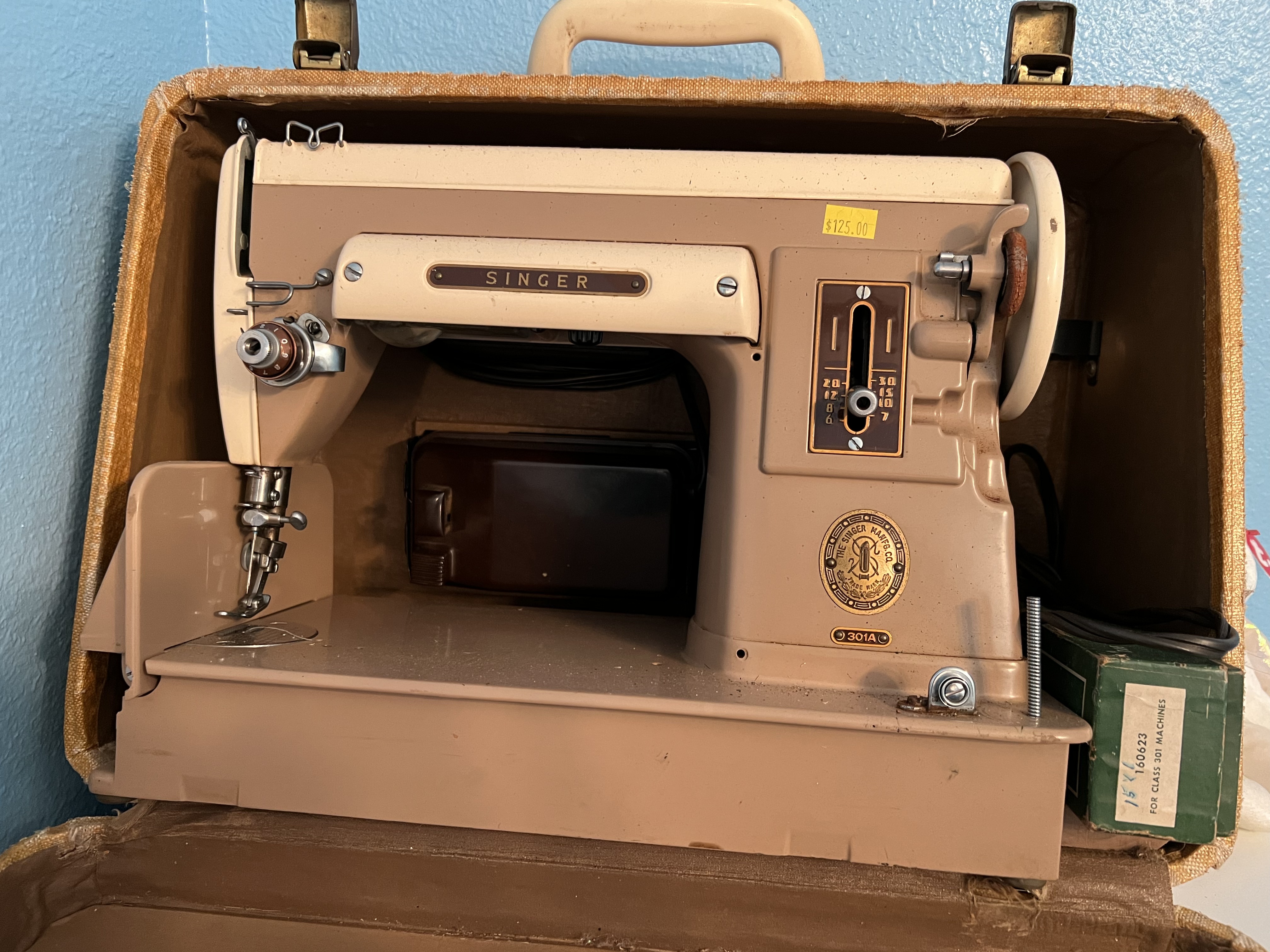
What if you have a vintage or modern mechanical machine where you can’t adjust the needle position on a straight stitch? The needle position remains in the middle or left and that’s it. Think Singer Featherweights, Singer 301, some entry level Brother machines. Even the Janome Jem Gold 660 doesn’t allow any adjustment to the needle position.

For the Janome Jem Gold 660, look into an O2 snap on presser foot. It is designed for a scant 1/4″ seam allowance.

For others, there is a scant 1/4″ foot offered by the Featherweight Shop and other online vintage machine retailers. Before you hit the purchase button, test your machine to make sure your machine sews a true 1/4″ seam using the markings on your needle plate. Is your seam allowance a true 1/4″? If so, the scant 1/4″ foot should work with your machine.

Some machines actually sew a generous 1/4″ seam when doing this test. My Singer 222 and 301 are this way. Nothing is wrong with my machines. They merely came from the factory this way. As long as I use the same 1/4″ foot consistently through my project, the quilt might be a little smaller, but it will be fine. For me, the scant 1/4″ foot is actually a true 1/4″ seam with my 222. It doesn’t matter if I use the snap-on or low shank scant 1/4″ foot. Surprisingly, the snap-on scant 1/4″ foot I use with my FW DOES provide a scant 1/4″ seam IF I use the snap-on slant shanks made with a 3D printer. This was a great discovery for me because I prefer piecing on my 301.

Photo by FOX on Pexels.com

Built in stitch regulators are FINALLY coming to other brands of home sewing machines

Bernina has long had the BSR – which I got to experience at the Kansas City Regional Quilt Festival in 2021. This option is available with several of the newer series machines from the Bernina 475 up to the TOL machine. I will admit I throughly enjoyed my time stitching on the 770 with the BSR. This became a must-have feature when I go to upgrade my existing Janome 8900.

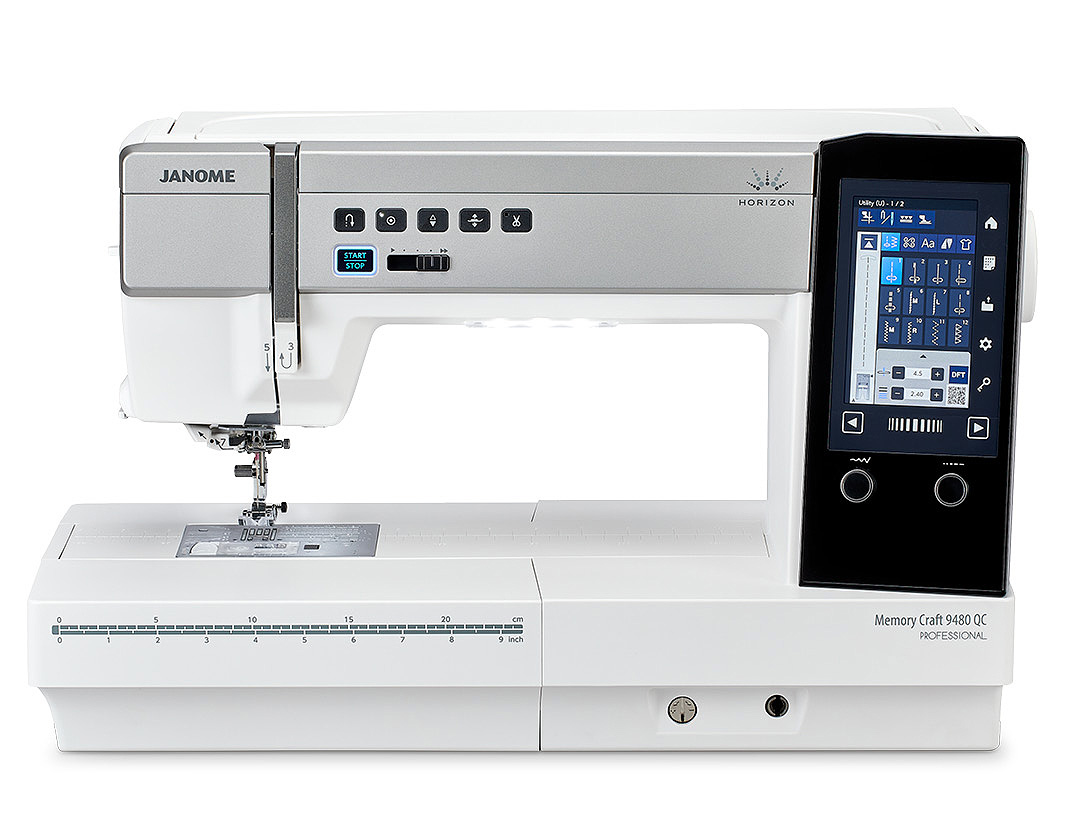
Janome developed its own version known as the ASR and introduced it on its TOL machine – the Continental M17. I asked my dealer when the ASR might be offered on other series in the line. Someday. This week, Janome reported that ASR is now available on two new models – the Continental 8 and the 9480QCP. The 9480 is the updated version of my 8900.

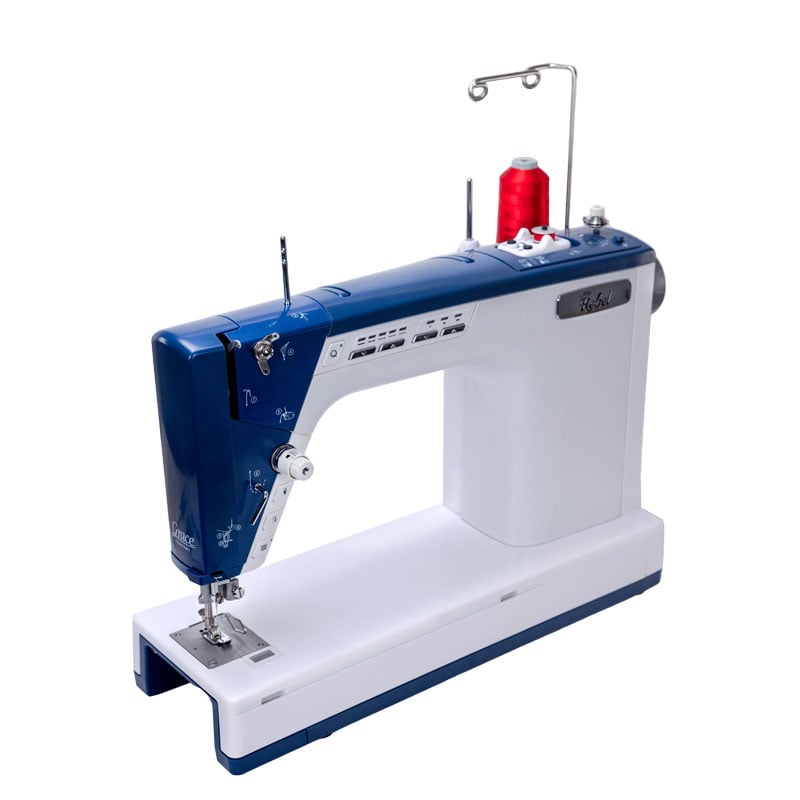
Grace Machine Company also has a machine coming out called the Little Rebel, which is a straight stitch only machine with built in stitch regulation.

I’ll definitely be checking out both of these machines!

Meanwhile, Baby Lock and Brother – where’s your wide-throat machine for quilters with built in stitch regulation?

I don’t need machine embroidery capabilities, 400 alphabet stitches or 32 buttonholes. I want 10-12″ of throat space, high clearance under the machine head, and built in stitch regulation. Oh, and it has to fit within my existing Horn Quilter’s Dream cabinet with a 12-1/2″ x 24-1/2″ opening. Desired price range: $3500-$5000 for total package. If you’ll take my 8900 on trade, even better. I’ll even consider a newer pre-owned machine in very good condition. Time horizon to buy – within the next year.