It’s this cold here in the ATL
December 24, 2022
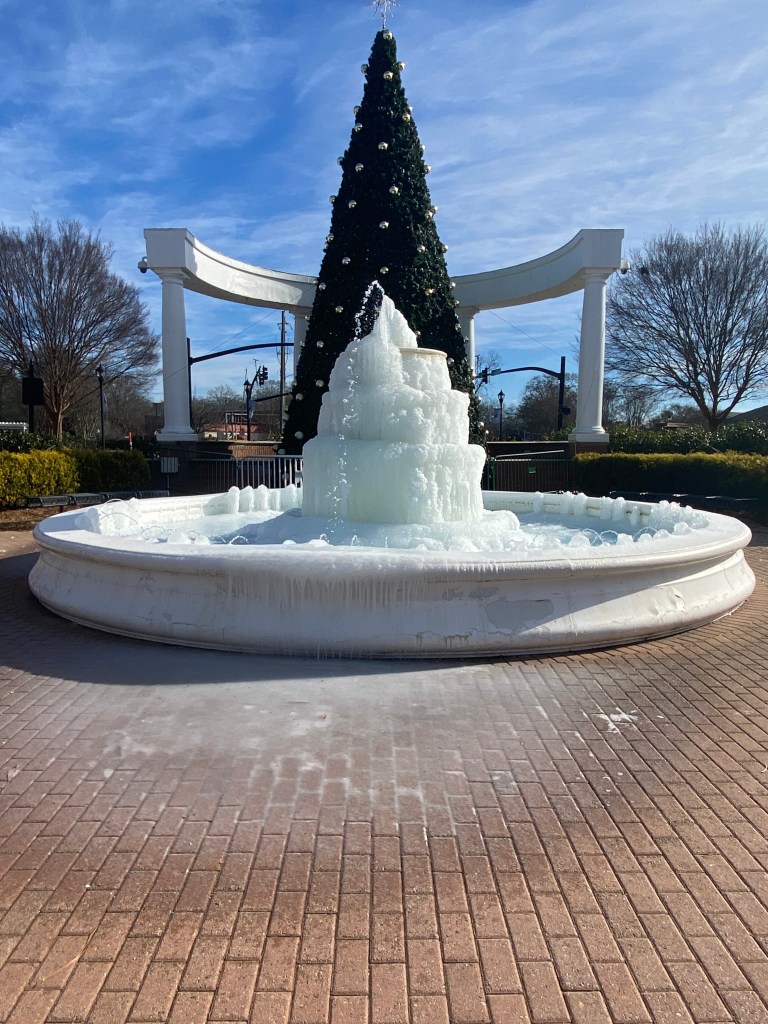
The fountain at the Smyrna Market Village. It was 15 degrees when I took the picture.
The fountain at the Smyrna Market Village. It was 15 degrees when I took the picture.
I didn’t realize how many specialty rulers and plastic/acrylic templates I’d accumulated until I had to pack up my entire sewing room for painting. Quite an investment sitting in that drawer! Reorganizing the template stash has been like going through old high school yearbooks. It tells of my quilting journey as many of those templates were purchased during my days as a beginning quilter. My advice to my younger quilty self would be: “Girl, save your money!”
Many patterns call for the use of a template to make the design. Designers include a paper/printable template with the pattern, but they may also offer a template that is sold separately from the pattern. Do you automatically buy the plastic/acrylic template that goes along with the pattern, if it is available?
My answer? Not necessarily. It depends on the project and/or how likely I’ll use the template again.
Most of the time, I’ve found tracing the paper template with a super fine point Sharpie marker onto heavy duty template plastic provides satisfactory results.
I did buy the Perfect 5 and Perfect 10 rulers after attempting to make a project in one of the books with a regular 5″ square ruler. Those rulers get used for so many other projects.
Inspired by something on Pinterest? Follow the link to an often free tutorial and printable template. Need more? Start with Quilter’s Cache for basic block instructions and then Google it.
Acrylic templates, dies for die cutting systems and SVG files (Cricut) make a lot of sense for shapes you are going to cut repeatedly.
Splurging on a laser cut kit can be totally worth if for the right project, especially if you love the designer’s color way and time is at a premium.
Meet the newest addition to my vintage sewing machine tribe: A 1956 Singer Model 301A in Light Beige/Oyster White (LBOW) with a short bed. She was manufactured in Anderson, South Carolina.

This gal was farm fresh from an estate sale near Pensacola, Florida. My best guess is the former owner passed away. Someone tried to run the machine and made a big mess resulting in a thread jam of epic proportion. Said machine was deemed inoperable and spent time in someone’s storage shed. Thankfully no rust and no bugs – just a lot of dirt and a crumbly bobbin winder tire.
This old girl is stitching pretty after a good clean under the needle plate & bobbin assembly, a long drink of oil and a new needle. Yep, she’s in dire need of a complete spa day, but that will come after Christmas. I’ve ordered the few parts she needs (Quilter’s Connection or Featherweight Shop linked in sidebar). Since her user manual was missing, I joined a 301 enthusiast group on FB to obtain a printable user guide and service manual free of charge.
The 301 is often referred to as the Big Sister to the Featherweight 221. They share some of the same parts – most notably the same bobbins, bobbin case and hook assembly – but the 301 is a slant shank machine with an internal, gear-driven motor. While I absolutely adore my FW, the 301 may just become my new favorite for quilt piecing. To me, the visibility seems better compared to the FW and the harp area is definitely much larger.
 Come Stitch With Me